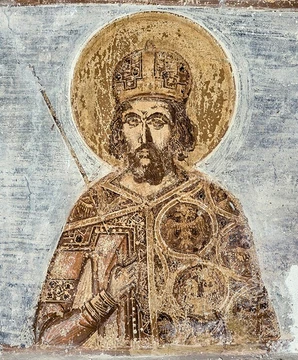
Galla (wife of Theodosius I)
Daughter of Valentinian I, wife of Theodosius I.
Last updated
Galla (died 394) was a Roman empress as the second wife of Theodosius I. She was the daughter of Valentinian I and his second wife Justina.
Family
Galla was the daughter of the Western Roman emperor Valentinian I, who ruled from 364 to 375, and his wife. Her uncle Valens was emperor of the East during the same period. Through her father’s first marriage, she had a half-brother, Gratian, who became emperor after Valentinian and reigned until 383.
Galla was one of four children from her parents’ marriage. Her brother was Valentinian II, who served as co-emperor with Gratian from 375 and later as the sole legitimate Western emperor from 383 until his death in 392. Her two sisters, Grata and Justa, never married and were recorded as still living in 392, after which they disappear from historical records.
Marriage to Theodosius
Galla became important due to the power struggles among three Roman emperors in the 380s. After Gratian was killed in a rebellion led by Magnus Maximus in 383, Maximus took over Britain, Gaul, Hispania, and the Diocese of Africa, ruling from Augusta Treverorum. He secured recognition from Valentinian II and Theodosius I by 384, leaving Valentinian II with only Italia, governed from Mediolanum. The peace broke down in 387 when Maximus crossed the Alps into the Po Valley, threatening Mediolanum.
Valentinian II and his mother Justina fled to Thessalonica, the capital of the Praetorian prefecture of Illyricum and Theodosius’s residence at the time. Galla went with them. Theodosius, a widower after his first wife Aelia Flaccilla died in 386, gave them refuge but hesitated for months before acting, reluctant to start a civil war. His eventual decision to fight was politically advantageous, allowing him to eliminate Maximus, the stronger emperor.
As part of this arrangement, Theodosius married Galla, and her family agreed to adopt religious orthodoxy, creating a public show of dynastic and religious unity.
Empress
Galla became a Roman empress and stepmother to Arcadius and Honorius, Theodosius I’s sons from his first marriage, when she wed him. Her mother Justina had made the marriage a condition for Theodosius’s help against the usurper Maximus. In July and August of 388, Theodosius and Valentinian II’s combined forces, led by Richomeres, Arbogast, Promotus, and Timasius, invaded Maximus’s territory. After a series of defeats, Maximus surrendered at Aquileia.
He and his son and co-ruler Victor were executed on 28 August 388, though the rest of their family was spared. Justina’s condition had been satisfied, but she died that same year, never seeing the outcome of her efforts. Theodosius remained in Italia from 388 to 391, while Galla and her stepsons stayed in the Great Palace of Constantinople. Marcellinus Comes records that Arcadius expelled her from the palace in 390, but since Arcadius was only thirteen, the decision may have come from those governing in his name.
When Theodosius decided to return to the East—possibly because of the conflict between Galla and Arcadius—he placed Valentinian and his court at Vienne in Gaul, away from Milan and Ambrose’s influence, and appointed Arbogast as magister militum for the Western provinces. On 15 May 392, Valentinian was found hanged in his room. Officials reported it as a suicide, but Arbogast was suspected of involvement, an accusation found in the works of Socrates of Constantinople, Orosius, and Zosimus, while Sozomen mentioned both possibilities.
Galla’s grief over her brother’s death was recorded by Zosimus and John of Antioch. On 22 August 392, Arbogast declared Eugenius emperor without Theodosius’s approval. Attempts to gain Theodosius’s recognition failed, and on 23 January 393, Theodosius proclaimed his second son Honorius an Augustus, implying he alone was the legitimate emperor. Conflict erupted the next year, culminating in the Battle of the Frigidus on 5–6 September 394.
Theodosius won, gaining control of the entire Roman Empire; Arbogast committed suicide, and Eugenius was executed. Galla did not live to see this victory—she died in childbirth before the battle began.
More in Daughters of Roman Emperors
Sources
Compiled from Wikipedia and the sources listed below. Text from Wikipedia is available under CC BY-SA 4.0; this entry is adapted from it.
- Wikipedia: Galla (wife of Theodosius I) (CC BY-SA 4.0).
Spotted an error? Know more?
Reader corrections go straight into our review queue. Suggest an edit · How this site is sourced