Gladysvale Cave
Fossil-bearing cave with hominid remains and Acheulean handaxe.
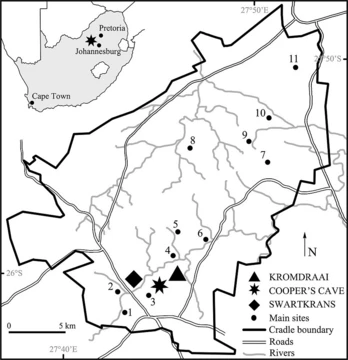
Gladysvale Cave is a fossil-bearing breccia filled cave located about 13 km northeast of the well-known South African hominid-bearing sites of Sterkfontein and Swartkrans and about 45 km north-northwest of Johannesburg, South Africa. It is situated within the Cradle of Humankind World Heritage Site and is itself a South African National Heritage Site.
Quick Facts
- Location
- Gauteng, South Africa
- Nearest city
- Krugersdorp, South Africa
- Area
- Less than 200 m² / 0 sq mi
- Established
- Incorporated into the Cradle of Humankind1999
- Governing body
- Cradle of Humankind and private landowner
Facts from the source article.
History of investigations
Robert Broom first visited Gladysvale in the mid-1930s after a butterfly collector reported a human mandible in the cave wall, but the mandible was gone by the time Broom arrived. Sterkfontein soon drew Broom away. In 1946 Phillip Tobias led a student expedition that recovered a baboon fossil. Frank Peabody of the Camp-Peabody expedition spent weeks at the site in 1948 without finding hominid remains. The site was lost from scientific memory until Lee Berger and Andre Keyser reopened it in 1991. Within weeks, two teeth of Australopithecus africanus were discovered, making Gladysvale the first new early hominid site found in South Africa since Swartkrans in 1948. Since then, joint teams from the University of the Witwatersrand, the University of Zurich and Duke University have recovered over a quarter of a million fossils.
Recovered fossils
Thousands of fossils have been recovered from Gladysvale, including rare hominid remains. Almost a quarter of a million bones have been taken from the external deposits since excavations began in 1992, with many millions still in place. Recovered fauna includes antelope, giant zebra, carnivores such as extinct wolves, monkeys, and hominids attributed to Australopithecus africanus and early Homo. An Acheulean handaxe was found in 1 million year old sediments.
The site is known for its horizontally-bedded stratigraphy and has been used to test absolute dating techniques on South African breccias. It is divided into three cave systems: the upper cave holds the Gladysvale Internal Deposits and an External Deposit. Gladysvale was among the first African sites to be 3-D digitally mapped, by Peter Schmid and University of Zurich students. Dating methods applied include biostratigraphy, palaeomagnetism, electron spin resonance and uranium series dating.
The oldest deposits likely yielding Australopithecus africanus are 2.4–2.0 million years old; the external deposits date between 780,000 and 530,000 years ago.
More in Cradle of Humankind
Spotted an error? Know more?
Reader corrections go straight into our review queue. Suggest an edit · How this site is sourced