Gondolin Cave
Pliocene–Pleistocene paleocave with hominin teeth and unique fossil fauna.

via Wikipedia: Gondolin Cave · see source
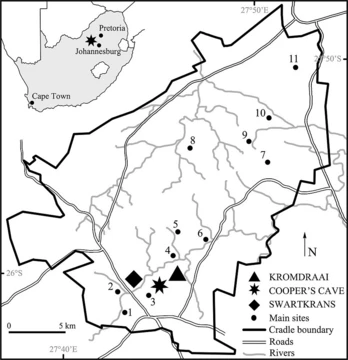
Gondolin Cave is a fossiliferous dolomitic paleocave system in the Northwest Province, South Africa. The paleocave formed in the Eccles Formation dolomites (Malmani Subgroup, Chuniespoort Group carbonate-banded iron formation marine platform). Gondolin is currently the only described hominin-bearing fossil site in the Northwest Province-portion of the designated Cradle of Humankind UNESCO World Heritage Site. The cave is located on privately owned land and is not accessible to the public. As is the case with other South African Paleo-cave systems with Pliocene and/or Pleistocene fossil deposits, the system was mined for lime during the early 20th century. As a result, the system has been heavily disturbed and consists of only a small active cave, a series of in situ remnant cave deposits, and extensive dumpsites of ex situ calcified sediments produced during mining activities.
Quick Facts
- Location
- Northwest Province
- Region
- South Africa
Facts from the source article.
Did You Know?
- The 1979 excavation removed approximately 2 m³ of calcified sediments from the northern cave wall in just three weeks.
- From 2002 to 2004, a reanalysis identified 95,549 total individual specimens from the GD 2 deposits, up from the 90,663 originally noted in 1993.
- Two hominin teeth were recovered from the 1997 Trench A sampling: GA 1 (a worn left molar resembling Homo) and GA 2 (a complete left m2 attributed to Paranthropus robustus).
- The GD 2 assemblage includes the first described occurrence of the extinct porcupine Hystrix makapanensis outside of Makapansgat Member 3.
Site history and excavations
No records exist of the date of lime mining at Gondolin, nor any maps or photographs of the cave before mining. Long-term residents report that mining occurred prior to the 1950s. The cave was named after J.R.R. Tolkien's Gondolin by the early 1970s. Exposed fossils were noted at least as early as the 1970s and brought to the attention of Elisabeth Vrba and David Panagos at the Transvaal Museum, who initiated excavations in early 1979.
The first phase targeted the fossiliferous in situ remnant deposits on the northern wall (the GD 2 deposits). Over three weeks, approximately 2 m³ of calcified sediment was removed from the northern cave wall. Although two distinct sediment phases were recognized during the original excavation, later work found no basis for multiple depositional phases within the sampled sequence. The removed sediment blocks were organized into 43 blocks/trays and processed with acetic acid at the Transvaal Museum.
A significant research gap occurred in the 1980s, during which all blocks were processed but no further sampling took place. The first description of the fossil assemblage in 1993 partially described 4,344 individual specimens assigned to taxonomic levels out of 90,663 total specimens. In 1997, a survey included the first sampling of ex situ dumpsite deposits via a test trench (Trench A). Materials from Trench A included fossiliferous breccia blocks from most stratigraphic units and loose fossil specimens.
From this material, two isolated hominin teeth were recovered: GA 1, a worn and fractured left molar resembling Homo in some features but not confidently attributed to genus or species, and GA 2, a complete left m2 attributed to Paranthropus robustus from a large individual.
Fossil fauna
The original description of the GD 2 assemblage addressed only a small portion of the collection. A single hominin tooth originally thought to derive from GD 2 was later determined to be an intrusive modern Homo tooth. A comprehensive reanalysis from 2002 to 2004 identified 95,549 total individual specimens, of which 16,477 are identifiable craniodental or postcranial specimens, and 79,076 are unidentifiable fragments. The reanalysis showed significant shifts in specimen counts for individual taxonomic categories and removed several species previously listed, including Hippopotamus sp., Antidorcas australis/marsupialis, and Procavia transvaalensis.
The revised description reinforced unique features: numerical dominance of klipspringer (Oreotragus oreotragus) and a reduncin species (Redunca sp.) similar to mountain reedbuck; the first described occurrence of the extinct porcupine Hystrix makapanensis outside Makapansgat Member 3; the first comprehensive taphonomic analysis of a South African early Pleistocene assemblage from in situ deposits; a robust sample of associated cranial and postcranial remains with articulated fossils; recovery of fragile elements such as hyoids and fetal/neonatal remains; and the absence of any identifiable primate remains.
More in Cradle of Humankind
Spotted an error? Know more?
Reader corrections go straight into our review queue. Suggest an edit · How this site is sourced