Kromdraai fossil site
Fossil site yielding the holotype of Paranthropus robustus.
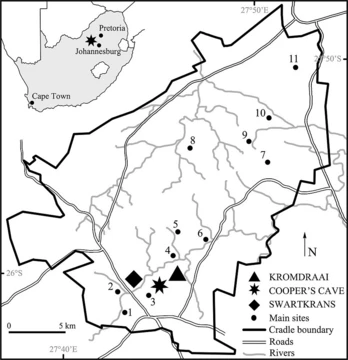
Kromdraai, whose name means "crooked turn" in Afrikaans, is a fossil-bearing breccia-filled cave located about 45 km northwest of Johannesburg, South Africa. It lies within the Cradle of Humankind World Heritage Site and is designated a South African National Heritage Site. The site is notable for yielding the holotype specimen of Paranthropus robustus.
Quick Facts
- Location
- Gauteng, South Africa
- Nearest city
- Krugersdorp, South Africa
- Established
- Incorporated into the Cradle of Humankind 1999
- Governing body
- Cradle of Humankind and Private Landowner
Facts from the source article.
Did You Know?
- Kromdraai is a roofless dolomite cave on the southern side of Blaauwbank stream.
- Kromdraai A is located 30 m south of Kromdraai B.
- The boundaries of both localities are lined by dolomite.
History of investigations
In 1938, a local schoolboy named Gert Terrblanche brought several hominin teeth to the attention of Robert Broom. These teeth were part of a skull that became the holotype of Paranthropus robustus. Broom conducted excavations at the site until about 1947, recovering numerous hominin remains. Two deposits were identified: Kromdraai A (KA) and Kromdraai B (KB), with hominin remains found only in KB. In 1955, C.K. Brain resumed work at Kromdraai B, discovering additional hominin remains and abundant non-hominin fauna. Elizabeth Vrba briefly excavated there in the 1980s to obtain more bovid samples. In 1993, Francis Thackeray and Lee Berger reopened excavations, later joined by teams from Harvard University and other collaborators. Their work has yielded further hominin fossils and more accurate dates for the site.
More in Cradle of Humankind
Spotted an error? Know more?
Reader corrections go straight into our review queue. Suggest an edit · How this site is sourced