
Levant
A historical and cultural subregion of West Asia along the Eastern Mediterranean.

Bassem Fleifel · CC BY-SA 1.0
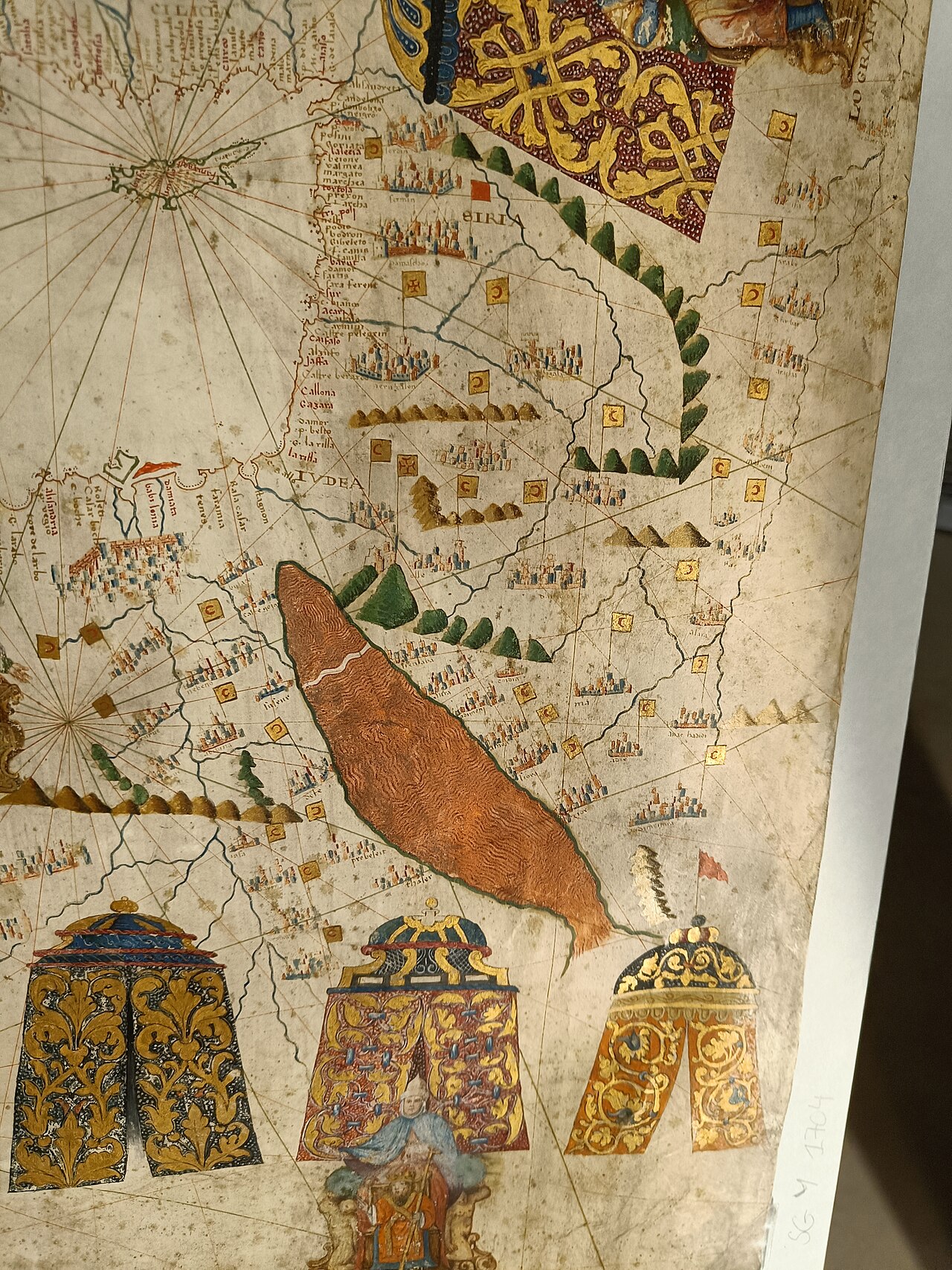
The Levant is a subregion of West Asia along the Eastern Mediterranean that forms part of the Middle East. The term is often used in conjunction with historical or cultural references. In its narrowest sense, used in archaeology and other contexts, the Levant refers to Cyprus and land bordering the Levantine Sea (Mediterranean) in West Asia that includes Syria, Lebanon, Jordan, Palestine, Israel, and south Cilicia (Turkey). In its widest historical sense, the Levant included all the Eastern Mediterranean; extending from Greece to Egypt and Cyrenaica (Eastern Libya).
Lore & Background
In the 13th and 14th centuries, levante was used for Italian maritime commerce in the Eastern Mediterranean, including Greece, Anatolia, Syria-Palestine, and Egypt, that is the lands east of Venice. It derives from the Italian, meaning 'rising', implying the rising of the Sun in the east, and is broadly equivalent to the Mashriq, meaning 'eastern place, where the Sun rises'. Eventually the term was restricted to the Muslim countries of Syria-Palestine and Egypt. The term entered English in the 15th century from French. In 1581, England set up the Levant Company to trade with the Ottoman Empire. The name Levant States was used to refer to the French mandate over Syria and Lebanon after World War I, so Levant has come to refer to modern Syria, Lebanon, Palestine, Israel, Jordan, and Cyprus. The term Levant appears in English in 1497, and originally meant 'the East' or 'Mediterranean lands east of Italy'. It is borrowed from the French 'rising', referring to the rising of the sun in the east, or the point where the sun rises. The phrase is ultimately from the Latin word meaning 'lift, raise'. The notion of the Levant has undergone a dynamic process of historical evolution in usage, meaning, and understanding. While the term 'Levantine' originally referred to the European residents of the eastern Mediterranean region, it later came to refer to regional 'native' and 'minority' groups. The term became current in English in the 16th century, along with the first English merchant adventurers in the region; English ships appeared in the Mediterranean in the 1570s, and the English merchant company signed its agreement ('capitulations') with the Ottoman Sultan in 1579. The English Levant Company was founded in 1581 to trade with the Ottoman Empire, and in 1670 the French was founded for the same purpose. At this time, the Far East was known as the 'Upper Levant'. In early 19th-century travel writing, the term sometimes incorporated certain Mediterranean provinces of the Ottoman Empire, as well as independent Greece (and especially the Greek islands). In 19th-century archaeology, it referred to overlapping cultures in this region during and after prehistoric times, intending to reference the place instead of any one culture. The French mandate of Syria and Lebanon (1920–1946) was called the Levant states.
Reader's Guide
Today, 'Levant' is the term typically used by archaeologists and historians in relation to the history of the region. Scholars have adopted the term Levant to identify the region due to its being a 'wider, yet relevant, cultural corpus' that does not have the 'political overtones' of Syria-Palestine. The term is also used for modern events, peoples, states or parts of states in the same region, namely Cyprus, Egypt, Iraq, Israel, Jordan, Lebanon, Palestine, Syria, and Turkey are sometimes considered Levant countries. Several researchers include the island of Cyprus in Levantine studies. Archaeologists seeking a neutral orientation that is neither biblical nor national have used terms such as Levantine archaeology and archaeology of the Southern Levant. While the usage of the term 'Levant' in academia has been restricted to the fields of archeology and literature, there is a recent attempt to reclaim the notion of the Levant as a category of analysis in political and social sciences. Two academic journals were launched in the early 2010s using the word: the Journal of Levantine Studies, published by the Van Leer Jerusalem Institute and The Levantine Review, published by Boston College. The word Levant has been used in some translations of the term ash-Shām as used by the organization known as ISIL, ISIS, and other names, though there is disagreement as to whether this translation is accurate. In The Oxford Handbook of the Archaeology of the Levant: c. 8000–332 BCE (OHAL; 2013), the definition of the Levant for the specific purposes of the book is synonymous to that of the Arabic 'bilad al-sham, 'the land of sham [Syria]'', translating in Western parlance to greater Syria. OHAL defines the boundaries of the Levant as follows: to the north: the Taurus Mountains or the Plain of 'Amuq; to the east: the eastern deserts, i.e. (from north to south) the Euphrates and the Jebel el-Bishrī area for the northern Levant, followed by the Syrian Desert east of the eastern hinterland of the Anti-Lebanon range (whose southernmost part is Mount Hermon), and Transjordan's highlands and eastern desert; to the south: Wadi al-Arish in Sinai; to the west: the Mediterranean Sea. A distinction is made between the main subregions of the Levant, the northern and the southern: The Litani River marks the division between the Northern Levant and the Southern Levant. The island of Cyprus i
Did You Know?
- The Levant is home to approximately 57.6 million people, consisting of the populations of Syria, Jordan, Israel, Lebanon and Palestine.
- The majority of Levantines are Muslims, with Islam first introduced following the Muslim conquest of the Levant in the 7th century; a Muslim majority may have only been reached by the 13th century.
- The Levant is the birthplace of Christianity and hosts many Christian denominations, including Antiochian Greek Orthodox, Syriac Orthodox, and various Eastern Catholic churches.
- Other religious groups in the Levant include Jews, Samaritans, Druze, and Yazidis.
- The term 'Levant' derives from the Italian word for 'rising', referring to the rising of the sun in the east.
Geographic Scope and Shifting Boundaries
The Levant occupies a distinctive position along the Eastern Mediterranean, serving as a subregion of West Asia within the broader Middle East. Its geographic identity has never been fixed; rather, it has expanded and contracted depending on the era and the discipline doing the defining. In its broadest historical conception, the region stretched from Greece all the way to Egypt and Cyrenaica in eastern Libya, encompassing the entire Eastern Mediterranean basin. At the other extreme, archaeologists and specialists in related fields confine the term to Cyprus and the territories bordering what was historically called the Levantine Sea—specifically Syria, Lebanon, Jordan, Palestine, Israel, and the southern portion of Cilicia in modern Turkey. Geologically, the area sits on the northwest edge of the Arabian plate, and the Levantine corridor functions as a natural land bridge connecting Africa to Eurasia. This positioning has earned it the description of a crossroads where West Asia, the Eastern Mediterranean, and Northeast Africa converge.
Etymology and the Language of the East
The word Levant carries a remarkably transparent etymology rooted in the simple observation of the sun's daily arc. It traces back to the Latin verb levare, meaning to lift or raise, which gave rise to the Italian levante and the French levant, both evoking the rising of the sun in the east. The term first appeared in English in 1497, initially signifying the Mediterranean lands east of Italy. This solar imagery is not unique to one linguistic tradition; parallel concepts appear across the region's languages. Greek offers Anatolē, the direction of sunrise, which also gave its name to Anatolia. Germanic languages produced Morgenland, literally morning land, while Hebrew uses mizraḥ for east. Spanish and Catalan share Levante and Llevant, Hungarian has Kelet, and Italian geography preserves the concept in Riviera di Levante, the stretch of Ligurian coast east of Genoa. Even the word Orient shares this root, deriving from the Latin orior, to rise. The Arabic equivalent, Mashriq, similarly means the eastern place where the Sun rises, making the Levant broadly equivalent to that concept.
Commerce, Empire, and Political Naming
For centuries, the Levant was inseparable from maritime trade and imperial ambition. In the thirteenth and fourteenth centuries, Italian merchants used the term levante to describe their commercial sphere across the Eastern Mediterranean, spanning Greece, Anatolia, Syria-Palestine, and Egypt—essentially all lands east of Venice. The English presence followed in the 1570s, when merchant adventurers sent ships into the Mediterranean and secured capitulations with the Ottoman Sultan in 1579. The Levant Company was formally established in 1581 to conduct trade with the Ottoman Empire, and the French Compagnie du Levant was founded in 1670 for a similar purpose. At that time, the Far East was even called the Upper Levant. In the early nineteenth century, travel writers sometimes extended the term to include Ottoman provinces and independent Greece, particularly the Greek islands. After World War I, the French mandate over Syria and Lebanon was officially designated the Levant States, a usage that cemented the term's association with the modern political geography of the region.
Academic Adoption and Cultural Reclamation
In contemporary scholarship, the Levant has found a particularly comfortable home in archaeology and the humanities. Scholars favor the term because it offers a wider yet relevant cultural corpus without the political overtones that labels like Syria-Palestine carry. Archaeologists routinely speak of Levantine archaeology or the archaeology of the Southern Levant, seeking a neutral orientation free from biblical or national framing. The 2013 Oxford Handbook of the Archaeology of the Levant equates the region with the Arabic bilad al-sham, or the land of Sham, and sets its northern boundary at the Taurus Mountains or the Plain of 'Amuq. Beyond archaeology, the term extends into food studies as Levantine cuisine, and Latin Catholics from the region are sometimes called Levantines. In the early 2010s, a deliberate effort emerged to reclaim the Levant as a category in political and social sciences, exemplified by the launch of the Journal of Levantine Studies from the Van Leer Jerusalem Institute and The Levantine Review from Boston College. Despite this academic vitality, several dictionaries still classify the word as archaic in everyday English.
Gallery
Frequently Asked Questions
What exactly is the Levant?
The Levant is a historical and cultural subregion situated along the Eastern Mediterranean coast within West Asia. It is commonly grouped under the broader Middle East but carries its own distinct archaeological and maritime identity.
Which modern countries and territories make up the Levant?
In its narrower archaeological sense, the Levant covers Cyprus, Syria, Lebanon, Jordan, Palestine, Israel, and the southern part of Cilicia in Turkey. In its widest historical usage, the term stretched as far as Greece, Egypt, and Cyrenaica in eastern Libya.
Where does the name 'Levant' come from?
The term traces back to the Italian word 'levante,' meaning 'rising,' which referred to the sun rising over the Eastern Mediterranean from the viewpoint of European observers.
How does the Levant differ from the broader Middle East?
Although the Levant is often treated as a subset of the Middle East, it specifically denotes the Eastern Mediterranean coastal strip rather than the entire region. Its identity is shaped more by maritime, archaeological, and cultural continuity than by the political borders of any single modern state.
More in Countries And Regions 1-24
Spotted an error? Know more?
This is a living reference — every entry is fact-audited, and reader corrections feed straight into our audit queue. Suggest an edit · See this site's audit record