
Screw mechanism
A rotating helix that converts rotational motion into linear motion.

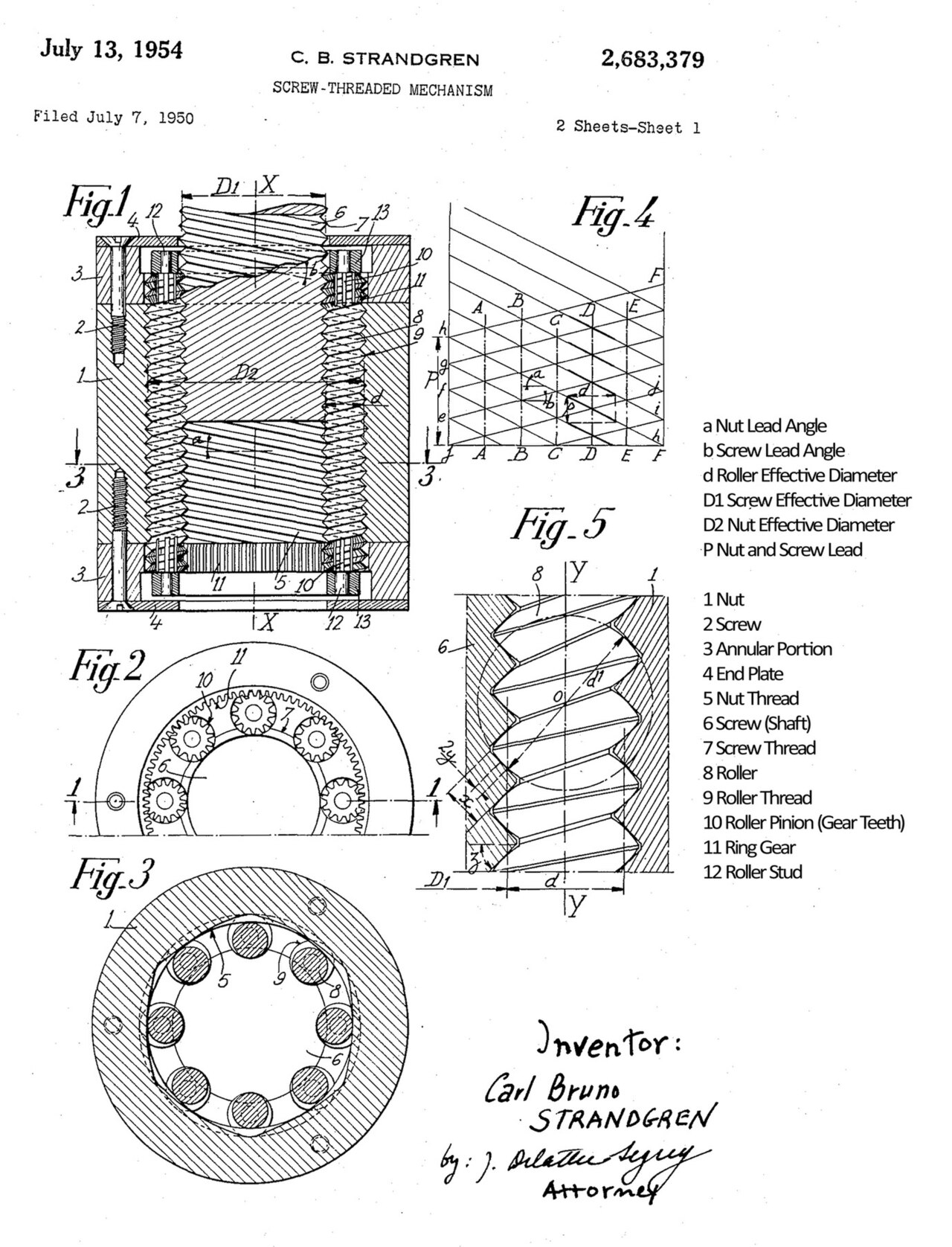
Carl Bruno Strandgren · Public domain
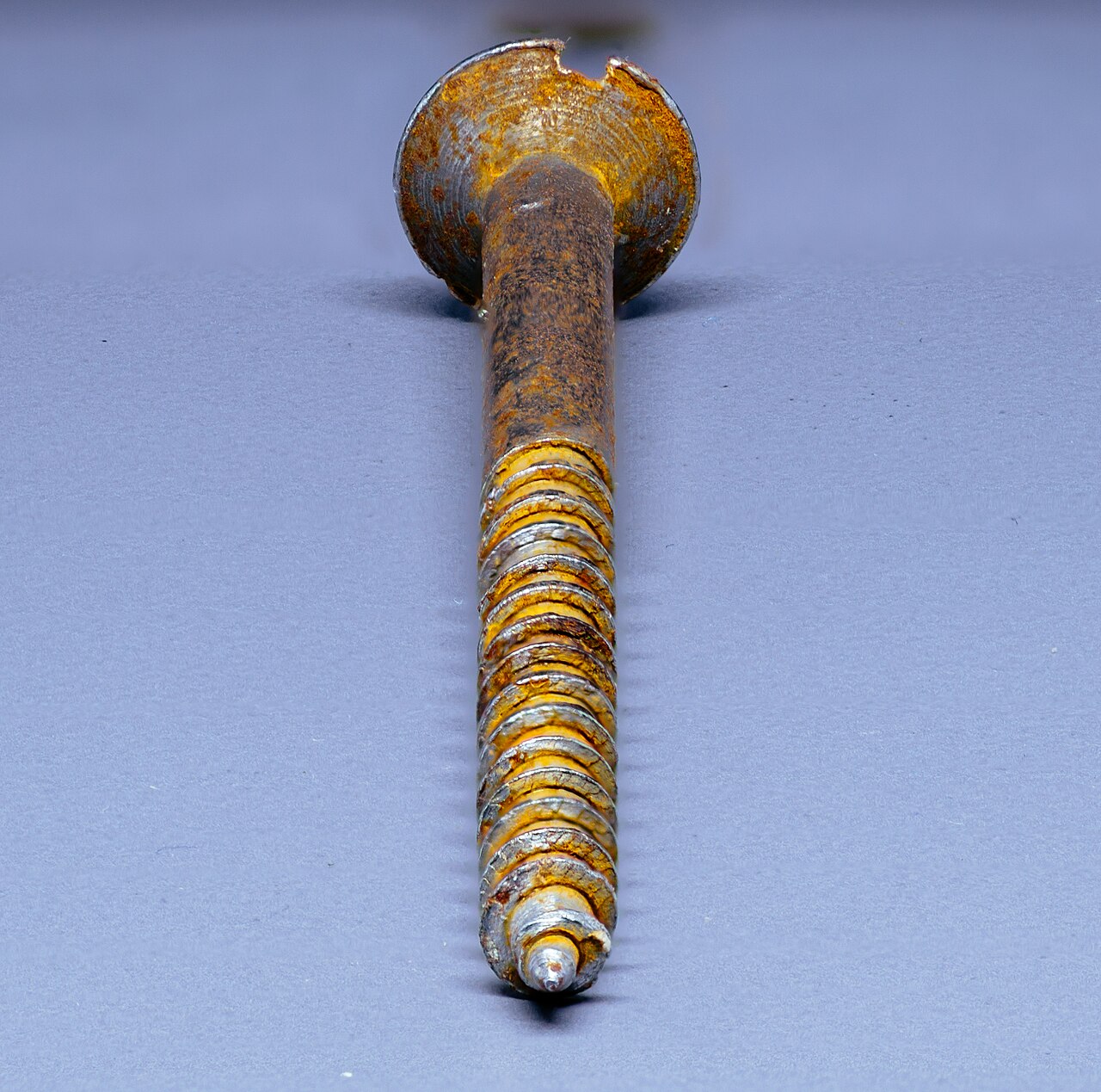
The screw is one of the six classic simple machines. It works by turning rotational motion into linear motion, and torque into linear force. The typical design features a cylindrical shaft with helical grooves, known as threads, running along its surface. This shaft fits into a hole in another object that has matching internal threads. When the shaft is rotated relative to those stationary threads, it moves forward or backward along its own axis. For example, turning a wood screw drives it into wood. In some setups, the shaft rotates through a threaded hole in a fixed object; in others, a threaded collar like a nut rotates around a stationary shaft. Geometrically, a screw is essentially an inclined plane wrapped around a cylinder.
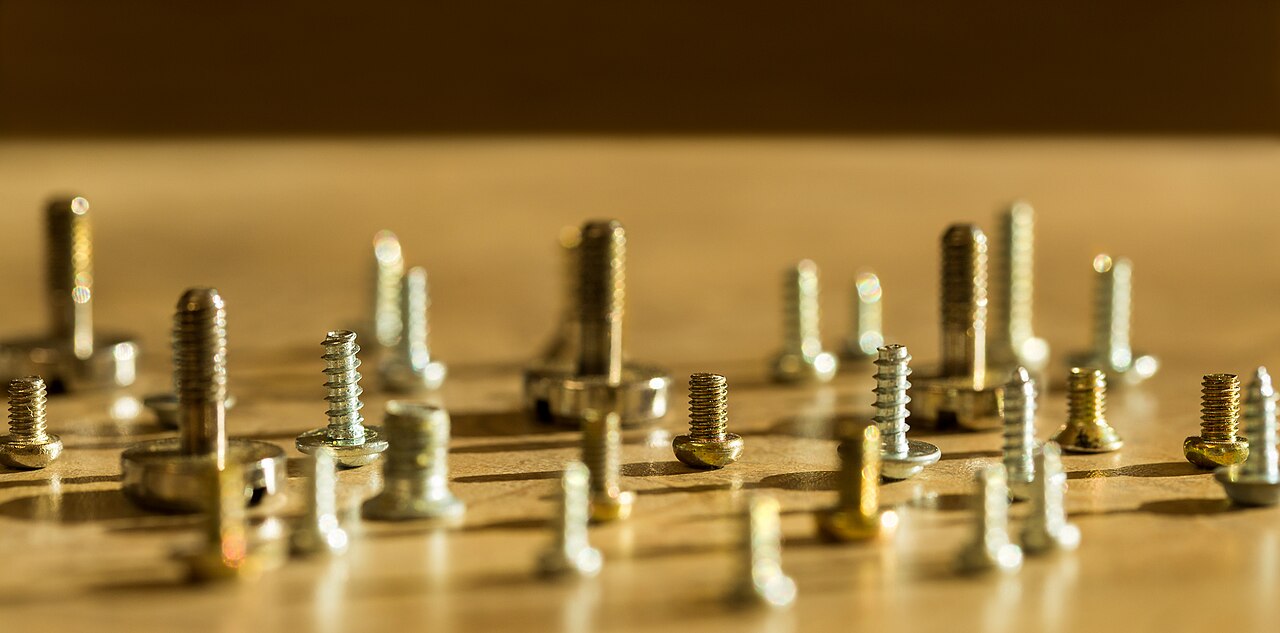
Like other simple machines, a screw can multiply force. A small rotational force, or torque, applied to the shaft can produce a much larger axial force on a load. The mechanical advantage—the ratio of output force to input force—increases as the pitch (the distance between adjacent threads) gets smaller. Screws are common in threaded fasteners that hold objects together, as well as in screw-top containers, vises, screw jacks, and screw presses.
Other devices that work on the same principle are also called screws, even if they lack a shaft or threads. A corkscrew, for instance, is a helix-shaped rod with a sharp point, while an Archimedes' screw is a water pump that uses a rotating helical chamber to move water uphill. The shared principle is that a rotating helix can cause linear motion.
**History**
The screw was the last of the simple machines to be invented. It first appeared in Mesopotamia during the Neo-Assyrian period (911–609 BC), and later showed up in Ancient Egypt and Ancient Greece. Records suggest the water screw, or screw pump, was used in Ancient Egypt before the Greek philosopher Archimedes described it around 234 BC. Archimedes wrote the earliest theoretical study of the screw as a machine and is credited with introducing it to Ancient Greece. By the first century BC, the screw was used in screw presses and Archimedes' screws. Greek philosophers classified the screw as one of the simple machines and could calculate its ideal mechanical advantage. For example, Heron of Alexandria (52 AD) listed it among five mechanisms that could "set a load in motion," defined it as an inclined plane wrapped around a cylinder, and described how to make it, including a tap for cutting female threads.
Because their complex helical shapes had to be carved by hand, screws were used only as linkages in a few ancient machines. Screw fasteners did not appear until the 15th century, when they were used in clocks after the development of screw-cutting lathes. Around that time, screws were also applied to drilling and moving materials (other than water), as images of augers and drills began appearing in European paintings. The complete dynamic theory of simple machines, including the screw, was worked out by Italian scientist Galileo Galilei in 1600 in *Le Meccaniche* ("On Mechanics").
**Lead and Pitch**
The fineness or coarseness of a screw's threads is defined by two related quantities. The **lead** is the axial distance the screw moves in one full revolution (360°) of the shaft. The lead determines mechanical advantage: a smaller lead gives a higher advantage. The **pitch** is the axial distance between the crests of adjacent threads. In most screws, called "single start" screws, which have a single helical thread, the lead and pitch are equal. They differ only in "multiple start" screws, which have several intertwined threads. In these, the lead equals the pitch multiplied by the number of starts. Multiple-start screws are used when a large linear motion is needed for a given rotation, such as in bottle caps and ballpoint pens.
**Handedness**
A screw's thread helix can twist in one of two directions, known as handedness. Most screw threads are oriented so that, when viewed from above, turning the shaft clockwise moves it away from the viewer (tightening it). This is a right-handed (RH) thread, following the right-hand grip rule: if you curl the fingers of your right hand around the shaft in the direction of rotation, your thumb points in the direction the shaft moves. Threads oriented the opposite way are left-handed (LH). By convention, right-handedness is the default for screw threads, so most threaded parts and fasteners use it. One explanation is that for a right-handed person, tightening a right-handed screw with a screwdriver is easier because it uses the stronger supinator muscle of the arm rather than the weaker pronator muscle. Since most people are right-handed, right-handed threads became standard on threaded fasteners. Screw linkages in machines are exceptions; they can be right- or left-handed depending on what works best. Left-handed threads are also used in some other applications: where the rotation of a shaft would cause a conventional right-handed nut to loosen rather than tighten due to fretting-induced precession. Examples include the left pedal on a bicycle, the left-hand screw holding a circular saw blade or bench grinder wheel, and devices with threads on both ends, like turnbuckles and removable pipe segments, which have one right-hand and one left-hand thread.
- earliest_theoretical_study
- Archimedes (c. 3rd century BC)
Lore & Background
The screw was one of the last of the simple machines to be invented. The earliest known evidence of the screw dates to the Hellenistic period, around the 3rd century BC. Records indicate that the water screw, or screw pump, was first described by the Greek philosopher Archimedes, and there is no reliable historical evidence for its use in Ancient Egypt predating Archimedes. Archimedes wrote the earliest theoretical study of the screw as a machine and is considered to have introduced the screw in Ancient Greece. By the first century BC, the screw was used in the form of the screw press and the Archimedes' screw. While some ancient Greek philosophers studied simple machines, the screw was not typically listed among them, and they did not calculate its ideal mechanical advantage. Heron of Alexandria (c. 10–70 AD) described the screw as an inclined plane wrapped around a cylinder and discussed its fabrication and uses, including a tap for cutting female screw threads. Because their complicated helical shape had to be laboriously cut by hand, screws were only used as linkages in a few machines in the ancient world. Screw fasteners only began to be used in the 15th century in clocks, after screw-cutting lathes were developed.
Reader's Guide
The screw mechanism is significant as one of the six classical simple machines, enabling the amplification of force: a small rotational force (torque) on the shaft can exert a large axial force on a load. The smaller the pitch (distance between threads), the greater the mechanical advantage. Screws are widely used in threaded fasteners to hold objects together, and in devices such as screw tops for containers, vises, screw jacks, and screw presses. Other mechanisms using the same principle include corkscrews and Archimedes' screws. The screw's legacy includes its role in ancient water pumping and pressing, and its later development into standardized threaded fasteners after the invention of screw-cutting lathes in the 15th century. The handedness of screws—most commonly right-handed—became standard partly because for a right-handed person, tightening a right-handed screw uses the stronger supinator muscle. Left-handed threads are used in specific applications such as bicycle pedals, circular saw blades, and gas supply connections to prevent dangerous misconnections.
Did You Know?
- The earliest known evidence of the screw is from the Hellenistic period, around the 3rd century BC.
- Archimedes wrote the earliest theoretical study of the screw as a machine (c. 3rd century BC).
- Heron of Alexandria (c. 10–70 AD) described the screw as an inclined plane wrapped around a cylinder.
Principle and Function
A differential screw is a precision mechanism designed to produce extremely fine adjustments in the spacing between two components. It finds application in instruments where minute positional changes matter—focusing a microscope, closing the gap between a micrometer's anvils, or aligning optical elements. The core idea is deceptively simple: a single spindle carries two screw threads whose leads differ, and sometimes whose handedness is reversed. Two nuts ride on these threads. When the spindle turns, each nut advances or retreats by an amount dictated by its own thread geometry. Because the two threads have different pitches, the net change in the gap between the nuts equals only the difference between the two travel amounts. This means that with ordinary, readily available screws, an operator can achieve adjustments far smaller than either thread alone would permit. The trade-off is mechanical: engaging two nuts against the spindle introduces greater friction than a single-nut arrangement, so the operator must apply more torque to achieve the same rotation.
Historical Origins
The earliest documented application of the differential screw principle appears in the work of Richard Towneley, who refined and completed the micrometer originally designed by Gascoigne. John Flamsteed, in the preface to his Historia Coelestis Britannica, noted that Towneley had made the instrument perform with a single screw what had previously required two on Gascoigne's design. A drawing produced by Robert Hooke in 1667 provides clear visual evidence of Towneley's micrometer, showing a single screw fitted with two threads of differing pitch. In that particular implementation, one thread had half the pitch of the other. This differential arrangement allowed Towneley to keep the micrometer's indicating pointers centered within the field of view as they opened and closed, a practical advantage for astronomical measurement. The fact that Hooke recorded the mechanism in a drawing underscores how significant and novel the design was to contemporaries, cementing the differential screw as a landmark in the history of precision instrumentation.
Mechanical Configurations
The differential screw is not limited to a single mechanical layout; several distinct configurations exist, each suited to different engineering needs. In one common arrangement, a nut sleeve carries different thread pitches on its inner and outer surfaces. The inner thread engages a screw at the end of an adjusting rod, while the outer thread engages threads inside a main barrel. Rotating the thimble turns the nut sleeve, and the rod and barrel shift relative to one another by the differential between the two pitches. Another design holds two nuts coaxially within a single fixture, with two separate screws of slightly different pitches entering from opposite ends. The heads of these screws are bolted to the two objects whose spacing is being controlled. Each rotation of the nut fixture drives one screw inward by a small amount and the other outward by a slightly larger amount, so the net spacing change equals the difference in their travels. A third possible layout fixes the two nuts directly to the two objects and joins the two screw heads together at the center; turning the combined assembly then adjusts the gap.
Mathematics of Differential Motion
The quantitative behavior of a differential screw follows directly from the geometry of its threads. For single-start threads, one full revolution changes the separation between the two nuts by an effective pitch, denoted Peff. When the two thread specifications are given as threads per inch (TPI1 and TPI2), the relationship is expressed as 1/TPI1 minus 1/TPI2 equals 1/TPIeff, which is numerically equal to Peff. A concrete illustration uses a bolt with 16 tpi coarse threads on one end and 24 tpi fine threads on the other; the calculation yields approximately 0.0208 inches per revolution, equivalent to a 48 tpi thread. For single-start metric threads the arithmetic is simpler: the effective pitch is just the difference between the two nominal pitches. Pairing an M5×0.80 thread with an M4×0.70 thread, for instance, produces a differential motion of 0.1 mm, or 100 micrometers, per turn. An even finer adjustment becomes possible by mixing metric and imperial threads, provided the imperial pitch is first converted to millimeters; a 26 TPI thread (roughly 0.977 mm pitch) paired with a 1.0 mm metric thread yields about 0.023 mm per revolution.
Gallery

Frequently Asked Questions
What is a screw mechanism in construction and engineering?
It is a rotating helical device that transforms rotational motion and torque into straight-line motion and linear force. In its most common form, it is a cylindrical shaft carrying helical threads that engage with matching threads in a mating part.
Who first studied the screw theoretically?
Archimedes, working in the third century BC, is credited with the earliest known theoretical analysis of the screw's mechanics and its ability to generate linear force from a turning motion.
How does a screw mechanism actually move an object?
When you rotate the threaded shaft, the helical ridges catch against the threads of a surrounding hole or nut, forcing the shaft to advance or retreat along its axis. Each full turn advances the screw by exactly one thread pitch.
Where does the screw sit among the classical simple machines?
It is counted as one of the six classical simple machines, alongside the lever, wheel-and-axle, pulley, inclined plane, and wedge. Its unique contribution is the direct conversion of circular input into a controlled linear output.
What is the geometric way to think about a screw?
A screw can be understood as a narrow inclined plane spirally wrapped around a cylinder. This perspective explains why a small rotational effort over many turns produces a large linear displacement, just as a long ramp lets you lift a load with less force.
More in Construction And Engineering 1-18
Spotted an error? Know more?
This is a living reference — every entry is fact-audited, and reader corrections feed straight into our audit queue. Suggest an edit · See this site's audit record