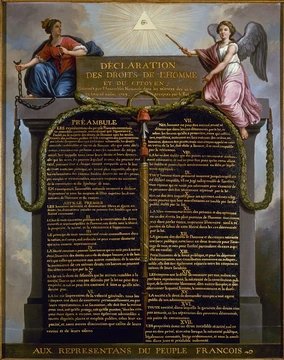
Pardon
A government decision relieving legal consequences of a criminal conviction.

Pascal Dagnan-Bouveret · Public domain
A pardon is a governmental act that removes some or all of the legal penalties tied to a criminal conviction. Depending on local law, it can be issued either before or after a conviction. One purpose of a pardon is to correct a miscarriage of justice, freeing someone who was wrongly convicted or given an overly harsh sentence. Another view holds that pardons are a second-best option when the justice system itself has failed. Many countries grant pardons to people who have shown they have "paid their debt to society" or are otherwise deemed worthy. In some places, accepting a pardon can be seen as admitting guilt, which is why some individuals refuse the offer. Today, wrongful convictions are more often corrected through appeals than pardons, but a pardon may still be used when innocence is clear, simply to avoid the cost of a new trial. Clemency is especially important in jurisdictions that still have the death penalty.
Pardons can become controversial, particularly when they appear to be political favors. Critics point to their arbitrary nature and the limited accountability of those who grant them.
**By country**
**Australia**
In Australia, the power to pardon is known as the royal prerogative of mercy, an executive power held by the King and exercised by the governor-general. This broad discretionary power can also be used by a state governor, acting on advice from the state executive council and the state attorney general. Australian courts also have a traditional power to show mercy when the circumstances of the defendant or the offense call for it. Beyond the prerogative of mercy, Australia has passed laws creating additional ways to seek a pardon, exoneration, reduced sentence, or conditional release.
**Canada**
In Canada, the Parole Board of Canada (PBC) is the federal agency that handles pardon decisions under the Criminal Records Act (CRA). The PBC can issue, grant, deny, and revoke pardons. In 2012, the Safe Streets and Communities Act changed the criminal justice system, replacing the term "pardon" with "record suspension" and altering the system accordingly. A pardon keeps a conviction record separate from other criminal records, helping law-abiding citizens reintegrate into society. The Royal Canadian Mounted Police removes all information about the pardoned conviction from the Canadian Police Information Centre (CPIC), and federal agencies cannot share that information without approval from the minister of public safety. However, a pardon does not erase the fact of the conviction; the record is simply kept apart. It removes disqualifications tied to a conviction, such as the ability to contract with the federal government or eligibility for Canadian citizenship. If someone with a pardon is convicted of a new offense, the original record may be reactivated in CPIC. A pardon does not guarantee entry or visa privileges to another country; travelers must check with that country’s authorities. Processing a pardon by the PBC generally takes six months for a summary offense and twelve months for an indictable offense, or up to 24 months if the board proposes to deny the application. Individuals can apply if they were convicted as an adult of a criminal offense in Canada, a federal offense, or a crime in another country and transferred to Canada under the Transfer of Offenders Act or International Transfer of Offenders Act. Non-Canadian citizens are not eligible unless convicted in Canada. To be eligible, individuals must have completed all sentences—including fines, surcharges, costs, restitution, imprisonment, parole, statutory release, and probation—and then wait a specified period. Before 2012, the waiting periods were: three years for summary convictions (except sexual crimes against children), three years under the National Defence Act for lesser punishments, five years for indictable convictions and summary convictions for sexual crimes against children, five years for transferred offenders, five years under the National Defence Act for more serious punishments, and ten years for indictable sexual crimes against children or serious personal injury offenses like manslaughter.
- Definition
- Government decision relieving legal consequences of a criminal conviction
- Purpose
- Overcome miscarriage of justice, grant freedom, or recognize rehabilitation
- Controversy
- Can be a source of political favor and criticized for arbitrariness
- Related concept
- Clemency, which plays a critical role when capital punishment exists
Lore & Background
Pardons can be viewed as a second-best to fair justice, and are sometimes offered when innocence is undisputed to avoid retrial costs. In some jurisdictions, accepting a pardon may implicitly constitute an admission of guilt, leading to refusal in some cases. Cases of wrongful conviction are in recent times more often dealt with by appeal rather than by pardon.
Reader's Guide
The pardon power varies by country. In Australia, it is the royal prerogative of mercy, vested in the King and exercised by the governor-general, with courts also able to exercise mercy. A Canadian pardon keeps the police record separate but does not erase the conviction; it removes disqualifications such as ability to contract with the federal government. Processing times range from six to twenty-four months depending on the offence. Clemency in Canada is granted by the governor general or the Governor in Council under the royal prerogative of mercy. In Chile, pardon (indulto) is regulated in the Criminal Code and may be general (by law) or particular (by presidential decree), but is forbidden for those convicted of terrorism.
Did You Know?
- A pardon may be granted before or after conviction for the crime, depending on the laws of the jurisdiction.
- In some jurisdictions, accepting a pardon may implicitly constitute an admission of guilt.
- In Canada, a pardon does not erase the fact that an individual was convicted; the criminal record is kept separate and apart.
- In Chile, particular pardons are forbidden for those convicted of a crime of terrorism.
Constitutional Foundation and Scope
The authority for federal pardons in the United States is anchored in Article II, Section 2, Clause 1 of the Constitution, which explicitly grants the president the power to issue reprieves and pardons for offenses against the United States, with the sole carve-out being cases of impeachment. The Supreme Court has interpreted this single sentence to encompass a wide spectrum of clemency tools, including conditional pardons, commutations of sentence, remissions of fines and forfeitures, respites, and amnesties. The power reaches even courts-martial proceedings involving members of the Armed Forces. Crucially, this authority is regarded as plenary, meaning neither Congress nor the judiciary may impose restrictions or modifications upon it. This broad scope means the president is not bound by temporal limitations beyond the requirement that the underlying crime must have actually been committed, giving the executive a uniquely sweeping instrument of mercy that stands apart from ordinary legislative or judicial processes.
Process, Definitions, and Practical Effects
The mechanics of granting a pardon involve both direct presidential action and a structured advisory pathway. The president may act on personal initiative or respond to applications channeled through the Office of the Pardon Attorney within the Department of Justice. That office investigates and reviews clemency petitions but holds only an advisory position; the president remains free to disregard its findings. A pardon is an executive order granting clemency for a conviction, issuable at any point after the crime was committed. Justice Department regulations set a waiting period of at least five years after sentence completion before a convicted person may apply, yet the constitutional power itself carries no such temporal restriction. A pardon functions as an expression of presidential forgiveness, typically reflecting the applicant's acknowledgment of responsibility and sustained good conduct. Importantly, it does not declare innocence. Its tangible effect is the restoration of civil rights and the removal of statutory disabilities tied to a criminal record, such as restrictions on firearm possession or occupational licensing. Distinct from a pardon, a reprieve merely postpones a punishment temporarily, while a commutation reduces the severity of a sentence without erasing the underlying conviction.
Historical Roots and Framers' Deliberations
The idea that a governing authority can relieve individuals from criminal punishment stretches back through ancient Jewish, Greek, and Roman legal traditions. The American formulation drew most directly from the English royal prerogative of mercy, which allowed monarchs to withdraw or substitute death sentences. The earliest known exercise is attributed to King Ine of Wessex in the early eighth century, and by Henry VIII's reign, Parliament had declared it an exclusive right of the Crown. By the eighteenth century, Parliament had introduced restrictions to curb abuse, yet the power retained broad application in the American colonies. The real disagreements centered on scope and placement. Hamilton, in Federalist No. 74, championed an unfettered pardon power vested in a single executive, arguing a body of men would be more prone to mutual obduracy. Edmund Randolph moved to reinstate a treason exception, warning the president might himself be guilty or that traitors could be his own instruments, while George Mason opposed ratification partly on the ground that the president should not hold such sweeping power.
Legal Boundaries and Landmark Precedents
The boundaries of the pardon power have been shaped by several pivotal Supreme Court decisions. This opened the door to what are sometimes called open pardons, most famously exemplified when President Gerald Ford extended clemency to Richard Nixon for any possible crimes connected to the Watergate scandal. The legal effect of such preemptive pardons—whether they can halt ongoing investigations or prevent a future indictment—has never been definitively resolved by the judiciary. In a separate but equally significant ruling, Burdick v. Together, these precedents illustrate a power that is simultaneously vast in scope yet subject to narrow, specific limitations, leaving certain edge cases—particularly around presumptive guilt and the interaction with ongoing criminal proceedings—permanently unsettled in American law.
Gallery






Frequently Asked Questions
What is a Pardon in constitutional and rights law?
A Pardon is a governmental act that removes some or all of the legal penalties attached to a criminal conviction. It functions as a mechanism to free individuals who were wrongly convicted, received disproportionately harsh sentences, or have sufficiently repaid their societal debt.
When can a Pardon be issued relative to a trial?
Depending on the jurisdiction's rules, a Pardon may be granted either before a formal conviction is entered or after one. This flexibility allows the power to address both pending cases and finalized sentences.
Why is the Pardon power considered important in rights law?
It serves as a critical safeguard against miscarriages of justice by giving authorities a way to correct wrongful convictions or excessively harsh punishments. It also recognizes rehabilitation by acknowledging that a person has fulfilled their obligation to society.
What criticism is directed at the Pardon power?
Critics argue that the Pardon can be wielded as a tool for political patronage or favoritism. Its highly discretionary nature also raises concerns about arbitrariness, since the decision rests on the judgment of a single authority rather than a transparent legal process.
How does Pardon connect to the broader concept of Clemency?
Pardon is a specific form of clemency, and together they play a vital role in legal systems that include capital punishment. Clemency provides a last-resort avenue for mercy when other judicial remedies have been exhausted.
More in Constitutional And Rights Law 1-19
Spotted an error? Know more?
This is a living reference — every entry is fact-audited, and reader corrections feed straight into our audit queue. Suggest an edit · See this site's audit record