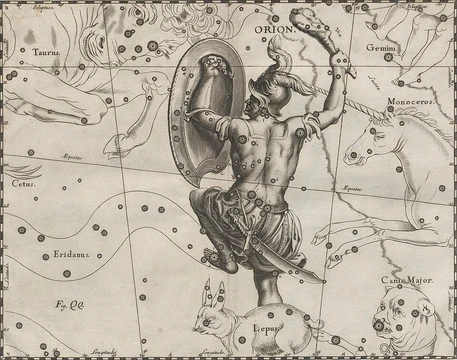
Gemini
Last updated
The constellation Gemini has 85 stars that can be seen without a telescope.[1] Pollux is the most luminous star in Gemini, with Castor being the next brightest.[1]
Key facts and history
In Babylonian astronomy, the stars Castor and Pollux were known as the Great Twins, regarded as minor gods named Meshlamtaea and Lugalirra.[2] Aristotle recorded an observation of Jupiter occulting a star in Gemini, which a 1990 study suggests was 1 Geminorum on 5 December 337 BC.[3] William Herschel discovered Uranus near η Gem on 13 March 1781.[4] In Greek mythology, the twins Castor and Pollux, both Argonauts, were Leda's children; Pollux's father was Zeus, while Castor's father was Tyndareus.[5]
Pluto was found by Clyde Tombaugh in 1930 using photographic plates that had δ Gem as their central point.[4] The open cluster M35 was first observed in 1745 by Philippe Loys de Chéseaux, a Swiss astronomer.[5]
What the cited sources add
The Live Science article notes that around 600 BC, the zero point of the zodiac was in Aries, with Gemini encompassing 60 to 90 degrees of the ecliptic.[6] U Geminorum, a dwarf nova type cataclysmic variable, was discovered by Hind in 1855.[7][8]
References
- Wikipedia, "Gemini (constellation)" (CC BY-SA 4.0), which cites: Elijah H. Burritt - The geography of the heavens and class book of astronomy: Accompanied by a celestial atlas Huntington, 1840 Retrieved 2012-06-25; E Colbert Astronomy without a telescope: being a guide-book to the visible heavens, with all necessary maps and illustrations George & C.W. Sherwood, 1869 Retri (original not read by us) en.wikipedia.org
- Wikipedia, "Gemini (constellation)" (CC BY-SA 4.0), which cites: Babylonian Star-lore by Gavin White, Solaria Pubs, 2008, page 125 (original not read by us) en.wikipedia.org
- Wikipedia, "Gemini (constellation)" (CC BY-SA 4.0), which cites: Star Names: Their Lore and Meaning by Richard Hinckley Allen, Dover, 1963, page 229; Cohen, "New Evidence for the Dating of Aristotle Meteorologica 1-3", Classical Philology, 1990, p. 126–129 (original not read by us) en.wikipedia.org
- Wikipedia, "Gemini (constellation)" (CC BY-SA 4.0), which cites: Star Names: Their Lore and Meaning by Richard Hinckley Allen, Dover, 1963, page 236; The Cambridge Guide to the Constellations by Michael E. Bakich, Cambridge University Press, 1995, page 210 (original not read by us) en.wikipedia.org
- Wikipedia, "Gemini (constellation)" (CC BY-SA 4.0), which cites: Ridpath Tirion 2017, p. 152-154 (original not read by us) en.wikipedia.org
- "Astrology: Why Your Zodiac Sign and Horoscope Are Wrong", Live Science, 21 September 2017. livescience.com
- Wikipedia, "Gemini (constellation)" (CC BY-SA 4.0), which cites: "U Geminorum", AAVSO (we also read that source) en.wikipedia.org
- "U Geminorum", AAVSO. aavso.org
Each numbered sentence above was checked against the source it cites before publication. Sentences citing Wikipedia adapt text from the English Wikipedia article Gemini (constellation) (contributors), used under CC BY-SA 4.0; this entry is available under the same licence. Other sources were used for facts only.
Sources
Compiled from Wikipedia and the sources listed below. Text from Wikipedia is available under CC BY-SA 4.0; this entry is adapted from it.
- Wikipedia: Gemini (constellation) (CC BY-SA 4.0).
Spotted an error? Know more?
Reader corrections go straight into our review queue. Suggest an edit · How this site is sourced