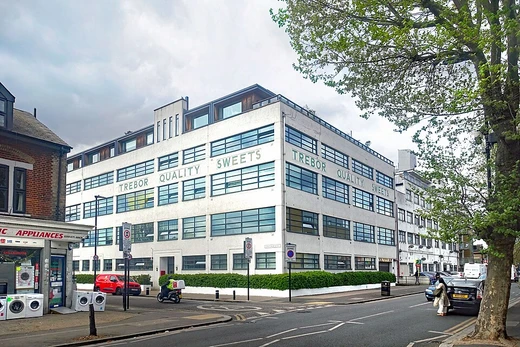
Mackintosh's
Halifax toffee maker behind Quality Street and Rolo.
Mackintosh's was a British confectionery firm founded in Halifax, West Yorkshire, England. It was known for its toffee and the Quality Street and Rolo brands.
Quick Facts
- Industry
- Confectionery
- Fate
- Merged with Rowntree's
- Successor
- Rowntree Mackintosh Confectionery
- Founded
- 1890 in Halifax, Yorkshire, England
- Founders
- John Mackintosh; Violet Mackintosh
- Defunct
- 1969
- Headquarters
- Halifax, West Yorkshire
- Country
- United Kingdom
Facts from the source article.
Did You Know?
- George Harrison's song 'Savoy Truffle', first recorded by the Beatles on their self-titled album, lists flavours in a box of Mackintosh's Good News Chocolates.
- The firm developed Caramac in 1959 and Toffee Crisp in 1963.
- In 1969, the company merged with Rowntree's to form Rowntree Mackintosh Confectionery.
Beginnings
John Mackintosh and his wife Violet used their joint savings of £100 to buy a pastry shop in Halifax in 1890, the year they married. Violet, who had worked as a confectioner's assistant, ran the shop while John kept his job at a cotton mill. To draw customers, they created a special toffee: Violet blended traditional brittle English butterscotch with soft American caramel, selling it as Mackintosh's Celebrated Toffee. Its success allowed expansion beyond Halifax by 1894 and transformed the popular understanding of the term 'toffee'.
The firm moved from retail to manufacturing, first renting a small warehouse on Bond Street in 1895, then moving to larger premises on Hope Street. In 1899 the business became a limited liability company, John Mackintosh Ltd, raising £11,000 and borrowing £4,000 to build a new works on Queen's Road. A fire destroyed that building in 1909; the insurance payout bought the vacant Albion Mills, and the Queen's Road factory was rebuilt and expanded in 1912 to begin chocolate manufacture.
An overseas factory in Asbury Park, New Jersey opened in 1904 but soon failed; a factory in Krefeld, near Düsseldorf followed in 1906. By 1914 operations existed in Australia and Canada, and the firm employed about 1,000 people. The German factory was confiscated during the First World War, and employment fell to 250. A chocolate-covered Toffee-De-Luxe line was developed in 1917, but all chocolate production ceased that year when a conscription tribunal refused an exemption for a key manager.
Power of publicity
Mackintosh understood the value of promotion. He distributed handbills for his Celebrated Toffee, aiming it at the Saturday afternoon crowd who had both a half-day off and their weekly pay. By 1896, he branded himself the "Toffee King" and his candy "The King of All the Toffees." In 1902, the company launched consumer contests and coupon offers, then moved to national newspaper ads in the Daily Mail. These ads featured storylines, graphics, and cartoons, while rivals still used dense text.
Postwar restructure and growth
After John Mackintosh's death in 1920, his eldest son Harold took charge. The company was floated as John Mackintosh & Sons Ltd in March 1921. By paying shareholders of the old company ordinary and preference shares worth more than the issued capital of John Mackintosh Ltd, plus a substantial distribution, the family controlled about 93% of the new firm; Harold and his brother Douglas held over half the ordinary shares. Some preference shares were offered to the public to pay estate duties.
Key management appointments supplemented family ownership: Harold as chairman and managing director handled purchasing; Harry Guy, a Quaker and Price Waterhouse-trained accountant, became finance director from 1922 until his death in 1955; Frank Bottomley, an old school friend of Harold, became works manager, retiring in 1966; and E. L. Fletcher, who had worked on the Mackintosh account at advertising agency T. B. Browne, oversaw marketing. A series of surreal Heath Robinson cartoons of 'Toffee Town' began a national newspaper campaign in October 1921, and Halifax became known as 'Toffee Town'.
Mackintosh re-entered the US market but by 1931 made an agreement with another Yorkshire company whose Toronto subsidiary manufactured its toffees on a royalty basis and exported them to the US. The North Kerry Manufacturing Company was acquired in 1924 when sales in the Irish Free State were hit by import duties; in 1931 Mackintosh merged its interests with Rowntree through a holding company, Associated Chocolate and Confectionery Company. In Britain, the 1927 purchase of two confectionery retailers, Meeson and Tuckshop, gave direct consumer access and some retail price control.
In 1929, Anglo-American Chewing Gum Ltd (later Anglo-American Confectionery) expanded the product range and forestalled American entry into the British market with a rival chewing product.
Caley acquisition
Albert Jarman Caley had started selling mineral waters and soft drinks in Norwich in 1863, later diversifying into cocoa (1883), chocolate (1886) and Christmas crackers (1898). The business was bought in 1918 by the African and Eastern Trading Company, which expanded it but left it overcapitalised and unprofitable; attempts to sell it in the 1920s failed. Through a chain of mergers, Unilever came to own Caley's. After a lunchtime meeting at the Savoy Hotel, Harold Mackintosh bought the A.J. Caley chocolate company in Norwich from Unilever in 1932, giving Mackintosh's access to chocolate production. Eric Mackintosh, Harold's younger brother and managing director of Mackintosh's since 1929, became chairman of Caley's, with Harry Guy controlling finance and Frank Bottomley as works manager.
More in Confectionery Companies of the United Kingdom
Spotted an error? Know more?
Reader corrections go straight into our review queue. Suggest an edit · How this site is sourced