S. Parkinson & Sons
Doncaster confectioner known for inventing butterscotch.
S. Parkinson & Sons was a Doncaster-based confectionery company known for its butterscotch, which it claimed to have invented in 1848. The company was acquired by Hollands of Southport in 1961 and later became part of Cavenham Confectionery.
Quick Facts
- Founded
- 1848 (butterscotch reputedly invented)
- Founder
- Samuel Parkinson
- Location
- Doncaster
- Key product
- Royal Doncaster Butterscotch
- Acquired by
- Hollands of Southport (1961)
- Peak employment
- Over 500 people (by 1956)
Facts from the source article.
Did You Know?
- Ewbanks, acquired by Hollands in 1961, was Pontefract's second liquorice factory, founded in 1810 by Thomas Firth.
- Yeatman & Co, founded in 1857 by Israel Edward Woolf, produced the first sweets for Marks & Spencer.
- Parkinsons' butterscotch was advertised as Royal Doncaster Butterscotch or the Queen's Sweetmeat.
History of H J Packer & Carsons
The business was founded in 1881 by Edward Packer in Armoury Square, Bristol, with his sister and brother. In 1884 H. J. Burrows joined, forming H. J. Packer & Co, but the partnership dissolved within a year and Burrows became sole owner. Burrows sold the business for £950 to Caleb Bruce Cole the following year. Sales grew significantly from 1894, prompting a move to a purpose-built factory in Greenbank in 1901.
Between 1903 and 1912 sales rose 250%, helped by Two ounces per penny quality chocolates for children and lines like Packers Chocolate Mixers. In 1908 the company bought Glasgow-based Carsons and created the Bonds of Bristol brand for luxury chocolates. Carsons' Glasgow factory closed and production moved to Shortwood, near Mangotsfield. By the early 1920s the company was Britain's fourth-largest chocolate manufacturer with over 2,000 employees, introducing Milk Crispets.
Carsons Chocolate was taken by Sir Ernest Shackleton on his expeditions. The company's fortunes declined by World War II. In 1955 the Packers brand was relaunched with Summit chocolate bars and penny sweets like White Mice and Sweet cigarettes. By 1961 Carsons' production moved to Greenbank.
Carsons was the largest British manufacturer of chocolate liqueurs under the Famous Brands name. In 1962 H. J. Packer was renamed Carsons Ltd, but it remained unprofitable, losing £39,000 by 1963. The company was taken over by James Goldsmith in 1964, becoming part of Cavenham Foods.
History of Hollands of Southport
John Holland came up with a new way to make creamy toffee in the 1890s, working out of a shop at 23a Cross Street in Southport that his uncle James Ford had given him. Holland had learned the trade as an apprentice to Ford, a confectioner in Ormskirk. His most popular item was Everton Toffee. During World War I, the company opened a new factory on Virginia Street.
John Arthur Holland took over as manager in 1927, and from 1932 the business operated as John Holland & Son. He became the sole head in 1936 and introduced the slogan Best on Earth. A fire hit the premises in 1940, but after the war the firm grew, shipping to the United States for the first time in 1953. In 1952, John Arthur’s sons, John Arthur Junior and Peter, took control, and the company was renamed J A & P Holland.
It went public on the Liverpool Stock Exchange in 1953, and the Virginia Street factory got an extension the next year. As the toffee market shrank, the brothers bought up competitors. Their first big acquisition was Coq D’or Chocolates in 1959, followed by Fillerys Toffees in 1960, which had a deal with Marks & Spencer, then Casket Confectionery and London’s Walters Palm Toffee for £385,000. Later that year the company listed on the London Stock Exchange, having absorbed over 20 firms.
In 1961 it bought S. Parkinson & Son, Harper Paper for £1.25 million, Mackay Brothers of Edinburgh, and George & Son of Southend-on-Sea, among others. The Daily Mail called it the world’s largest toffee maker, and by 1965 it ran 33 wholesale warehouses. John Arthur Holland Junior invented a soft toffee in 1963, sold as Chewzits. The company skipped dividends in 1963 and 1964, as many subsidiaries struggled.
Independent shareholders clashed with the Holland family, and in 1965 James Goldsmith’s Cavenham Foods launched a takeover bid that the Hollands fought but ultimately lost.
Cavenham Confectionery Ltd
Carsons was joined by Yeatmans, J A & P Holland, and Paramount Laboratories to form the Cavenham Confectionery arm of Cavenham Foods. Products included Famous Names, Chewits, Hollands Toffee, Fillery's Toffee, Walters Palm Toffee, Ewbanks Liquorice, Dr Who & The Daleks Sweet Cigarettes, Royal Doncaster Butterscotch, and Parkinsons Boiled Sweets. Many factories were closed, concentrating production at Carsons' Greenbank site, Holland's Southport location, and Parkinsons' Doncaster factory.
In 1967, with Cavenham Foods in financial difficulty, James Goldsmith merged Cavenham Confectionery into a 50/50 partnership with Perrier's confectionery business, which included Menier and Lindt. The business exported $750,000 of goods to America in 1968 and purchased the brand and recipes of Elizabeth Shaw. The partnership with Perrier was dissolved in 1969, and Cavenham Confectionery was sold to Conwood SA for £1.2 million, a company owned 50/50 by Cavenham Foods and Conwood Corporation, but was soon sold back to Cavenham Foods.
In 1981 the management purchased the business as part of James Goldsmith's breakup of Cavenham Foods for £8 million, and the business name was changed to Famous Names Ltd.
Greenbank factory site
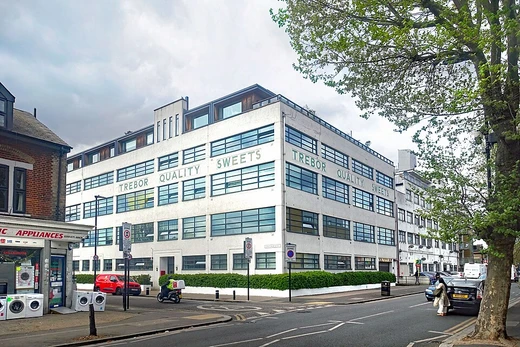
When the S. Parkinson & Sons factory shut down in 2006, locals pushed back against the first developer’s plan to turn it into flats and houses, arguing the building was a key piece of Bristol’s industrial past. George Ferguson, who had previously transformed an old Bedminster tobacco factory into the Tobacco Factory arts venue, backed their fight. By 2012, the site was still empty because no one had come up with a workable second plan. In late 2013, ownership reverted to Clydesdale Bank, and the Generator Group started drawing up new ideas.
In August 2014, Generator South West put forward a proposal for open spaces around a mix of flats and houses. By 2016, the project had hit serious snags: the developer asked to be let off the legal requirement that 30 to 40 percent of any development be social housing, claiming the cost of restoring old buildings made it unaffordable. The community group ACORN campaigned against this, pointing to Bristol’s housing crisis and the shortage of affordable homes.
Generator Group then worked with the city council to create 36 shared ownership homes alongside the private ones. The first homes ready for people to move into in 2021 were shared ownership. Details on what’s planned for the still-undeveloped 1950s factory block can be found in the city council’s planning archive.
More in Confectionery Companies of the United Kingdom
Spotted an error? Know more?
Reader corrections go straight into our review queue. Suggest an edit · How this site is sourced