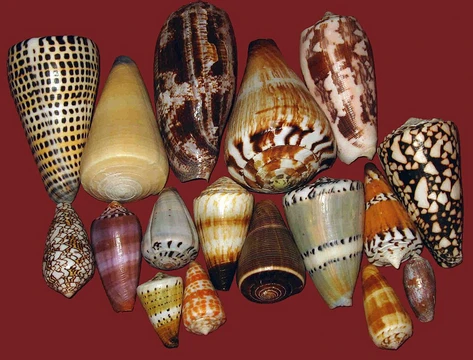
Conus tulipa
Last updated

H. Zell · via Wikipedia: Conus tulipa · CC BY-SA 3.0
The species was first described by Linnaeus in 1758 and is accepted in the World Register of Marine Species.[1] The tulip cone, known scientifically as Conus tulipa, belongs to the family Conidae and is classified as a marine gastropod mollusk.[2]
Scientific classification
- KingdomAnimalia
- PhylumMollusca
- ClassGastropoda
- SubclassCaenogastropoda
- OrderNeogastropoda
- FamilyConidae
- GenusConus
- SpeciesConus tulipa
Named by Linnaeus, 1758
Close relatives
Other species of Conus with a Codexery entry.
- Conus abbas Conus abbas
- Conus abrolhosensis Conus abrolhosensis
- Conus achatinus Conus achatinus
- Conus acutangulus Conus acutangulus
- Conus aito Conus aito
- Conus ammiralis Conus ammiralis
- Conus anabathrum Conus anabathrum
- Conus anemone Conus anemone
Sources: Wikipedia taxobox: Conus tulipa (CC BY-SA 4.0) · order, family and genus agree with WoRMS AphiaID 215503 (CC BY 4.0)
Conservation status
Least Concern (LC)
- LC▲ this species
- NT
- VU
- EN
- CR
- EW
- EX
Source: IUCN Red List assessment · GBIF copy of the Red List category
How big is it?
Largest length in the source, 0.1 m, next to a 1.8 m person.
Diagram: drawn by Codexery, schematic shapes to scale (not a likeness). Length: Wikipedia: Conus tulipa
Where the conus tulipa has been recorded
Each dot is a place where the species has been observed and reported (495 records, half-degree grid) — not a modelled range. 41 inland records left out (institution coordinates).
Map: drawn by Codexery. Data: GBIF occurrence search (records CC0 / CC BY) · Natural Earth basemap (public domain)
Biology and range
The shell of Conus tulipa varies in size from 45 mm to 95 mm.[3] Conus tulipa preys on fishes.[4] Tryon (1884) described the aperture's interior as having a violaceous coloration.[3] In 2001, researchers discovered a conopeptide class designated rho-TIA within Conus tulipa.[5]
What the specialist sources record
The World Register of Marine Species lists Conus tulipa as an accepted species in the family Conidae, order Neogastropoda, class Gastropoda.[1] GBIF holds 1,540 occurrence records for this taxon as of 7 October 2026.[6]
References
- World Register of Marine Species, Conus tulipa (AphiaID 215503). CC BY 4.0. marinespecies.org
- Wikipedia, "Conus tulipa" (CC BY-SA 4.0) en.wikipedia.org
- Wikipedia, "Conus tulipa" (CC BY-SA 4.0), which cites: G.W. Tryon (1884) Manual of Conchology, structural and systematic, with illustrations of the species, vol. VI; Philadelphia, Academy of Natural Sciences (original not read by us) en.wikipedia.org
- Wikipedia, "Conus tulipa" (CC BY-SA 4.0), which cites: Sharpe, "Two new classes of conopeptides inhibit the alpha1-adrenoceptor and noradrenaline transporter.", Nature Neuroscience, 2001, p. 902–907 (original not read by us) en.wikipedia.org
- Wikipedia, "Conus tulipa" (CC BY-SA 4.0), which cites: Sharpe, "Two new classes of conopeptides inhibit the alpha1-adrenoceptor and noradrenaline transporter.", Nature Neuroscience, 2001, p. 902–907; Sharpe, "Two new classes of conopeptides inhibit the alpha1-adrenoceptor and noradrenaline transporter.", Nature Neuroscience, 2001, p. 902–907 (original not read by us) en.wikipedia.org
- GBIF Backbone Taxonomy and occurrence index, Conus tulipa (taxon key 5728233). CC BY 4.0 (backbone); counts are facts. gbif.org
Each numbered sentence above was checked against the source it cites before publication. Sentences citing Wikipedia adapt text from the English Wikipedia article Conus tulipa (contributors), used under CC BY-SA 4.0; this entry is available under the same licence. Other sources were used for facts only.
More in Cone Snails
Sources
Compiled from Wikipedia and the sources listed below. Text from Wikipedia is available under CC BY-SA 4.0; this entry is adapted from it.
- Wikipedia: Conus tulipa (CC BY-SA 4.0).
- Classification: the source article's taxobox; order, family and genus checked against WoRMS, the World Register of Marine Species (CC BY 4.0).
- Conservation status: IUCN Red List assessment.
- Occurrence records: GBIF (CC0 / CC BY). Basemap: Natural Earth (public domain).
- Word definitions: the Codexery glossary, each quoted from its Wikipedia article.
Spotted an error? Know more?
Reader corrections go straight into our review queue. Suggest an edit · How this site is sourced