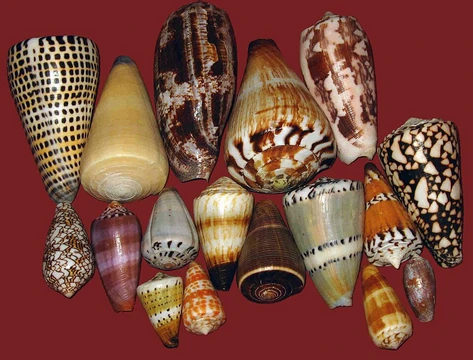
Conus ammiralis
A venomous marine snail with a chestnut shell and white triangular spots.
Last updated

H. Zell · via Wikipedia: Conus ammiralis · CC BY-SA 3.0
The admiral cone (Conus ammiralis) is a marine gastropod mollusk in the family Conidae, a group of sea snails. As with all members of the genus Conus, it is a predatory and venomous species. Its sting can harm humans, so live specimens should be handled with great caution or avoided entirely. The shell ranges from 35 mm to 109 mm in length.
Its color is chestnut, marked with darker revolving lines, and features upper, basal, and one or two approximate bands that are finely reticulated with yellow on a white background. Large, irregularly placed triangular white spots overlay this pattern. This species is found in the Red Sea and the Mascarenes, as well as across the Indo-West Pacific, including Fiji, Indo-China, Indo-Malaysia, the Marshall Islands, New Caledonia, the Solomon Islands, Thailand, Vanuatu, and parts of Australia (Northern Territory, Queensland, and Western Australia).
Scientific classification
- KingdomAnimalia
- PhylumMollusca
- ClassGastropoda
- SubclassCaenogastropoda
- OrderNeogastropoda
- FamilyConidae
- GenusConus
- SpeciesConus ammiralis
Named by Linnaeus, 1758
Close relatives
Other species of Conus with a Codexery entry.
- Conus abbas Conus abbas
- Conus abrolhosensis Conus abrolhosensis
- Conus achatinus Conus achatinus
- Conus acutangulus Conus acutangulus
- Conus aito Conus aito
- Conus anabathrum Conus anabathrum
- Conus anemone Conus anemone
- Conus aplustre Conus aplustre
Sources: Wikipedia taxobox: Conus ammiralis (CC BY-SA 4.0) · order, family and genus agree with WoRMS AphiaID 426315 (CC BY 4.0)
Conservation status
Least Concern (LC)
- LC▲ this species
- NT
- VU
- EN
- CR
- EW
- EX
Source: IUCN Red List assessment · GBIF copy of the Red List category
How big is it?
Largest length in the source, 0.11 m, next to a 1.8 m person.
Diagram: drawn by Codexery, schematic shapes to scale (not a likeness). Length: Wikipedia: Conus ammiralis
Where the conus ammiralis has been recorded
Each dot is a place where the species has been observed and reported (412 records, half-degree grid) — not a modelled range. 35 inland records left out (institution coordinates). 3 isolated far-off records not drawn.
Map: drawn by Codexery. Data: GBIF occurrence search (records CC0 / CC BY) · Natural Earth basemap (public domain) · place coordinates: Wikipedia (CC BY-SA 4.0)
Lore & Background
The shell of Conus ammiralis varies in size between 35 mm and 109 mm. Its coloration is chestnut with darker revolving lines, and upper, basal and one or two approximate bands that are finely reticulated with yellow on a white ground. This pattern is overlaid with large, irregularly disposed triangular white spots. The species occurs in the Red Sea and the Mascarenes, as well as across the Indo-West Pacific, including Fiji, Indo-China, Indo-Malaysia, the Marshall Islands, New Caledonia, the Solomon Islands, Thailand, Vanuatu, and parts of Australia (Northern Territory, Queensland, Western Australia).
More in Cone Snails
Sources
Compiled from Wikipedia and the sources listed below. Text from Wikipedia is available under CC BY-SA 4.0; this entry is adapted from it.
- Wikipedia: Conus ammiralis (CC BY-SA 4.0).
- Classification: the source article's taxobox; order, family and genus checked against WoRMS, the World Register of Marine Species (CC BY 4.0).
- Conservation status: IUCN Red List assessment.
- Occurrence records: GBIF (CC0 / CC BY). Basemap: Natural Earth (public domain).
- Word definitions: the Codexery glossary, each quoted from its Wikipedia article.
Spotted an error? Know more?
Reader corrections go straight into our review queue. Suggest an edit · How this site is sourced