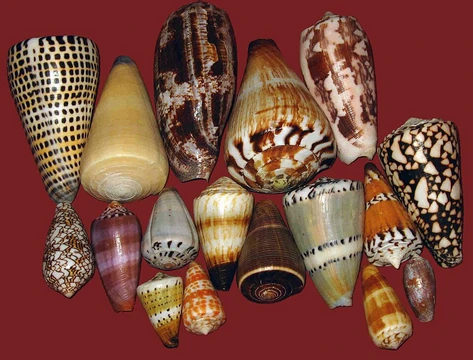
Conus pulicarius
A venomous cone snail with a white shell marked by dark square spots.
Last updated

Almed2 · via Wikipedia: Conus pulicarius · CC BY-SA 3.0
Conus pulicarius, called the flea-bitten cone, is a marine snail in the family Conidae. Like other cone snails, it is a predator and venomous. Its sting can harm people, so live specimens should be handled with care—or avoided entirely. The shell, which grows from 30 to 75 mm, is white with square, dark chocolate or nearly black spots; sometimes these spots line up to form two bands.
The spire is bumpy, and the thin, translucent outer layer is typical of its group. The form once called Conus fustigatus has larger, fewer spots. A former subspecies, Conus pulicarius vautieri, is now considered a synonym of Conus vautieri. This species lives in the central and western Pacific, including Polynesia (but not the Marquesas), Cocos (Keeling) Island, New Guinea, and parts of Australia (Northern Territory, Queensland, and Western Australia).
Scientific classification
- KingdomAnimalia
- PhylumMollusca
- ClassGastropoda
- SubclassCaenogastropoda
- OrderNeogastropoda
- FamilyConidae
- GenusConus
- SpeciesConus pulicarius
Named by Hwass in Bruguière, 1792
Close relatives
Other species of Conus with a Codexery entry.
- Conus abbas Conus abbas
- Conus abrolhosensis Conus abrolhosensis
- Conus achatinus Conus achatinus
- Conus acutangulus Conus acutangulus
- Conus aito Conus aito
- Conus ammiralis Conus ammiralis
- Conus anabathrum Conus anabathrum
- Conus anemone Conus anemone
Sources: Wikipedia taxobox: Conus pulicarius (CC BY-SA 4.0) · order, family and genus agree with WoRMS AphiaID 215492 (CC BY 4.0)
Conservation status
Least Concern (LC)
- LC▲ this species
- NT
- VU
- EN
- CR
- EW
- EX
Source: IUCN Red List assessment · GBIF copy of the Red List category
How big is it?
Largest length in the source, 0.07 m, next to a 1.8 m person.
Diagram: drawn by Codexery, schematic shapes to scale (not a likeness). Length: Wikipedia: Conus pulicarius
Where the conus pulicarius has been recorded
Each dot is a place where the species has been observed and reported (1,530 records, half-degree grid) — not a modelled range. 60 inland records left out (institution coordinates).
Map: drawn by Codexery. Data: GBIF occurrence search (records CC0 / CC BY) · Natural Earth basemap (public domain) · place coordinates: Wikipedia (CC BY-SA 4.0)
Lore & Background
The shell of Conus pulicarius is white, covered by square-shaped, dark chocolate or nearly black spots that sometimes by their juxtaposition indicate two bands. The spire is tuberculated, and the epidermis is very thin and translucent. The synonym Conus fustigatus includes varieties in which the spots are larger and less numerous. This marine species occurs in the Central and Western Pacific, including Polynesia (not Marquesas), Cocos (Keeling) Island, New Guinea, and Australia (Northern Territory, Queensland and Western Australia).
More in Cone Snails
Sources
Compiled from Wikipedia and the sources listed below. Text from Wikipedia is available under CC BY-SA 4.0; this entry is adapted from it.
- Wikipedia: Conus pulicarius (CC BY-SA 4.0).
- Classification: the source article's taxobox; order, family and genus checked against WoRMS, the World Register of Marine Species (CC BY 4.0).
- Conservation status: IUCN Red List assessment.
- Occurrence records: GBIF (CC0 / CC BY). Basemap: Natural Earth (public domain).
- Word definitions: the Codexery glossary, each quoted from its Wikipedia article.
Spotted an error? Know more?
Reader corrections go straight into our review queue. Suggest an edit · How this site is sourced