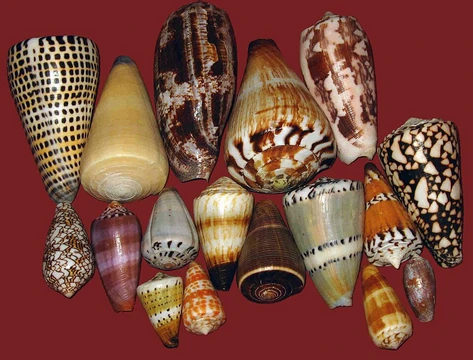
Conus arenatus
A venomous, sand-dusted cone snail of Indo-Pacific seas.
Last updated

Almed2 · via Wikipedia: Conus arenatus · CC BY-SA 3.0
The sand-dusted cone (Conus arenatus) is a marine gastropod mollusk belonging to the cone snail family, Conidae. It is both predatory and venomous, and its sting can affect humans, so live specimens should be handled with caution—or avoided entirely.
The shell, which ranges from 25 mm to 90 mm in size, is stout and turbinate, with a coronated spire. Its white surface is marked by tiny, closely spaced brown dots arranged in wavy longitudinal patterns, sometimes forming faint bands. The aperture is typically a light flesh color.
This species is found in the Red Sea and across the Indo-Pacific, including off the coasts of Australia (Northern Territory, Queensland, Western Australia). It has also spread to the Mediterranean Sea off Israel, having entered as a Lessepsian migrant via the Suez Canal.
Scientific classification
- KingdomAnimalia
- PhylumMollusca
- ClassGastropoda
- SubclassCaenogastropoda
- OrderNeogastropoda
- FamilyConidae
- GenusConus
- SpeciesConus arenatus
Named by Hwass in Bruguière, 1792
Close relatives
Other species of Conus with a Codexery entry.
- Conus abbas Conus abbas
- Conus abrolhosensis Conus abrolhosensis
- Conus achatinus Conus achatinus
- Conus acutangulus Conus acutangulus
- Conus aito Conus aito
- Conus ammiralis Conus ammiralis
- Conus anabathrum Conus anabathrum
- Conus anemone Conus anemone
Sources: Wikipedia taxobox: Conus arenatus (CC BY-SA 4.0) · order, family and genus agree with WoRMS AphiaID 215482 (CC BY 4.0)
Conservation status
Least Concern (LC)
- LC▲ this species
- NT
- VU
- EN
- CR
- EW
- EX
Source: IUCN Red List assessment · GBIF copy of the Red List category
How big is it?
Largest length in the source, 0.09 m, next to a 1.8 m person.
Diagram: drawn by Codexery, schematic shapes to scale (not a likeness). Length: Wikipedia: Conus arenatus
Where the conus arenatus has been recorded
Each dot is a place where the species has been observed and reported (1,575 records, half-degree grid) — not a modelled range. 100 inland records left out (institution coordinates).
Map: drawn by Codexery. Data: GBIF occurrence search (records CC0 / CC BY) · Natural Earth basemap (public domain) · place coordinates: Wikipedia (CC BY-SA 4.0)
Lore & Background
The shell of Conus arenatus varies in size from 25 mm to 90 mm. It is stoutly turbinated and coronated on the spire. The shell is white, sprinkled in a waved longitudinal manner with very small, close brown dots, sometimes forming indistinct bands. The aperture usually has a light flesh-color.
This marine species occurs in the Red Sea and in the Indo-Pacific, and off Australia (Northern Territory, Queensland, Western Australia). The species now also occurs in the Mediterranean off Israel, having invaded as a Lessepsian migrant through the Suez Canal.
As a predatory and venomous cone snail, Conus arenatus is capable of stinging humans, and live ones should be handled carefully or not at all.
Reader's Guide
Conus arenatus, the sand-dusted cone, is notable for its distinctive shell pattern and its status as a Lessepsian migrant. Its shell, white with fine brown dots in waved longitudinal lines, sometimes forming indistinct bands, makes it recognizable among cone snails. The species has expanded its range from the Red Sea and Indo-Pacific into the Mediterranean off Israel via the Suez Canal, illustrating a modern pathway of marine species dispersal. Its venomous nature, shared with other cone snails, underscores the need for caution when handling live specimens.
The species has been documented in multiple scientific works from the late 18th century onward, including those by Bruguière, Röding, Tryon, and others, reflecting sustained interest in its taxonomy and distribution. Its presence in Australian waters and across the Indo-Pacific highlights its adaptability. The sand-dusted cone remains a subject of study for malacologists, particularly regarding its invasive spread and ecological impact in the Mediterranean.
More in Cone Snails
Sources
Compiled from Wikipedia and the sources listed below. Text from Wikipedia is available under CC BY-SA 4.0; this entry is adapted from it.
- Wikipedia: Conus arenatus (CC BY-SA 4.0).
- Classification: the source article's taxobox; order, family and genus checked against WoRMS, the World Register of Marine Species (CC BY 4.0).
- Conservation status: IUCN Red List assessment.
- Occurrence records: GBIF (CC0 / CC BY). Basemap: Natural Earth (public domain).
- Word definitions: the Codexery glossary, each quoted from its Wikipedia article.
Spotted an error? Know more?
Reader corrections go straight into our review queue. Suggest an edit · How this site is sourced