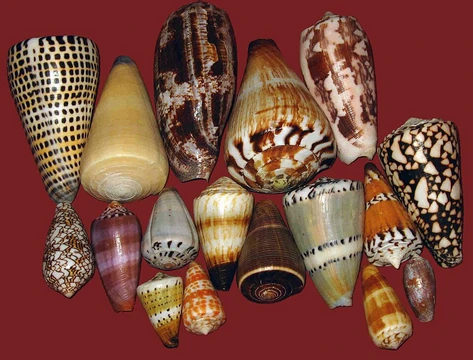
Conus gloriamaris
Once the rarest shell, now accessible through improved diving technology.
Last updated

H. Zell · via Wikipedia: Conus gloriamaris · CC BY-SA 3.0
The Glory of the Sea Cone, Conus gloriamaris, is a marine gastropod mollusk belonging to the family Conidae. This sea snail lives in the Pacific and Indian Oceans. Its shell typically grows between 8 and 12 centimeters long, though it can reach 16 centimeters. Compared to other cone snails, it is relatively large and slender, with a tall spire.
The shell is covered in fine, orange-brown lines that form a net-like pattern, enclosing triangular spaces similar to those seen on other textile cones. Across the body are two or three bands of chestnut markings that resemble hieroglyphs. Its tan color can range from a light, golden hue to a deep dark brown, with very fine detailing. It is sometimes mistaken for the common Textile cone and also resembles the Bengal cone.
Collector value
For shell collectors, this species holds special significance because it was once considered the rarest shell in the world. For roughly two centuries, from its first discovery until its habitat was found in 1969, individual specimens were worth thousands of U.S. dollars and were generally owned only by museums and wealthy private collectors.
The shell’s popularity also inspired urban legends, most notably a story about a collector who bought one at auction in 1792 and then destroyed it to preserve the value of another specimen he already owned. With improvements in diving technology, especially the use of scuba gear, larger numbers were discovered. Today, shells are often available from retailers or online auction sites for less than $100 U.S. Even so, the shell’s history, along with its pleasing shape and patterns, keeps it popular and desirable among collectors.
Distribution
This cone snail is one of many Indo-Pacific species. It is found mainly off the Solomon Islands, but its range extends from the Philippines and eastern Indonesia through New Guinea and as far east as Samoa and Fiji.
Scientific classification
- KingdomAnimalia
- PhylumMollusca
- ClassGastropoda
- SubclassCaenogastropoda
- OrderNeogastropoda
- FamilyConidae
- GenusConus
- SpeciesConus gloriamaris
Named by (Chemnitz, 1777)
Close relatives
Other species of Conus with a Codexery entry.
- Conus abbas Conus abbas
- Conus abrolhosensis Conus abrolhosensis
- Conus achatinus Conus achatinus
- Conus acutangulus Conus acutangulus
- Conus aito Conus aito
- Conus ammiralis Conus ammiralis
- Conus anabathrum Conus anabathrum
- Conus anemone Conus anemone
Sources: Wikipedia taxobox: Conus gloriamaris (CC BY-SA 4.0) · order, family and genus agree with WoRMS AphiaID 428137 (CC BY 4.0)
Conservation status
Least Concern (LC)
- LC▲ this species
- NT
- VU
- EN
- CR
- EW
- EX
Source: IUCN Red List assessment · GBIF copy of the Red List category
How big is it?
Largest length in the source, 0.16 m, next to a 1.8 m person.
Diagram: drawn by Codexery, schematic shapes to scale (not a likeness). Length: Wikipedia: Conus gloriamaris
Where the conus gloriamaris has been recorded
Each dot is a place where the species has been observed and reported (95 records, half-degree grid) — not a modelled range. 15 inland records left out (institution coordinates).
Map: drawn by Codexery. Data: GBIF occurrence search (records CC0 / CC BY) · Natural Earth basemap (public domain) · place coordinates: Wikipedia (CC BY-SA 4.0)
Lore & Background
The shell of Conus gloriamaris can reach 16 cm in length, though it typically measures between 8 and 12 cm. Compared with other cones, it is relatively large and slender, with a tall spire.
Its surface is finely reticulated with orange-brown lines that enclose triangular spaces, similar to other textile cones, and it bears two or three bands of chestnut hieroglyphic markings across its body. The tan coloration can vary from a lighter golden color to a deeper dark brown, with intricate detailing. It is sometimes confused with the common Textile cone and shows similarity to the Bengal cone.
For about two centuries between its initial discovery and the discovery of its habitat in 1969, specimens were valued in the thousands of U.S. dollars and generally only owned by museums and wealthy private collectors. The shell's popularity among collectors spawned urban legends, most notably the story of a collector purchasing one at auction in 1792 only to destroy it, to maintain the value of another one already in his collection.
Improvements in diving technology such as the advent of scuba led to their discovery in larger numbers. Today shells can often be found from retailers or online auction sites for less than $100 U.S. Nonetheless, the legacy of this shell in addition to its pleasing shape and patterns makes it popular and desirable among shell collectors today.
More in Cone Snails
Sources
Compiled from Wikipedia and the sources listed below. Text from Wikipedia is available under CC BY-SA 4.0; this entry is adapted from it.
- Wikipedia: Conus gloriamaris (CC BY-SA 4.0).
- Classification: the source article's taxobox; order, family and genus checked against WoRMS, the World Register of Marine Species (CC BY 4.0).
- Conservation status: IUCN Red List assessment.
- Occurrence records: GBIF (CC0 / CC BY). Basemap: Natural Earth (public domain).
- Word definitions: the Codexery glossary, each quoted from its Wikipedia article.
Spotted an error? Know more?
Reader corrections go straight into our review queue. Suggest an edit · How this site is sourced