Central processing unit
Last updated
Its principal components are the arithmetic-logic unit, processor registers, and a control unit that orchestrates instruction fetching, decoding, and execution.[1] A computer's primary processor, known as a central processing unit (CPU), uses its electronic circuitry to carry out program instructions that include arithmetic, logic, control, and input/output operations.[2] Integrated circuit microprocessors, which may contain one or more CPUs on a single chip, are how the majority of contemporary CPUs are realized.[3]
Quick Facts
- First use of term
- 1955
- Early stored-program computer
- Manchester Baby (first program 21 June 1948)
- Notable early architecture
- von Neumann architecture (EDVAC design)
- Modern variant
- Multi-core processors (MCPs)
Facts from the source article.
Key facts and history
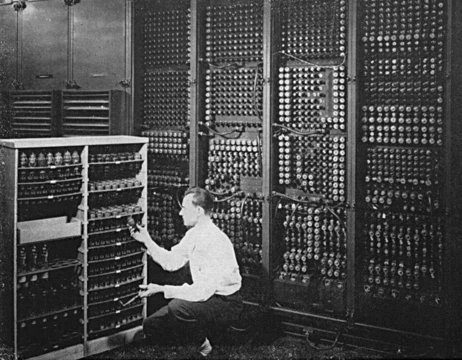
The Manchester Baby ran the first stored-program on 21 June 1948, and the Manchester Mark 1 followed in June 1949.[4] Before transistors, relays and vacuum tubes served as switching elements, with tube-based CPUs like EDVAC averaging eight hours between failures.[5][6] The first transistorized computers emerged during the 1950s, and by 1960 new designs were fully transistorized.[7] Machines like ENIAC needed physical rewiring to change their tasks, but the stored-program concept, which allowed programs to be held in memory, was outlined in a June 30, 1945 paper by John von Neumann describing the EDVAC design.[8][9][10]
The Intel 4004, which debuted in 1971, was the first microprocessor available commercially.[11] Multi-core processors are microprocessor chips that contain multiple CPUs.[3] Until 2016, Moore's law was a fairly reliable predictor of how CPU complexity would increase.[12]
What the cited sources add
The GeeksforGeeks article on the control unit states that the CU coordinates the sequence of data movements into, out of, and between a processor's many sub-units.[13] It also notes there are two types of control units: hardwired and microprogrammed.[13] The same source notes that the Metropolitan Vickers Electrical Company manufactured six units as the Metrovick 950, used commercially from 1956.[7] According to the Computer History Museum, the National Bureau of Standards Eastern Automatic Computer (SEAC) became operational in April 1950 and used 10,500 germanium diodes along with 747 vacuum tubes.[7]
TechTarget's article by Bigelow states that cores contain all the registers and circuitry—sometimes hundreds of millions of individual transistors—needed to perform the closely-synchronized tasks of ingesting data and instructions, processing that content, and outputting logical decisions or results.[14]
References
- Wikipedia, "Central processing unit" (CC BY-SA 4.0), which cites: Prabhat, "Ultimate Guide to SSC CGL Combined Graduate Level Tier-I & Tier II Prelims & Mains (with Latest Solved Question Papers) Guide Book English: Bestseller Book by Team Prabhat: Ultimate Guide to SSC CGL Combined Gr (original not read by us) en.wikipedia.org
- Wikipedia, "Central processing unit" (CC BY-SA 4.0), which cites: Team, "Engineering Drawing & Basic Science", Youth Competition Times, p. 425; Nagpal, "Computer Fundamentals", S. Chand Publishing, 2008, p. 33; "What is processor (CPU)? A definition from WhatIs.com", WhatIs, 14 August 2019; Chesalov, "The fourth industrial revolution glossarium: over 1500 of the hottest terms you will use to create the future", Litres, 2023-04-12; Jagare, "Operating AI: Bridging the Gap Between Technology and Business", John Wiley & Sons, 2022-04-19; Kuck, "Computers and Computations, Vol 1", John Wiley & Sons en.wikipedia.org
- Wikipedia, "Central processing unit" (CC BY-SA 4.0), which cites: "What is a multicore processor and how does it work?", TechTarget, 2022-03-07; Dementiev, "Intel® Performance Counter Monitor - A Better Way to Measure CPU Utilization", Intel, 2022-11-30 (original not read by us) en.wikipedia.org
- Wikipedia, "Central processing unit" (CC BY-SA 4.0), which cites: Enticknap, "Computing's Golden Jubilee", Resurrection, Summer 1998; "The Manchester Mark 1", The University of Manchester (original not read by us) en.wikipedia.org
- Wikipedia, "Central processing unit" (CC BY-SA 4.0), which cites: "Switches, transistors and relays", BBC; Han, "Introducing the Vacuum Transistor: A Device Made of Nothing", IEEE Spectrum, 2014-06-23 (original not read by us) en.wikipedia.org
- Wikipedia, "Central processing unit" (CC BY-SA 4.0), which cites: Weik, "A Third Survey of Domestic Electronic Digital Computing Systems", Ed Thelen's Nike Missile Web Site, 1961 (original not read by us) en.wikipedia.org
- "1953: Transistorized Computers Emerge", Computer History Museum. facts only, no text reused. computerhistory.org
- Wikipedia, "Central processing unit" (CC BY-SA 4.0), which cites: Regan, "A Brief History of Computing", Springer, 2008, p. 66; Weik, "A Survey of Domestic Electronic Digital Computing Systems", Ed Thelen's Nike Missile Web Site, 1955; Weik, "A Third Survey of Domestic Electronic Digital Computing Systems", Ed Thelen's Nike Missile Web Site, 1961 (original not read by us) en.wikipedia.org
- Wikipedia, "Central processing unit" (CC BY-SA 4.0), which cites: "Bit By Bit", Haverford College; "First Draft of a Report on the EDVAC", Moore School of Electrical Engineering, University of Pennsylvania, 1945 (original not read by us) en.wikipedia.org
- Wikipedia, "Central processing unit" (CC BY-SA 4.0), which cites: Copeland, "The Modern History of Computing", Metaphysics Research Lab, Stanford University, 2020; "ENIAC's Birthday", The MIT Press, February 9, 2016 (original not read by us) en.wikipedia.org
- Wikipedia, "Central processing unit" (CC BY-SA 4.0), which cites: Cass, "Chip Hall of Fame: Intel 4004 Microprocessor", IEEE Spectrum, 2018-07-02 (original not read by us) en.wikipedia.org
- Wikipedia, "Central processing unit" (CC BY-SA 4.0), which cites: Simonite, "Moore's Law Is Dead. Now What?", MIT Technology Review, 2016-05-13; Moore, "Excerpts from A Conversation with Gordon Moore: Moore's Law", Intel, 2005 (original not read by us) en.wikipedia.org
- "Introduction of Control Unit and its Design", GeeksforGeeks, 2018-09-24. facts only, no text reused. geeksforgeeks.org
- Bigelow, "What is a multicore processor and how does it work?", TechTarget, 2022-03-07. facts only, no text reused. techtarget.com
Each numbered sentence above was checked against the source it cites before publication. Sentences citing Wikipedia adapt text from the English Wikipedia article Central processing unit (contributors), used under CC BY-SA 4.0; this entry is available under the same licence. Other sources were used for facts only; no text or images are copied from them.
More in Computing & Digital
Sources
Compiled from Wikipedia and the sources listed below. Text from Wikipedia is available under CC BY-SA 4.0; this entry is adapted from it.
- Wikipedia: Central processing unit (CC BY-SA 4.0).
Spotted an error? Know more?
Reader corrections go straight into our review queue. Suggest an edit · How this site is sourced