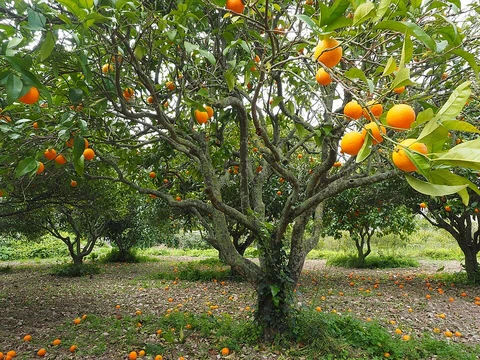
Pecan
A hickory species cultivated for its edible seed.

The pecan (Carya illinoinensis) is a hickory tree that originally grew wild in the south-central United States and northern Mexico, particularly along the Mississippi River. Today, it is farmed for its edible seeds—commonly called nuts—mainly in Georgia, New Mexico, Texas, Louisiana, and Mexico. These seeds are eaten as snacks or used in dishes like praline candy and pecan pie. The pecan is the official state nut of Alabama, Arkansas, California, Texas, and Louisiana, and it is also the state tree of Texas.
The word "pecan" comes from Algonquian languages, where it referred to pecans, walnuts, and hickory nuts. Its pronunciation varies widely across the U.S., with no single version universally accepted. In 1927, the National Pecan Growers Association chose an official pronunciation—"pea-con"—and asked everyone to use that one exclusively.
A pecan tree is large and deciduous, reaching 20 to 40 meters tall (rarely 44 meters), with a spread of 12 to 23 meters and a trunk up to 2 meters in diameter. A 10-year-old sapling in good conditions stands about 5 meters tall. Its leaves are alternate, 30 to 45 centimeters long, and pinnate with 9 to 17 leaflets, each 5 to 12 centimeters long and 2 to 6 centimeters wide.
Technically, a pecan is not a true nut but a drupe—a fruit with a single pit inside a husk. The husk comes from the flower’s exocarp, while the nut part develops from the endocarp and holds the seed. The husk is brassy greenish-gold, oval to oblong, 2.6 to 6 centimeters long and 1.5 to 3 centimeters wide. It is 3 to 4 millimeters thick, starts green, turns brown at maturity, and splits into four sections to release the thin-shelled seed.
Pecan trees are native to the south-central U.S. but have spread through cultivation. They grow in bottomlands, suburban woodlands, disturbed areas, and forest edges, often naturalizing near planted trees. They prefer moist, well-drained, rich soils that do not flood often.
Carya illinoinensis belongs to the Juglandaceae family, which includes seven to ten living genera and over 60 species worldwide. Most are found in the Northern Hemisphere of the New World, though some occur on every continent except Antarctica.
The first fossil Juglandaceae appear from the Cretaceous period. The subfamilies Engelhardioideae and Juglandioideae split about 64 million years ago in the early Paleogene. Engelhardioideae species are mostly tropical and evergreen, while Juglandioideae are deciduous and live in temperate zones. A key step in pecan evolution was a shift from wind-dispersed to animal-dispersed fruits, which coincided with the development of a husk and a change in fatty acid ratios—oleic to linoleic acids reversed between the two dispersal types. Further differentiation from other Juglandaceae occurred about 44 million years ago in the Eocene. Pecans (genus Carya) differ from walnuts (genus Juglans) only in how the husk forms: walnut husks develop from bracts, bracteoles, and sepals (or just sepals), while pecan husks develop from bracts and bracteoles alone.
Pecans are one of the most recently domesticated major crops. Wild pecans were known to Native Americans and colonial settlers, but commercial U.S. farming did not start until the 1880s. By 2014, the U.S. produced 119.8 million kilograms annually, with 75% from Georgia, New Mexico, and Texas. The trees grow best in USDA hardiness zones 5 through 9, preferring long, hot, humid summers. Harvest typically occurs around mid-October. The tree naturally forms a vase-shaped canopy and needs little pruning—only to remove diseased, broken, or dead limbs. In 2017, Mexico produced nearly half the world’s pecans, similar to the U.S. total, and together they accounted for 93% of global production. As of 2024, South Africa is the third-largest producer, mostly exporting to China. Pecan trees need lots of water during the growing season, so many orchards use flood irrigation. Generally, two or more different cultivars are needed for pollination. Choosing cultivars involves the Alternate Bearing Index (ABI), which measures a tree’s tendency to bear fruit every other year (an index of 1.0 means it likely yields little to nothing in alternate years). Pollination timing splits cultivars into two groups: protandrous (shedding pollen before receiving it) and protogynous (shedding pollen after becoming receptive). State-level resources are available for growers.
- Scientific name
- Carya illinoinensis
- Family
- Juglandaceae
- Native range
- Southern United States and northern Mexico
- Fruit type
- Drupe (not a true nut)
- Primary U.S. producers
- Georgia, New Mexico, Texas
- State nut of
- Alabama, Arkansas, California, Texas, Louisiana
Lore & Background
The pecan tree is a large deciduous species of hickory, native to the southern United States and northern Mexico, particularly the Mississippi River region. It grows to a substantial height with a broad spread and a trunk up to two feet in diameter; a ten-year-old sapling in good conditions can stand about twenty feet tall. Its leaves are alternate and pinnate, composed of nine to seventeen leaflets. The fruit is technically a drupe, not a true nut, with a single pit surrounded by a husk. This husk is brassy greenish-gold in color, oval to oblong, and about three to four inches long. The outer husk is a quarter-inch thick, starting green and turning brown at maturity, when it splits into four sections to release the thin-shelled seed. The tree naturally forms a vase-shaped canopy and requires little pruning beyond removing damaged limbs. It is cultivated primarily in Georgia, New Mexico, Texas, Louisiana, and Mexico. Pecans grow best in moist, well-drained, rich soils, often found in bottomlands, suburban woodlands, and along forest edges, but they avoid areas subject to frequent flooding. The species is one of the most recently domesticated major crops; wild pecans were known as a delicacy among native and colonial Americans, but commercial cultivation in the United States did not begin until the 1880s.
Reader's Guide
Pecans are one of the most recently domesticated major crops, with commercial growth in the United States beginning only in the 1880s. and Mexico accounted for 93% of global production. South Africa is the third largest producer, mostly exporting to China. The tree requires little pruning and grows best in long, hot, humid summers. Active breeding programs by the USDA Agricultural Research Service and the University of Georgia work to select varieties adapted to different regions, though most acreage today is of older cultivars such as 'Stuart', 'Schley', 'Elliott', and 'Desirable'. Northern-adapted varieties like 'Kanza' offer cold tolerance, while 'Western' is the only commonly available variety for low-chill zones.
Did You Know?
- The pecan is not a true nut but a drupe, with a single stone surrounded by a husk.
- Pecans are one of the most recently domesticated major crops, with commercial growth starting in the 1880s.
- The ratio of oleic to linoleic acids is inverted between wind-dispersed and animal-dispersed seeds.
Frequently Asked Questions
Who is Pecan?
Pecan (Carya illinoinensis) is a hickory species in the Juglandaceae family, originally native to the Southern United States and northern Mexico along the Mississippi River region. It is a large deciduous tree that typically reaches 20 to 40 meters in height, with rare specimens growing to 44 meters.
What are Pecan's powers/role?
Pecan produces a drupe—commonly called a nut—that is prized as an edible seed for snacks, praline candy, and pecan pie. The tree is primarily cultivated in Georgia, New Mexico, Texas, and Louisiana to harvest this seed.
How does Pecan's story end?
As a long-lived perennial, Pecan has no single narrative ending but instead cycles through decades of growth, fruiting, and regeneration. Its seeds can germinate into new trees, allowing the species to persist across native and cultivated landscapes indefinitely.
Why is Pecan important?
Pecan holds official state-nut status in Alabama, Arkansas, California, Texas, and Louisiana, and additionally serves as the state tree of Texas. It is one of the most commercially significant nut crops in the United States, anchoring entire regional economies.
Where does Pecan call home?
Pecan is native to the south-central United States and northern Mexico, particularly around the Mississippi River basin. Today it is widely grown across the southern U.S., with Georgia, New Mexico, and Texas leading domestic production.
More in Common Plants And Crops 1-24
Spotted an error? Know more?
This is a living reference — every entry is fact-audited, and reader corrections feed straight into our audit queue. Suggest an edit · See this site's audit record