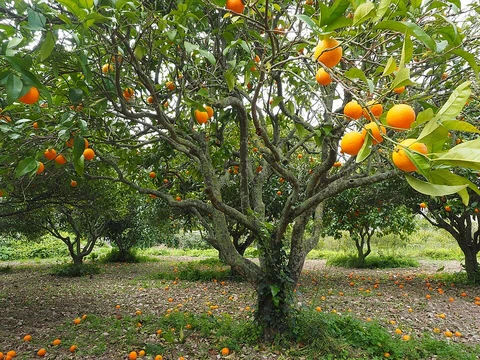
Pear
A genus of trees bearing edible pome fruit, cultivated worldwide.

Pears belong to the genus *Pyrus* within the rose family, and the name also refers to the apple-like fruit these trees produce. Some pear species are grown for their fruit and juice, while others are cultivated as ornamental flowering trees. The genus likely originated in Central Asia, particularly the foothills of the Tian Shan range in what is now western China, and from there spread across Europe, North Africa, and the temperate parts of Asia.
The word "pear" comes from Old English *pere* or *peru*, which traces back through Vulgar Latin *pera* and Latin *pirum*, possibly related to the Greek *apion*. The ultimate source may be an ancient Mediterranean language, perhaps Semitic. The classical Latin term for the tree itself is *pirus*, with *pyrus* appearing as a medieval variant.
Pear trees are mostly small to medium in size, though some grow as shrubs, and a few species have thorns. Their leaves are arranged alternately, simple, and range from 2 to 12 cm long; they can be glossy green or densely silvery-hairy, with shapes from broad oval to narrow lanceolate. Most pears are deciduous, but one or two Southeast Asian species are evergreen. Some pears tolerate winter cold as low as −25 to −40 °C, but many agricultural varieties are vulnerable to frost, while evergreen species only withstand temperatures down to about −12 °C.
The flowers are white, rarely yellow or pink, 2–4 cm across, with five petals, five sepals, and many stamens. The fruit is a pome, like an apple, and in wild species it is usually 1–4 cm in diameter, but cultivated forms can reach up to 18 cm long and 9 cm wide. Shape varies from round or globe-like to the classic pear shape with a long base and bulbous end. Botanically, the fruit is a pseudofruit formed from the swollen receptacle; inside the flesh are 2–5 cartilaginous carpels known as the core. Pears and apples are not always easy to tell apart by fruit shape—some cultivated pears, like the nashi, closely resemble apples.
The genus is thought to have two domestication centers: one in China and another in Asia Minor near the Caucasus Mountains. The word for pear appears in all Celtic languages, and different names exist in Slavic and other dialects, leading botanist Alphonse Pyramus de Candolle to conclude the tree was cultivated very early from the Caspian Sea to the Atlantic. Pear cultivation goes back to prehistoric times, with traces found in pile dwellings around Lake Zurich. Pears were grown in China as early as 2000 BC, and an article on pear cultivation appears in Ibn al-'Awwam's 12th-century agricultural work. The European pear (*Pyrus communis* subsp. *communis*) likely descends from one or two wild subspecies widespread in Europe. Court records from Henry III of England mention pears shipped from La Rochelle-Normande and given to the king by London sheriffs; French names for varieties in English medieval gardens suggest French influence, with one favored variety named for Saint Rieul of Senlis. The Romans cultivated pears, eating them raw or cooked, and introduced them to Britain. Pliny's *Natural History* recommended stewing them with honey and listed three dozen varieties, while the Roman cookbook *De re coquinaria* includes a recipe for a spiced, stewed-pear soufflé. Asian species with medium to large edible fruit include *P. pyrifolia*, *P. ussuriensis*, *P. × bretschneideri*, and *P. × sinkiangensis*, while small-fruited species like *Pyrus calleryana* serve as rootstocks. *Pyrus nivalis*, with white down on its leaf undersides, is mainly used in Europe to make perry, a drink like cider. Another small-fruited species, *P. cordata*, is found wild in southwestern Europe and noted for early ripening and round fruit.
About 3,000 pear varieties are grown worldwide, varying in shape and taste. In 2024, global production was about 28 million tonnes, with China accounting for 76%. The fruit is eaten fresh, canned, juiced, dried, or fermented into perry. Pear wood is a preferred material for high-quality woodwind instruments and furniture. The genus *Pyrus* was described by Carl Linnaeus in 1753 and can be divided into two subgenera: *Pyrus* (the Occidental clade, found mainly in western Eurasia and North Africa) and *Pashia* (the Oriental clade, native to East Asia).
- genus
- Pyrus
- family
- Rosaceae
- native_range
- Asia, Europe, mountains of North Africa
- world_production_2024
- about 28 million tonnes
- leading_producer
- China (76% of total)
- known_varieties
- about 3,000
- uses
- fruit, juice, perry, ornamental, timber for instruments and furniture
Lore & Background
The word pear comes from Old English pere or peru, from Vulgar Latin pera, from Latin pirum, probably akin to Greek apion. The source is likely an ancient Mediterranean language, perhaps Semitic. The classical Latin word for a pear tree is pirus; pyrus is an alternate form used in medieval Latin. Pears are mostly small or medium-sized trees, with leaves alternately arranged, simple, and glossy green or silvery-hairy. Most are deciduous, but one or two species in Southeast Asia are evergreen. The flowers are white, rarely tinted yellow or pink, with five petals, five sepals, and numerous stamens. The fruit is a pome, shaped from oblate to the classic pyriform 'pear shape'.
Reader's Guide
Pears have been cultivated since prehistoric times, with evidence from pile dwellings around Lake Zurich and in China as early as 2000 BC. The Romans cultivated pears, eating them raw or cooked, and introduced them to Britain. Pliny's Natural History noted three dozen varieties. The enormous number of varieties of the cultivated European pear likely derive from one or two wild subspecies. Asian species with edible fruit include P. pyrifolia, P. ussuriensis, P. × bretschneideri, and P. × sinkiangensis. About 3,000 varieties are grown worldwide. The fruit is consumed fresh, canned, as juice, dried, or fermented as perry. Pear wood is a preferred material for high-quality woodwind instruments and furniture. Pears are propagated by grafting onto rootstocks, often of quince for smaller trees.
Did You Know?
- The word pear likely originates from an ancient Mediterranean language, possibly Semitic.
- Pear wood is a preferred material for high-quality woodwind instruments and furniture.
- About 3,000 varieties of pears are grown worldwide, varying in shape and taste.
- The pear fruit is a pseudofruit composed of the swollen receptacle, enclosing 2–5 cartilaginous carpels known as the core.
Frequently Asked Questions
What is a pear?
A pear is the edible pome fruit produced by deciduous trees in the genus Pyrus, members of the rose family (Rosaceae). The fruit is apple-like in structure and is eaten fresh, pressed into juice, or used in cooking.
Where did pears originally come from?
Pears are believed to have first appeared in the foothills of the Tian Shan mountains in present-day western China. Over time the genus spread across temperate Asia, Europe, and the mountainous regions of North Africa.
What is the pear's botanical classification?
Pears sit in the genus Pyrus within the family Rosaceae, the same family that includes roses, apples, and cherries. They are native to temperate zones spanning Asia, Europe, and the mountains of North Africa.
Are pears grown only for their fruit?
Not exclusively—while most cultivated pears are valued for their edible fruit and pressed juices, a number of Pyrus species are planted purely as ornamental flowering trees in gardens and public landscapes.
More in Common Plants And Crops 1-24
Spotted an error? Know more?
This is a living reference — every entry is fact-audited, and reader corrections feed straight into our audit queue. Suggest an edit · See this site's audit record