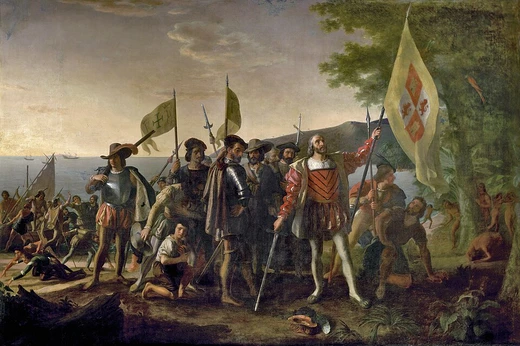
Fall of Tenochtitlan

The fall of Tenochtitlan, the Mexica capital, marked a key moment in the Spanish conquest of the Mexica. Hernán Cortés, the Spanish conquistador, led the campaign after extensive talks with local groups. He relied heavily on La Malinche, his interpreter and companion, and on thousands of indigenous allies, most notably Tlaxcaltec warriors. While many battles occurred between the Mexica and the Spanish-led coalition—which was mostly made up of Tlaxcaltec men—it was the siege of Tenochtitlan that caused the Aztec civilization to collapse, followed by looting and violence against those who survived. At the time, a smallpox epidemic had devastated the indigenous population, killing much of its leadership. Because smallpox had been common in Spain for centuries, the Spanish had built up immunity and were far less affected. This conquest was a crucial step in Spain’s colonization of the Americas.
In April 1519, Cortés—a nobleman recently arrived in Cuba and leader of the third Spanish expedition to Mexico’s coast—landed at San Juan de Ulúa, a good harbor on the eastern shore. He brought 508 soldiers, 100 sailors, and 14 small cannons. Survivors of earlier expeditions had guided him there. Diego Velázquez de Cuéllar, Cuba’s governor, had ordered Cortés to lead the expedition after favorable reports from two prior trips to Yucatán caught Spanish interest. But under pressure from relatives who wanted a different leader, Velázquez revoked Cortés’s command before he left Cuba. Cortés had to fight to keep his role; twice messengers from Velázquez arrived to remove him, and twice they were talked out of it. After Cortés sailed, Velázquez sent an army under Pánfilo de Narváez to arrest him.
Once in Mexico, Cortés used the same legal trick Velázquez had employed when invading Cuba years earlier: he created a local government and had himself elected magistrate, making him answerable only to Spain’s king. He did this after founding the city of Villa Rica de la Vera Cruz (Veracruz), seven miles from San Juan de Ulúa. A 1529 inquiry in Spain looked into his actions but took no action against him.
Cortés landed near Cempoala, a vassal state of the Aztecs with many grievances. Meeting several polities that resented Aztec rule, he claimed he had come on his Emperor’s orders to improve conditions, end human sacrifice, teach the true faith, and stop them from robbing each other. He kept his army well-behaved around potential allies. He clashed with some groups, including the Totonac and Tlaxcalan. The Tlaxcalan fought him twice during the day and once at night, holding off his army on a hilltop for two weeks. His smaller force finally won when the Tlaxcalan began to consider his constant peace offers. Notably, Xicotencatl the Elder wanted an alliance with the Spaniards against the Aztecs, which was also Cortés’s goal.
It was once widely thought the Aztecs first believed Cortés was Quetzalcoatl, a god prophesied to return to Mexico in the same year and from the same direction. This is now seen as a myth of the conquerors, and perhaps of natives who wanted to explain the actions of the Aztec tlatoani, Moctezuma II. Most scholars agree the Aztecs, especially Moctezuma’s inner circle, did not view Cortés as a god. However, messages between Cortés and Moctezuma often refer to the legend, which was well-known across Aztec lands and influenced both Aztecs and their subjects, as Bernal Díaz del Castillo repeatedly notes.
Moctezuma sent noblemen and other emissaries to meet Cortés at Quauhtechcac. They brought golden jewelry, which delighted the Spaniards. According to the Florentine Codex, Moctezuma also ordered his messengers to bring the highly symbolic penacho (headdress) of Quetzalcoatl de Tula and place it on Cortés. As news of the strangers reached the capital, Moctezuma grew fearful and considered fleeing. He reportedly resigned himself to what he saw as his people’s fate.
Cortés continued his march toward Tenochtitlan. Before entering the city on November 8, 1519, he and his troops prepared for battle by armoring themselves and their horses, forming into military ranks: four leading horsemen, then five contingents of foot soldiers. The contingents included men with iron swords and wooden or leather shields; horsemen in cuirasses with iron lances, swords, and wooden shields; crossbowmen; more horsemen; soldiers with arquebus guns; and finally indigenous soldiers from Tlaxcalan, Tliliuhquitepec, and Huexotzinco, armed with cotton armor, shields, and crossbows, many carrying provisions or escorting cannons on wooden carts.
Cortés’s army entered the city on the flower-covered causeway from Iztapalapa, associated with the god Quetzalcoatl. Cortés was amicably received by Moctezuma. The captive woman Malinalli Tenépal, also called Doña Marina, translated from Nahuatl to Chontal Maya; the Spaniard Gerónimo de Aguilar then translated from Chontal Maya to Spanish.
- event
- Fall of Tenochtitlan
- location
- Tenochtitlan (capital of the Mexica)
- key_participants
- Hernán Cortés, La Malinche, Moctezuma II
- allied_forces
- Tlaxcaltec warriors and other indigenous allies
- result
- Fall of Aztec civilization, Spanish colonization of the Americas
Lore & Background
He had been sent by Governor Diego Velázquez de Cuéllar of Cuba, though Velázquez revoked his mandate before departure. Cortés persisted, creating a local government at Veracruz and having himself elected magistrate, theoretically responsible only to the King of Spain. He encountered polities resentful of Aztec rule, including the Totonac and Tlaxcalan, and after battles and negotiations secured Tlaxcalan allies. La Malinche translated from Nahuatl to Chontal Maya, and Gerónimo de Aguilar from Chontal Maya to Spanish. Miscommunications occurred, as La Malinche's primary objectives were to avoid war and obtain gold.
Reader's Guide
The fall of Tenochtitlan marked a critical stage in the Spanish colonization of the Americas. The siege directly caused the collapse of the Aztec civilization, followed by widespread sacking and violence. The indigenous population was devastated by a smallpox epidemic, which killed much of its leadership; the Spanish, having acquired immunity from centuries of endemic smallpox in Spain, were affected relatively little. Cortés's coalition relied heavily on thousands of indigenous allies, especially Tlaxcaltec warriors. The event demonstrated how European diseases, military technology, and local political divisions combined to enable conquest. The capture of Moctezuma and subsequent tensions led to the eventual destruction of the city. The conquest reshaped the region's political and demographic landscape, establishing Spanish colonial rule.
Did You Know?
- Cortés was aided by La Malinche, his interpreter and companion, and by thousands of indigenous allies, especially Tlaxcaltec warriors.
- A smallpox epidemic devastated the indigenous population, killing much of its leadership, while the Spanish were relatively unaffected due to acquired immunity.
- Moctezuma sent emissaries bearing golden jewellery and the symbolic headdress of Quetzalcoatl to Cortés.
More in Colonialism And Exploration 1-18
Spotted an error? Know more?
This is a living reference — every entry is fact-audited, and reader corrections feed straight into our audit queue. Suggest an edit · See this site's audit record