English overseas possessions

Before the 1707 Acts of Union united England and Scotland into the Kingdom of Great Britain, the territories and colonies taken or claimed by the English crown are often called the English overseas possessions, or the English Empire. Until that union, Scots were barred from these holdings; afterward, they could join the growing British Empire. England’s first overseas settlements appeared in Ireland, where a system for ruling a conquered population took shape after the Tudor conquest in the 1500s.
The Kingdom of England is usually dated from King Æthelstan’s rule in 927. Under the Danish House of Knýtlinga (1013–1014 and 1016–1042), England was part of a personal union with Scandinavian domains. In 1066, William the Conqueror, Duke of Normandy, took England, making the duchy a crown possession. Through the Middle Ages, English kings held large French territories because of this Norman link. The Plantagenet dynasty’s Angevin Empire included lands in the British Isles and France. Its collapse sparked the Hundred Years’ War (1337–1453) with France. At the war’s start, English kings ruled nearly all of France; by its end, only Calais remained, which France retook in 1558. The Channel Islands, remnants of the Duchy of Normandy, still retain their tie to the crown.
English overseas expansion began as early as 1169 with the Norman invasion of Ireland, bringing thousands of English and Welsh settlers. Friedrich Engels later called Ireland “the first English colony.” For centuries, English monarchs claimed the Lordship of Ireland, but actual control was mostly limited to the Pale. Large parts of Munster, Ulster, and Connaught stayed independent until Tudor and Stuart times. In the 1500s, Tudor monarchs began “planting” Protestant settlers in Ireland, including King’s County (now Offaly) and Queen’s County (now Laois) in 1556. A joint-stock plantation was set up near Cork in the late 1560s on land leased from the Earl of Desmond. In the early 1600s, the Plantation of Ulster settled thousands of Scottish and northern English colonists. West Country men like Sir Humphrey Gilbert, Sir Walter Raleigh, Sir Ralph Lane, Sir Richard Grenville, and John White worked on Irish plantation schemes before turning to the New World, seeing how such projects boosted personal wealth and power. English control over Ireland fluctuated until Ireland was incorporated into the United Kingdom in 1801 after the 1798 rebellion.
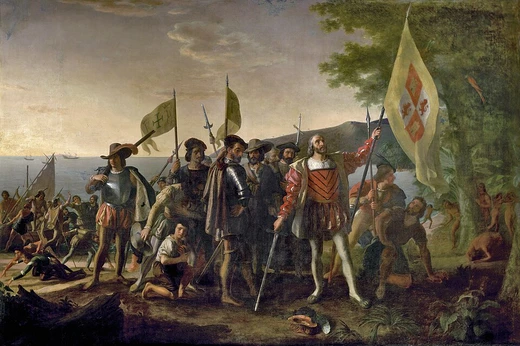
Spanish success in exploring and colonizing the Western Hemisphere from the late 1400s inspired and modeled English efforts. Christopher Columbus sailed in 1492, hoping to reach Asia, and landed in the West Indies on October 12, naming the locals “Indians.” Spanish colonists sought riches but found little treasure beyond gold ornaments; they enslaved indigenous peoples. In 1496, inspired by Portuguese and Spanish exploration, King Henry VII commissioned John Cabot to find a route from the Atlantic to Asia’s Spice Islands—the search for the Northwest Passage. Cabot sailed in 1497, landing on Newfoundland’s coast, believing he had reached Asia, and made no attempt to settle. He led another voyage the next year but vanished.
Under Henry VII, early English voyages of exploration occurred, along with further Irish settlement. During Elizabeth I’s reign (1558–1603), attempts to colonize North America failed. Only after James VI of Scotland became England’s king as James I in 1603 did permanent overseas settlements succeed in North America: first at Jamestown, Virginia (1607), then in the West Indies, and the Plymouth Colony of religious dissenters in New England (1620). All these lands were already occupied by indigenous peoples and claimed by Spain, though Spain had not settled them. During the 1600s, settlers established Maine, Plymouth, New Hampshire, Salem, Massachusetts Bay, Nova Scotia, Connecticut, New Haven, Maryland, and Rhode Island and Providence. In 1664, England took New Netherland and New Sweden from the Dutch, creating New York, New Jersey, and parts of Delaware and Pennsylvania.
In Asia, England set up trading posts called “factories” in the East Indies, such as Bantam, and on the Indian subcontinent, starting with Surat. In 1639, a series of English fortresses on India’s coast began with Fort St George. In 1661, King Charles II’s marriage to Catherine of Braganza brought him former Portuguese possessions as her dowry, including Tangier in North Africa and Bombay in India.
- field
- Colonial expansion
- nationality
- English
- known_for
- First overseas settlements in Ireland, then North America and the West Indies; t
Lore & Background
Friedrich Engels observed that 'Ireland may be regarded as the first English colony.' The Lordship of Ireland was claimed for centuries by the English monarch, though English control was mostly resigned to an area known as The Pale. Most of Ireland—large swaths of Munster, Ulster and Connaught—remained independent of English rule until the Tudor and Stuart periods. It was not until the 16th century that the Tudor monarchs began to 'plant' Protestant settlers in Ireland as part of the plantations of Ireland. These plantations included King's County (now County Offaly) and Queen's County (now County Laois) in 1556. A joint-stock plantation was established in the late 1560s at Kerrycurrihy near Cork city, on land leased from the Earl of Desmond. In the early 17th century the Plantation of Ulster began, and thousands of Scottish and Northern English colonists were settled in the province of Ulster. West Country men, including Sir Humphrey Gilbert, Sir Walter Raleigh, Sir Ralph Lane, Sir Richard Grenville, and John White, were involved in projects of plantation schemes in Ireland before then becoming involved in the New World and saw how individual wealth and power were enhanced by them.
Reader's Guide
The first English overseas settlements were in Ireland, where patterns of rule over a subordinated populated territory developed following the sixteenth-century Tudor conquest. These early colonies in Ireland served as a model for later ventures in North America, with many of the same West Country men—including Sir Humphrey Gilbert, Sir Walter Raleigh, Sir Ralph Lane, Sir Richard Grenville, and John White—involved in plantation schemes in Ireland before becoming involved in the New World. The possessions in North America, the West Indies, and Asia created networks of trade and migration that transformed England's economy and global influence. The possessions also involved conflict with indigenous populations and other European powers, particularly Spain and the Netherlands, as English colonies were established in areas already occupied by indigenous peoples and claimed by the Spanish Empire.
Did You Know?
- Friedrich Engels observed that 'Ireland may be regarded as the first English colony.'
- The first English overseas settlements were established in Ireland as early as 1169, when the Norman invasion of Ireland began.
- The Plantation of Ulster in the early 17th century brought thousands of Scottish and Northern English colonists to the province.
- In 1661, the marriage of King Charles II to Catherine of Braganza brought him Tangier in North Africa and Bombay in India as part of her dowry.
- The Channel Islands, as remnants of the Duchy of Normandy, retain their link to the Crown to the present day.
Continental Roots and the Channel Islands
The Kingdom of England is generally dated from the rule of Æthelstan from 927. In 1066, William the Conqueror, Duke of Normandy, conquered England, making the Duchy a Crown land of the English throne. Through the remainder of the Middle Ages the kings of England held extensive territories in France, based on their history in this Duchy. Under the Angevin Empire, England formed part of a collection of lands in the British Isles and France held by the Plantagenet dynasty. The collapse of this dynasty led to the Hundred Years' War (1337-1453) between England and France. At the outset of the war the Kings of England ruled almost all of France, but by the end of it in 1453 only the Pale of Calais remained to them. Calais was eventually lost to the French in 1558. The Channel Islands, as the remnants of the Duchy of Normandy, retain their link to the Crown to the present day.
Ireland as the First Colony
Long before any English flag flew over North American soil, the island of Ireland served as the laboratory for English colonial rule. The first English overseas expansion occurred as early as 1169, when the Norman invasion of Ireland began to establish English possessions in Ireland, with thousands of English and Welsh settlers arriving in Ireland. For centuries, effective English authority was confined to a narrow strip known as The Pale, while vast regions of Munster, Ulster, and Connaught remained beyond the Crown's reach. The Tudor monarchs changed this trajectory in the sixteenth century, launching plantations that transplanted Protestant settlers into the island. These plantations included King's County (now County Offaly) and Queen's County (now County Laois) in 1556. A joint-stock plantation was established in the late 1560s at Kerrycurrihy near Cork city, on land leased from the Earl of Desmond. The Plantation of Ulster in the early 1600s brought thousands of Scottish and Northern English colonists to the province. Crucially, figures such as Sir Humphrey Gilbert, Sir Walter Raleigh, Sir Ralph Lane, Sir Richard Grenville, and John White gained their colonial experience in Ireland before turning their ambitions toward the New World, carrying with them the conviction that individual wealth and power could be amplified through overseas settlement.
The North American Arc
English ambitions in the Western Hemisphere moved from aspiration to reality over roughly a century. During Elizabeth I's reign (1558-1603), attempts at North American colonization proved unsuccessful. Not until the succession in 1603 of James VI of Scotland to the throne of England (ruling as James I) were permanent overseas settlements successfully established in North America, first at Jamestown, Virginia (1607), the West Indies, and the Plymouth Colony of religious dissenters in New England (1620). All these locations sat in territories already inhabited by indigenous populations and claimed by the Spanish Empire, though the Spanish had not settled them. The seventeenth century saw a rapid multiplication of settlements across the Atlantic coast, including Maine, Plymouth, New Hampshire, Salem, Massachusetts Bay, Nova Scotia, Connecticut, New Haven, Maryland, and Rhode Island and Providence. In 1664, New Netherland and New Sweden were taken from the Dutch, becoming New York, New Jersey, and parts of Delaware and Pennsylvania.
Asia, the Portuguese Dowry, and the Union
While the Atlantic colonies captured popular imagination, England's reach extended into the Indian Ocean and beyond through a different model: trading posts called 'factories' in the East Indies, such as Bantam, and in the Indian subcontinent, beginning with Surat. In 1639, a series of English fortresses on the Indian coast was initiated with Fort St George. In 1661, the marriage of King Charles II to Catherine of Braganza brought him as part of her dowry new possessions which until then had been Portuguese, including Tangier in North Africa and Bombay in India. These territories had previously belonged to Portugal, but the marriage transferred them into English hands. This episode illustrates how the English overseas possessions were built not only through military expedition and settler migration but also through the intricate web of royal alliances and territorial exchanges that characterized early modern European diplomacy.
More in Colonialism And Exploration 1-18
Spotted an error? Know more?
This is a living reference — every entry is fact-audited, and reader corrections feed straight into our audit queue. Suggest an edit · See this site's audit record