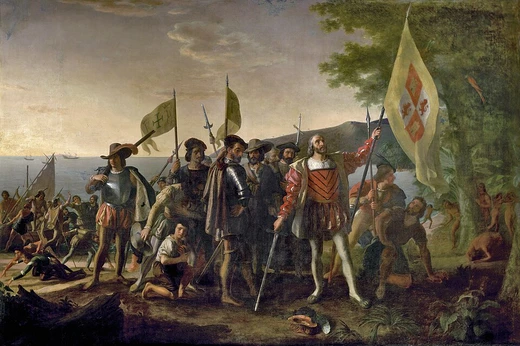
Encomienda
A Spanish labor system that entrusts conquered peoples to conquerors.

The encomienda was a Spanish labor system from the 1500s. It gave conquistadors control over the work of conquered people who were not Christian. In theory, the conquerors were supposed to offer benefits like military protection and schooling. In reality, the conditions were much like forced labor or outright slavery. The system began in Spain after the Christian Reconquista and was used much more widely during Spanish colonization in the Americas and the Spanish East Indies.
Under this system, conquered peoples were considered subjects of the Spanish king. The Crown gave an encomienda as a grant to a specific person, called an encomendero. In the early 1500s, these grants gave the encomendero a permanent monopoly on the labor of certain Indigenous groups. After the New Laws of 1542, the encomienda ended when the encomendero died, and it was replaced by the repartimiento.
Encomiendas changed from their original form in Spain into a kind of communal slavery. The Crown granted a person a set number of natives from a particular community, but did not say which individuals had to work. Indigenous leaders were responsible for gathering the required tribute and labor. In return, encomenderos were supposed to teach the natives Catholicism and Spanish, protect them from enemy tribes or pirates, put down rebellions against Spaniards, and maintain infrastructure. The natives paid tribute in goods like metals, maize, wheat, pork, and other crops.
After Christopher Columbus was removed in 1498, the Crown replaced him with Francisco de Bobadilla. Bobadilla was followed by royal governor Nicolás de Ovando, who set up the formal encomienda system. In many cases, natives were forced to do hard labor and faced extreme punishment or death if they resisted. However, Queen Isabella I of Castile banned enslaving the native population and declared them "free vassals of the crown." Starting in 1512, various versions of the Laws of the Indies tried to regulate interactions between settlers and natives. Both natives and Spaniards appealed to the Real Audiencias for relief under the system.
Encomiendas often involved moving enslaved people away from their homes and breaking up communities and families. But in New Spain, the encomienda ruled free vassals through existing community leaders, and natives stayed in their settlements with their families.
The words encomienda and encomendero come from the Spanish verb *encomendar*, meaning "to entrust." The system was based on a Reconquista institution where *adelantados* could take tribute from Muslims or other peasants in conquered and resettled areas. It traveled to the Americas with Castilian law. Created in the Middle Ages, it helped repopulate and protect frontier land during the Reconquista. It began in Catholic southern Spain to get labor and tribute from Muslims (Moors) before they were exiled in 1492 after the Granada War. It rewarded soldiers and financiers who defeated the Moors. The encomienda worked like a feudal relationship: military protection was exchanged for tributes or specific work. It was common among military orders guarding frontier areas. The king often intervened directly or indirectly to guarantee fairness and to stop abuses.
The encomienda system in Spanish America was different from the one in Spain. Encomenderos did not own the land where the natives lived. The system did not involve direct land ownership; native lands stayed in their communities' possession. This right was formally protected by the crown of Castile, since the rights of administration in the New World belonged to that crown, not to the Catholic monarchs as a whole.
The first encomenderos were usually conquerors who got the labor grants for taking part in a successful conquest. Later, some encomenderos in New Spain (Mexico) were not conquerors themselves but had good connections. In his study of early colonial Mexico's encomenderos, Robert Himmerich y Valencia divided conquerors into "first conquerors" (those in Hernán Cortés' original expedition) and "conquerors" (those in the later Narváez expedition, who joined Cortés). He also called a group of encomenderos in New Spain *pobladores antiguos* (old settlers)—people who had lived in the Caribbean before the Spanish conquest of the Aztec Empire.
In the New World, the Crown gave conquistadors the right to extract labor and tribute from natives under Spanish rule. Nicolás de Ovando, the third governor of the Spanish colony, set up the encomienda system on the island of Hispaniola in 1502. Some women and some Indigenous elites also became encomenderos. For example, Maria Jaramillo, daughter of Marina and conqueror Juan Jaramillo, received income from her father's encomiendas after he died. Two of Moctezuma's daughters, Isabel Moctezuma and another, also held encomiendas.
- field
- Labor system
- nationality
- Spanish
- known_for
- Granting conquistadors the labor of conquered non-Christian peoples; later replaced by the repartimiento
Lore & Background
The encomienda system originated in the Catholic south of Spain during the Reconquista, where it extracted labor and tribute from Muslims. It traveled to America with Castilian law. Conquered peoples were considered vassals of the Spanish monarch, and the Crown awarded an encomienda as a grant to a particular individual, called an encomendero.
Reader's Guide
The encomienda was essential to the Spanish crown's control over North, Central, and South America in the first decades after colonization. It was the first major organizational law instituted on the continent, affected by war, epidemics, and turmoil. The system did not grant land; native lands remained in community possession. Encomenderos were to ensure Catholic instruction, protection from warring tribes, and suppression of rebellion. Natives provided tributes in metals, maize, wheat, pork, and other products. The system became corrupt and harsh, with natives forced into hard labor and subjected to extreme punishment. Its legacy includes geographical displacement and breakup of communities, though in New Spain, natives remained in their settlements with families.
Did You Know?
- The encomienda was first established in Spain after the Christian Reconquista, applied on a much larger scale in the Americas and East Indies.
- Queen Isabella I of Castile forbade slavery of the native population and deemed them 'free vassals of the crown.'
- Some women and Indigenous elites, such as Isabel Moctezuma and her sister, were granted encomiendas.
More in Colonialism And Exploration 1-18
Spotted an error? Know more?
This is a living reference — every entry is fact-audited, and reader corrections feed straight into our audit queue. Suggest an edit · See this site's audit record