Marine sediment
Deposits of insoluble particles covering most of the seafloor.
Last updated
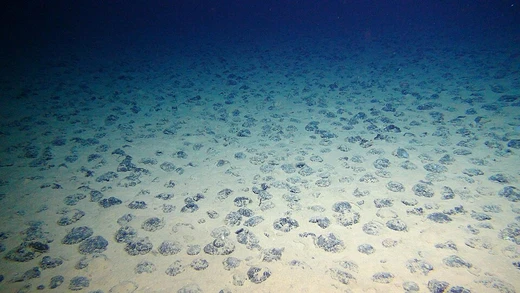
It provides habitat for marine life, especially microorganisms, and its fossilized remains record past climates, plate tectonics, and extinction events.[1] Most of the seafloor is covered in sediment except within a few kilometres of a mid-ocean ridge.[2]
Quick Facts
- Composition sources
- Terrigenous
- biogenous
- hydrogenous
- cosmogenous
- Accumulation rate (coarse particles)
- ~1 meter per thousand years
- Accumulation rate (biogenous oozes)
- ~1 centimeter per thousand years
Facts from the source article.
Key facts and history
Biogenous sediment comes from the hard parts of organisms, such as shells and skeletons, that settle after death.[1] Hydrogenous sediment forms when dissolved substances in seawater precipitate out, usually due to changes in temperature, pressure, or pH.[1] Sediment texture is described by grain size, sorting, and maturity, with grain size classified by the Wentworth scale.[1][3] Surface runoff, river discharge, and other processes deposit land-derived sediments onto continental margins.[1]
Lava flows and emissions from deep-sea hydrothermal vents return molten material from the interior to the surface, allowing the process to continue indefinitely.[1]
What the research sources say
Most microscopic tests are consumed by other organisms and expelled as fecal pellets, sinking to the ocean floor in 10–15 days.[1] Clay minerals, mostly terrestrial in origin, are dominant over wide areas in the deepest parts of the ocean.[2] Siliceous oozes, derived from radiolaria and diatoms, are common in the south polar region, along the Pacific equator, south of the Aleutian Islands, and in large parts of the Indian Ocean.[2]
References
- Wikipedia, "Marine sediment" (CC BY-SA 4.0), which cites: Webb, Paul (2019) Introduction to Oceanography, Chapter 12: Ocean Sediments, page 273–297, Rebus Community. Updated 2020. 50px Modified text was copied from thi (original not read by us) en.wikipedia.org
- Wikipedia, "Marine sediment" (CC BY-SA 4.0), which cites: Earle, Steven (2019) Physical geology, second edition, "Sea-Floor Sediments", chapter 18.3. 50px Modified text was copied from this source, which is available u (original not read by us) en.wikipedia.org
- Wikipedia, "Marine sediment" (CC BY-SA 4.0), which cites: Sediments NOAA. Accessed 5 April 2021. (original not read by us) en.wikipedia.org
Each numbered sentence above was checked against the source it cites before publication. Sentences citing Wikipedia adapt text from the English Wikipedia article Marine sediment (contributors), used under CC BY-SA 4.0; this entry is available under the same licence. Other sources were used for facts only; no text or images are copied from them.
More in Coastal & Marine Geology
Sources
Compiled from Wikipedia and the sources listed below. Text from Wikipedia is available under CC BY-SA 4.0; this entry is adapted from it.
- Wikipedia: Marine sediment (CC BY-SA 4.0).
Spotted an error? Know more?
Reader corrections go straight into our review queue. Suggest an edit · How this site is sourced