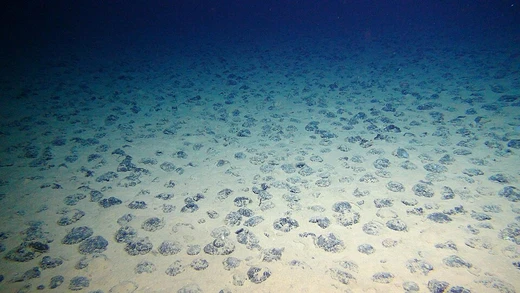
Seabed
The ocean floor, shaped by tectonics and sediment.
Last updated
The ocean floor, known as the seabed, contains features such as mid-ocean ridges and oceanic trenches.[1]
Quick Facts
- Field
- Oceanography
- Geology
- Marine Biology
- Composition
- Terrigenous
- biogenous
- hydrogenous
- and cosmogenous sediments
- Depth zones
- Abyssal zone (to 6,000 m / 3.73 mi) and hadal zone (6,000–11,000 m)
Facts from the source article.
Key facts and history
A mountainous rise called the mid-ocean ridge runs through the center of every ocean, positioned between continents.[1] Mantle circulation moving from the mid-ocean ridge toward tectonic plate edges creates deep valleys known as oceanic trenches.[1] The abyssal zone sits atop the abyssal plain, with its lowest extent at roughly 6,000 m.[2] The deepest oceanic zone, the hadal zone, spans from 6,000 to 11,000 meters and includes the oceanic trenches.[2]
In fields like geology, paleontology, oceanography, and petrology, depth below seafloor serves as a vertical coordinate.[3] "Meters below the seafloor" is what the abbreviation "mbsf" stands for.[3] On the seafloor, terrigenous sediment is the type found in the greatest quantity.[4] The second most plentiful material on the seafloor is biogenous sediment.[5]
In 1977, scientists employing an underwater camera platform came across hydrothermal vents.[6]
What the research sources say
The "Marine Science" account states biogenous bottoms are common in temperate oceans less than 4,000-5,000 meters deep.[7] According to the Woods Hole Oceanographic Institution, Robert Ballard sat aboard the research vessel Knorr in February 1977 staring at photos.[8] A 2020 phys.org article reports the world's sea floor is littered with an estimated 14 million tonnes of microplastics.[9] The National Park Service describes the hadopelagic zone as deep ocean trenches greater than 6,000m.[10]
The same source states the Mariana Trench is the deepest known point in the ocean at over 36,000 feet.[10] Calcareous oozes do not appear at depths exceeding roughly 4,000 to 5,000 meters, since calcium dissolves below that point.[7]
References
- Wikipedia, "Seabed" (CC BY-SA 4.0), which cites: Kump, "The Earth System", Pearson Education, Inc., 2010, p. 122–148 (we also read that source) en.wikipedia.org
- Wikipedia, "Seabed" (CC BY-SA 4.0), which cites: "Open Ocean – Oceans, Coasts, and Seashores", National Park Service; NOAA, "Ocean floor features", National Oceanic and Atmospheric Administration (we also read that source) en.wikipedia.org
- Wikipedia, "Seabed" (CC BY-SA 4.0), which cites: Flood, "Preface: Depth Below Seafloor Conventions", 1997, p. 3; Parkes, "Sulphate-reducing bacteria environmental and engineered systems", Cambridge University Press, 2007, p. 329–358 (we also read that source) en.wikipedia.org
- Wikipedia, "Seabed" (CC BY-SA 4.0), which cites: Chester, "Marine Geochemistry", Blackwell Publishing Ltd., 2012, p. 273–289 (we also read that source) en.wikipedia.org
- Wikipedia, "Seabed" (CC BY-SA 4.0), which cites: "The Bottom of the Ocean," Marine Science (we also read that source) en.wikipedia.org
- Wikipedia, "Seabed" (CC BY-SA 4.0), which cites: "The Discovery of Hydrothermal Vents", Woods Hole Oceanographic Institution, 11 June 2018; "Ocean Surface Topography", Science Mission Directorate, 31 March 2010 (we also read that source) en.wikipedia.org
- "The Bottom of the Ocean," Marine Science. facts only, no text reused. marinebio.net
- "The Discovery of Hydrothermal Vents", Woods Hole Oceanographic Institution, 11 June 2018. facts only, no text reused. whoi.edu
- "14 million tonnes of microplastics on sea floor: Australian study", phys.org. facts only, no text reused. phys.org
- "Open Ocean – Oceans, Coasts, and Seashores", National Park Service. facts only, no text reused. nps.gov
Each numbered sentence above was checked against the source it cites before publication. Sentences citing Wikipedia adapt text from the English Wikipedia article Seabed (contributors), used under CC BY-SA 4.0; this entry is available under the same licence. Other sources were used for facts only; no text or images are copied from them.
More in Coastal & Marine Geology
Sources
Compiled from Wikipedia and the sources listed below. Text from Wikipedia is available under CC BY-SA 4.0; this entry is adapted from it.
- Wikipedia: Seabed (CC BY-SA 4.0).
- Word definitions: the Codexery glossary, each quoted from its Wikipedia article.
Spotted an error? Know more?
Reader corrections go straight into our review queue. Suggest an edit · How this site is sourced