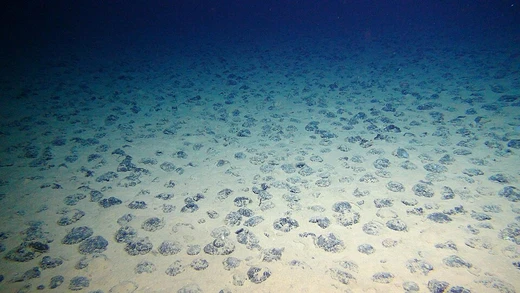
Oceanic basin
Ocean basins are vast, interconnected depressions holding most of Earth's seawater.
Last updated
The ocean is most commonly divided into basins following the continents: North and South Atlantic, North and South Pacific, Indian, Arctic, and Southern Oceans.[1] The global ocean is held within Earth's large depressions known as ocean basins, which cover 67% of the planet's surface and contain roughly 97% of all water on Earth.[1][2]
Quick Facts
- Surface coverage
- 67% of Earth's surface
- Water content
- nearly 97% of all water on Earth
- Average depth
- almost 4 km (about 2.5 miles)
- Oldest crust age
- around 200 million years
Facts from the source article.
Key facts and history
The International Hydrographic Office published "Limits of Oceans and Seas" in 1953, defining ocean basins largely as they are known today.[3] Older references, such as Littlehales (1930), considered oceanic basins to be the complement to the continents, with erosion dominating the latter and sediments ending up in the basins.[4] More modern sources, like Floyd (1991), regard ocean basins more as basaltic plains than as sedimentary depositories.[5] Around 200 million years in the past, a single supercontinent called Pangea contained nearly all land, and it subsequently began to break apart.[6]
The Mariana Trench, situated near the Mariana Islands, is the deepest trench on Earth, stretching about 2500 km (1600 miles) along the seabed.[7]
What the research sources say
Eigenvectors from the model show regions of attraction where things on the ocean surface become trapped, such as the Atlantic garbage patch.[8] These boundaries show lines of very little surface connectivity between regions.[8]
References
- Wikipedia, "Oceanic basin" (CC BY-SA 4.0), which cites: "How much water is in the ocean?" (we also read that source) en.wikipedia.org
- "How much water is in the ocean?". facts only, no text reused. oceanservice.noaa.gov
- Wikipedia, "Oceanic basin" (CC BY-SA 4.0), which cites: International Hydrographic Organization (IHO), (1953): Limits of Oceans and Seas, International Hydrographic Organization., Bremerhaven, PANGAEA, https://epic.a (original not read by us) en.wikipedia.org
- Wikipedia, "Oceanic basin" (CC BY-SA 4.0), which cites: Littlehales, G. W. (1930) The configuration of the oceanic basins Graficas Reunidas, Madrid, Spain, OCLC 8506548 (original not read by us) en.wikipedia.org
- Wikipedia, "Oceanic basin" (CC BY-SA 4.0), which cites: Floyd, P. A. (1991) Oceanic basalts Blackie, Glasgow, Scotland, ISBN 978-0-216-92697-4; Biju-Duval, Bernard (2002) Sedimentary geology: sedimentary basins, depositional environments, petroleum formation Editions Technip, Paris, ISBN 978-2-7108-0802 (we also read that source) en.wikipedia.org
- Wikipedia, "Oceanic basin" (CC BY-SA 4.0), which cites: Luyendyk, B. Peter (2016, September 2). Ocean basin. Encyclopædia Britannica. https://www.britannica.com/science/ocean-basin (original not read by us) en.wikipedia.org
- Wikipedia, "Oceanic basin" (CC BY-SA 4.0), which cites: "Scientists map Mariana Trench, deepest known section of ocean in the world". The Telegraph. 7 December 2011. Archived from the original on December 8, 2011. Re (original not read by us) en.wikipedia.org
- Wikipedia, "Oceanic basin" (CC BY-SA 4.0), which cites: Froyland, G., Stuart, R., van Sebille, E., 2014. How well-connected is the surface of the global ocean? Chaos 24, 033126. (original not read by us) en.wikipedia.org
Each numbered sentence above was checked against the source it cites before publication. Sentences citing Wikipedia adapt text from the English Wikipedia article Oceanic basin (contributors), used under CC BY-SA 4.0; this entry is available under the same licence. Other sources were used for facts only; no text or images are copied from them.
More in Coastal & Marine Geology
Sources
Compiled from Wikipedia and the sources listed below. Text from Wikipedia is available under CC BY-SA 4.0; this entry is adapted from it.
- Wikipedia: Oceanic basin (CC BY-SA 4.0).
- Word definitions: the , each quoted from its Wikipedia article.
Spotted an error? Know more?
Reader corrections go straight into our review queue. Suggest an edit · How this site is sourced