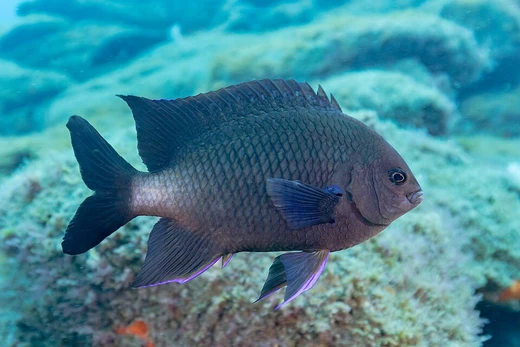
Stegastes pictus
A territorial Brazilian damselfish with yellow fins, associated with fire coral.
Last updated

Oudart · via Wikipedia: Stegastes pictus · Public domain
It grows to about 7.5 cm in length and has a deep, laterally compressed body.[1] The species is endemic to shallow rocky reefs off the coast of Brazil.[1]
Scientific classification
- KingdomAnimalia
- PhylumChordata
- ClassActinopterygii
- DivisionTeleostei
- OrderBlenniiformes
- FamilyPomacentridae
- GenusStegastes
- SpeciesStegastes pictus
Named by (Castelnau, 1855)
Close relatives
Other species of Stegastes with a Codexery entry.
- Stegastes beebei Stegastes beebei
- Stegastes fuscus Stegastes fuscus
- Stegastes leucostictus Stegastes leucostictus
- Stegastes nigricans Stegastes nigricans
- Stegastes planifrons Stegastes planifrons
- Stegastes variabilis Stegastes variabilis
- Stegastes xanthurus Stegastes xanthurus
Sources: Wikipedia taxobox: Stegastes pictus (CC BY-SA 4.0) · differs from this box at order: WoRMS AphiaID 276678 (CC BY 4.0)
Conservation status
Least Concern (LC)
- LC▲ this species
- NT
- VU
- EN
- CR
- EW
- EX
Source: IUCN Red List assessment · GBIF copy of the Red List category
How big is it?
Largest length in the source, 0.07 m, next to a 1.8 m person.
Diagram: drawn by Codexery, schematic shapes to scale (not a likeness). Length: Wikipedia: Stegastes pictus
Where the stegastes pictus has been recorded
Each dot is a place where the species has been observed and reported (2,545 records, half-degree grid) — not a modelled range. 5 inland records left out (institution coordinates).
Map: drawn by Codexery. Data: GBIF occurrence search (records CC0 / CC BY) · Natural Earth basemap (public domain)
Biology and range
The yellowtip damselfish is a demersal, territorial species that grazes algae and eats detritus on the sea floor.[2] At breeding time, individuals form pair bonds.[3] The fire coral Millepora alcicornis is a common habitat associate for this damselfish.[2] After egg deposition on the substrate, the male parent provides protection and fans the developing eggs to enhance oxygenation.[3]
Two spines and approximately 14 soft rays make up the anal fin.[1] Only soft rays are present in the paired pectoral and pelvic fins.[1] The lateral line carries either 19 or 20 scales, and there are about 20 gill rakers.[1] The snout's tip is where the mouth is positioned.[1]
What the specialist sources record
The World Register of Marine Species lists Stegastes pictus as an accepted species in the family Pomacentridae, order Ovalentaria incertae sedis, class Teleostei.[4] GBIF records the species under the order Perciformes and family Pomacentridae, with 2,601 occurrence records as of 7 October 2026.[5] The species was originally described by Castelnau in 1855.[4][5]
References
- Wikipedia, "Stegastes pictus" (CC BY-SA 4.0), which cites: Stegastes pictus (Castelnau, 1855) FishBase. Retrieved 2011-12-24. (original not read by us) en.wikipedia.org
- Wikipedia, "Stegastes pictus" (CC BY-SA 4.0), which cites: Stegastes pictus (Castelnau, 1855) FishBase. Retrieved 2011-12-24.; Stegastes pictus (Castelnau, 1855) FishBase. Retrieved 2011-12-24. (original not read by us) en.wikipedia.org
- Wikipedia, "Stegastes pictus" (CC BY-SA 4.0), which cites: Breder, C. M., "Modes of reproduction in fishes.", T.F.H. Publications, 1966, p. 941 (original not read by us) en.wikipedia.org
- World Register of Marine Species, Stegastes pictus (AphiaID 276678). CC BY 4.0. marinespecies.org
- GBIF Backbone Taxonomy and occurrence index, Stegastes pictus (taxon key 2398843). CC BY 4.0 (backbone); counts are facts. gbif.org
Each numbered sentence above was checked against the source it cites before publication. Sentences citing Wikipedia adapt text from the English Wikipedia article Stegastes pictus (contributors), used under CC BY-SA 4.0; this entry is available under the same licence. Other sources were used for facts only; no text or images are copied from them.
More in Clownfish and Damselfish
Sources
Compiled from Wikipedia and the sources listed below. Text from Wikipedia is available under CC BY-SA 4.0; this entry is adapted from it.
- Wikipedia: Stegastes pictus (CC BY-SA 4.0).
- Classification: the source article's taxobox; compare WoRMS, the World Register of Marine Species (CC BY 4.0).
- Conservation status: IUCN Red List assessment.
- Occurrence records: GBIF (CC0 / CC BY). Basemap: Natural Earth (public domain).
- Word definitions: the , each quoted from its Wikipedia article.
Spotted an error? Know more?
Reader corrections go straight into our review queue. Suggest an edit · How this site is sourced