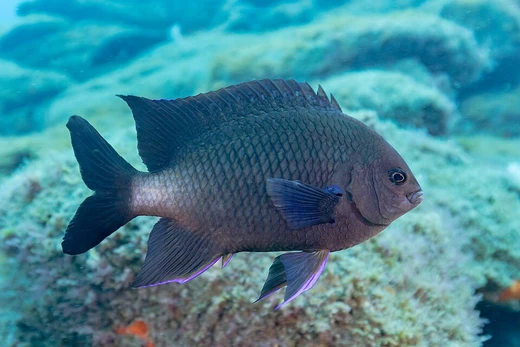
Fusilier damselfish
A color-changing damselfish found in Indo-Pacific coral reefs.
Last updated

NOAA Fisheries/Jan Willem Staman · Public domain
Scientific classification
- KingdomAnimalia
- PhylumChordata
- ClassActinopterygii
- DivisionTeleostei
- OrderBlenniiformes
- FamilyPomacentridae
- GenusLepidozygus
- SpeciesLepidozygus tapeinosoma
Named by (Bleeker, 1856)
Sources: Wikipedia taxobox: Fusilier damselfish (CC BY-SA 4.0) · differs from this box at order: WoRMS AphiaID 212793 (CC BY 4.0)
Conservation status
Least Concern (LC)
- LC▲ this species
- NT
- VU
- EN
- CR
- EW
- EX
Source: IUCN Red List assessment · GBIF copy of the Red List category
How big is it?
Largest length in the source, 0.1 m, next to a 1.8 m person.
Diagram: drawn by Codexery, schematic shapes to scale (not a likeness). Length: Wikipedia: Fusilier damselfish
Where the fusilier damselfish has been recorded
Each dot is a place where the species has been observed and reported (1,948 records, half-degree grid) — not a modelled range. 4 inland records left out (institution coordinates).
Map: drawn by Codexery. Data: GBIF occurrence search (records CC0 / CC BY) · Natural Earth basemap (public domain)
Biology and range
In the Indian Ocean it is found from eastern Africa to Australia, and in the Pacific from Cambodia to Hawaii and Peru.[3] Its coloration changes with behavior: it turns silvery green when feeding and darkens when resting.[4][5] This species' geographic distribution covers the Indo-Pacific region.[6][3] Its depth range is from 1 m down to 30 m, and it inhabits coral reef and lagoon environments.[3]
Fin ray counts for this fish are: 12 spines on the dorsal fin, 14–15 soft rays on the dorsal fin, 2 spines on the anal fin, and 15–16 soft rays on the anal fin.[2] Zooplankton constitutes the diet of the fusilier damselfish.[7] This species gathers into groups.[5]
What the specialist sources record
The World Register of Marine Species lists Lepidozygus tapeinosoma as an accepted species described by Bleeker in 1856.[8] GBIF records 2,069 occurrence observations for this taxon as of October 2026.[9] The GBIF Backbone Taxonomy places the species in the order Perciformes and family Pomacentridae.[9]
References
- Wikipedia, "Fusilier damselfish" (CC BY-SA 4.0), which cites: "Fishes of the World", Wiley, 2016, p. 752 (we also read that source) en.wikipedia.org
- Wikipedia, "Fusilier damselfish" (CC BY-SA 4.0), which cites: ; (original not read by us) en.wikipedia.org
- Wikipedia, "Fusilier damselfish" (CC BY-SA 4.0), which cites: ; ; (original not read by us) en.wikipedia.org
- Wikipedia, "Fusilier damselfish" (CC BY-SA 4.0), which cites: "Lepidozygus tapeinosoma Overview" Encyclopedia of Life Retrieved on December 25, 2014; "Lepidozygus tapeinosoma Overview" Encyclopedia of Life Retrieved on December 25, 2014; "Lepidozygus tapeinosoma Overview" Encyclopedia of Life Retrieved on December 25, 2014; "Lepidozygus tapeinosoma Overview" Encyclopedia of Life Retrieved on December 25, 2014 (original not read by us) en.wikipedia.org
- Wikipedia, "Fusilier damselfish" (CC BY-SA 4.0), which cites: "Lepidozygus tapeinosoma Overview" Encyclopedia of Life Retrieved on December 25, 2014; ; "Lepidozygus tapeinosoma Overview" Encyclopedia of Life Retrieved on December 25, 2014 (original not read by us) en.wikipedia.org
- Wikipedia, "Fusilier damselfish" (CC BY-SA 4.0) en.wikipedia.org
- Wikipedia, "Fusilier damselfish" (CC BY-SA 4.0), which cites: ; "Lepidozygus tapeinosoma Overview" Encyclopedia of Life Retrieved on December 25, 2014 (original not read by us) en.wikipedia.org
- World Register of Marine Species, Lepidozygus tapeinosoma (AphiaID 212793). CC BY 4.0. marinespecies.org
- GBIF Backbone Taxonomy and occurrence index, Lepidozygus tapeinosoma (taxon key 2398762). CC BY 4.0 (backbone); counts are facts. gbif.org
Each numbered sentence above was checked against the source it cites before publication. Sentences citing Wikipedia adapt text from the English Wikipedia article Fusilier damselfish (contributors), used under CC BY-SA 4.0; this entry is available under the same licence. Other sources were used for facts only; no text or images are copied from them.
More in Clownfish and Damselfish
Sources
Compiled from Wikipedia and the sources listed below. Text from Wikipedia is available under CC BY-SA 4.0; this entry is adapted from it.
- Wikipedia: Fusilier damselfish (CC BY-SA 4.0).
- Classification: the source article's taxobox; compare WoRMS, the World Register of Marine Species (CC BY 4.0).
- Conservation status: IUCN Red List assessment.
- Occurrence records: GBIF (CC0 / CC BY). Basemap: Natural Earth (public domain).
- Word definitions: the , each quoted from its Wikipedia article.
Spotted an error? Know more?
Reader corrections go straight into our review queue. Suggest an edit · How this site is sourced