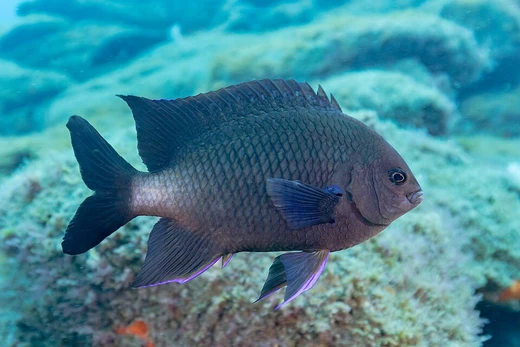
Stegastes beebei
A territorial damselfish of eastern Pacific reefs.
Last updated

Geichhorn2000 · via Wikipedia: Stegastes beebei · CC BY-SA 3.0
Its taxonomic status is accepted in both WoRMS and GBIF, with the authority Nichols, 1924.[1][2] The Galapagos ringtail damselfish, also known as the southern whitetail major, inhabits coral and rocky reef environments in waters up to 15 meters deep.[3] William Beebe (1877–1962), an American naturalist and explorer, is the person for whom this species was named.[4]
Scientific classification
- KingdomAnimalia
- PhylumChordata
- ClassActinopterygii
- DivisionTeleostei
- OrderBlenniiformes
- FamilyPomacentridae
- GenusStegastes
- SpeciesStegastes beebei
Named by (Nichols, 1924)
Close relatives
Other species of Stegastes with a Codexery entry.
- Stegastes fuscus Stegastes fuscus
- Stegastes leucostictus Stegastes leucostictus
- Stegastes nigricans Stegastes nigricans
- Stegastes pictus Stegastes pictus
- Stegastes planifrons Stegastes planifrons
- Stegastes variabilis Stegastes variabilis
- Stegastes xanthurus Stegastes xanthurus
Sources: Wikipedia taxobox: Stegastes beebei (CC BY-SA 4.0) · differs from this box at order: WoRMS AphiaID 276665 (CC BY 4.0)
Conservation status
Least Concern (LC)
- LC▲ this species
- NT
- VU
- EN
- CR
- EW
- EX
Source: IUCN Red List assessment · GBIF copy of the Red List category
How big is it?
Largest length in the source, 0.17 m, next to a 1.8 m person.
Diagram: drawn by Codexery, schematic shapes to scale (not a likeness). Length: Wikipedia: Stegastes beebei
Where the stegastes beebei has been recorded
Each dot is a place where the species has been observed and reported (2,827 records, half-degree grid) — not a modelled range. 3 inland records left out (institution coordinates).
Map: drawn by Codexery. Data: GBIF occurrence search (records CC0 / CC BY) · Natural Earth basemap (public domain)
Biology and range
GBIF holds 2,863 occurrence records for this taxon.[2] This fish has an oval, compressed body shape and possesses a single pair of nostrils.[3] Algae, small crustaceans, and anemone tentacles make up the diet of this omnivorous species.[3] Small intruders are chased away by these somewhat territorial fish.[3]
Breeding involves distinct pairing, and the species reproduces by laying eggs (oviparous).[3] Aeration and guarding of the eggs are tasks performed by the males.[3]
What the specialist sources record
The WoRMS record lists the family as Pomacentridae and the order as Ovalentaria incertae sedis.[1] The GBIF Backbone Taxonomy lists the order as Perciformes and the family as Pomacentridae.[2] The environment is marine according to WoRMS.[1]
References
- World Register of Marine Species, Stegastes beebei (AphiaID 276665). CC BY 4.0. marinespecies.org
- GBIF Backbone Taxonomy and occurrence index, Stegastes beebei (taxon key 2398845). CC BY 4.0 (backbone); counts are facts. gbif.org
- Wikipedia, "Stegastes beebei" (CC BY-SA 4.0), which cites: "Galápagos Ringtail Damselfish @eol.org" (original not read by us) en.wikipedia.org
- Wikipedia, "Stegastes beebei" (CC BY-SA 4.0), which cites: "Subseries OVALENTARIA (Incertae sedis): Family POMACENTRIDAE", The ETYFish Project Fish Name Etymology Database, 29 August 2018 (original not read by us) en.wikipedia.org
Each numbered sentence above was checked against the source it cites before publication. Sentences citing Wikipedia adapt text from the English Wikipedia article Stegastes beebei (contributors), used under CC BY-SA 4.0; this entry is available under the same licence. Other sources were used for facts only; no text or images are copied from them.
More in Clownfish and Damselfish
Sources
Compiled from Wikipedia and the sources listed below. Text from Wikipedia is available under CC BY-SA 4.0; this entry is adapted from it.
- Wikipedia: Stegastes beebei (CC BY-SA 4.0).
- Classification: the source article's taxobox; compare WoRMS, the World Register of Marine Species (CC BY 4.0).
- Conservation status: IUCN Red List assessment.
- Occurrence records: GBIF (CC0 / CC BY). Basemap: Natural Earth (public domain).
- Word definitions: the Codexery glossary, each quoted from its Wikipedia article.
Spotted an error? Know more?
Reader corrections go straight into our review queue. Suggest an edit · How this site is sourced