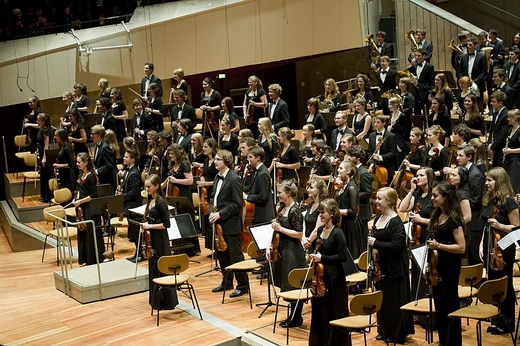
The Four Seasons (Vivaldi)
Four violin concerti evoking each season through music.

Antonio Vivaldi’s *The Four Seasons* is a set of four violin concertos, one for each season of the year. The Italian composer wrote them between about 1718 and 1723, while serving as chapel master at the court in Mantua, though some scholars, like Karl Heller, suggest they may have been started as early as 1716–1717, before Vivaldi took that post. The concertos were published in 1725 in Amsterdam (then part of the Dutch Republic) as part of a larger collection of twelve concertos titled *Il cimento dell’armonia e dell’inventione* (The Contest Between Harmony and Invention).
This is Vivaldi’s most famous work. The music was a breakthrough in how composers thought about instrumental pieces: it depicts flowing streams, different species of singing birds, a shepherd with his barking dog, buzzing flies, storms, drunken dancers, hunting scenes from both hunter and prey perspectives, frozen landscapes, and the warmth of a winter fire. Unusually for the time, Vivaldi published the concertos with sonnets—possibly written by himself—that explain what each season’s music is meant to suggest. This makes the concertos an early and very detailed example of program music, where the music tells a story. Vivaldi carefully matched the music to the poems, even translating lines directly into the notes. For instance, in the slow second movement of “Spring,” the viola section imitates a dog barking while a goatherd sleeps. Each concerto has three movements in a fast–slow–fast pattern, and each sonnet is also divided into three sections.
The four concertos are: Concerto No. 1 in E major, Op. 8, RV 269, “Spring”; Concerto No. 2 in G minor, Op. 8, RV 315, “Summer”; Concerto No. 3 in F major, Op. 8, RV 293, “Autumn”; and Concerto No. 4 in F minor, Op. 8, RV 297, “Winter.” A full performance takes about 40 to 43 minutes, with “Spring” lasting roughly 10 minutes, “Summer” and “Autumn” about 11 minutes each, and “Winter” about 9 minutes.
It is not certain whether the sonnets were written to go with the concertos or the other way around. The idea that Vivaldi wrote them is supported by the fact that each sonnet has three sections matching the three movements of its concerto. Regardless of who wrote them, the work is clearly program music—instrumental music meant to evoke something beyond itself—and Vivaldi wanted to show that this kind of music could be taken seriously. Besides the sonnets, Vivaldi added instructions in the score, such as “The barking dog” in “Spring,” “Languor caused by the heat” in “Summer,” and “the drunkards have fallen asleep” in “Autumn.” A new English translation of the sonnets by Armand D’Angour was published in 2019.
The first recording of *The Four Seasons* is disputed. A compact disc exists of a performance by violinist Alfredo Campoli, taken from acetates of a French radio broadcast thought to date from early 1939. The first proper electrical recording was made in 1942 by Bernardino Molinari, whose interpretation differs somewhat from modern ones but is still clearly the same work. Molinari’s recording was released by Cetra in Italy and later in the United States on six double-sided 78s in the 1940s, then on LP in 1950, and eventually on CD. The first American recording was made in the final week of 1947 by violinist Louis Kaufman at Carnegie Hall, just before a recording ban took effect on January 1, 1948. The performers included The Concert Hall Chamber Orchestra under Henry Swoboda, with Edith Weiss-Mann on harpsichord and Edouard Nies-Berger on organ. This recording helped bring Vivaldi’s music back into the mainstream in Europe and America, building on earlier work by Molinari and others. It won the French Grand Prix du Disque in 1950, was inducted into the Grammy Hall of Fame in 2002, and was selected for the National Recording Registry at the Library of Congress in 2003. Kaufman later learned that the four concertos were part of a set of twelve, found a full score, and recorded the other eight in Zürich in 1950, making his the first complete recording of Vivaldi’s Op. 8.
The ensemble I Musici has recorded *The Four Seasons* more often than most groups: their debut recording in 1955 with Felix Ayo, a stereo version with Ayo in 1959 (the first stereo recording of the work), and later recordings with Roberto Michelucci (1969), Pina Carmirelli (1982, highly acclaimed), Federico Agostini (1988), Mariana Sîrbu (1995), Antonio Anselmi (2012), and Marco Fiorini (2021). There is also a video recording of I Musici performing in Venice, Vivaldi’s hometown, filmed by Anton van Munster in 1988. The 1969 Argo recording by the Academy of St. Martin-in-the-Fields, conducted by Neville Marriner with soloist Alan Loveday, sold over half a million copies and became the ensemble’s first gold record.
- field
- Classical music
- nationality
- Italian
- known_for
- Four violin concerti representing the seasons, a landmark of program music
- opus_number
- Op. 8
Lore & Background
The inspiration is not the countryside around Mantua, as initially supposed. The concerti were a revolution in musical conception, representing flowing creeks, singing birds, a shepherd and his barking dog, buzzing flies, storms, drunken dancers, hunting parties, frozen landscapes, and warm winter fires. Unusually for the period, Vivaldi published the concerti with accompanying sonnets—possibly written by himself—that elucidated what the music was intended to evoke. Each concerto is divided into three movements (fast–slow–fast), and each linked sonnet into three sections. Vivaldi provided additional instructions such as 'The barking dog' and 'Languor caused by the heat.'
Reader's Guide
The Four Seasons is the best known of Vivaldi's works and a foundational example of program music—instrumental music intended to evoke extra-musical narratives. A performance of all four concerti may take about 40–43 minutes. Martin-in-the-Fields sold over half a million copies. The concerti remain a staple of the classical repertoire, noted for their vivid musical depiction of natural scenes and their integration of poetry and music.
Did You Know?
- Each concerto is accompanied by a sonnet, possibly written by Vivaldi himself, that explains the music's narrative.
Frequently Asked Questions
Why is The Four Seasons considered so important in classical music?
It is Vivaldi's best-known work and is widely cited as one of the earliest and most detailed examples of program music in the Western canon. Its vivid musical depiction of natural scenes—reinforced by accompanying descriptive sonnets—set a precedent for composers telling stories purely through instrumental sound.
What is the structure of The Four Seasons?
The work comprises four solo violin concertos—Spring, Summer, Autumn, and Winter—each following the standard three-movement concerto form. Short sonnets, traditionally attributed to Vivaldi, accompany each concerto and spell out the specific scenes, weather, and sounds the music is meant to evoke.
More in Classical Music 1-16
Spotted an error? Know more?
This is a living reference — every entry is fact-audited, and reader corrections feed straight into our audit queue. Suggest an edit · See this site's audit record