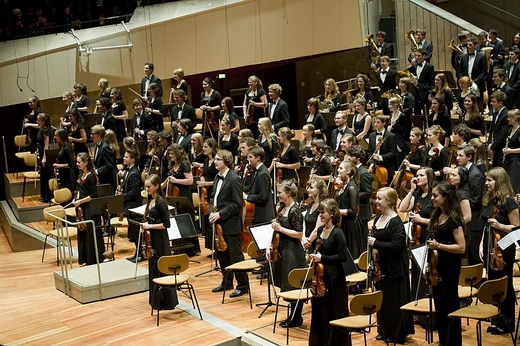
Symphony No. 41 (Mozart)

Wolfgang Amadeus Mozart finished his Symphony No. 41 in C major, K. 551, on 10 August 1788. It is his longest symphony and the last one he composed, and many critics consider it among the finest in classical music. The nickname "Jupiter Symphony" was likely invented by the impresario Johann Peter Salomon. The original handwritten score is kept in the Berlin State Library.
The symphony calls for a flute, two oboes, two bassoons, two horns in C (and in F during the Andante), two trumpets in C, timpani, and strings (first and second violins, violas, cellos, and double basses).
This work is the last of three symphonies Mozart wrote quickly during the summer of 1788: No. 39 was finished on 26 June and No. 40 on 25 July. Nikolaus Harnoncourt believed Mozart intended these three as a single, unified work, noting that No. 41, as the finale, lacks an introduction (unlike No. 39) but ends with a grand finale. Around the same time, Mozart also composed his piano trios in E major (K. 542) and C major (K. 548), his Piano Sonata No. 16 in C (K. 545, called the *Sonata facile*), and a violin sonatina (K. 547).
It is uncertain whether the symphony was ever performed while Mozart was alive. According to Otto Erich Deutsch, Mozart was planning a series of "Concerts in the Casino" around this period at a new casino in the Spiegelgasse owned by Philipp Otto, and he sent two tickets for the series to his friend Michael Puchberg. Historians do not know if the concert series actually took place or was cancelled due to lack of interest. However, the new symphony in C was performed at the Gewandhaus in Leipzig in 1789, according to that venue's concert program.
Musicologist Elaine Sisman suggested the symphony might have been a patriotic work. Its key and orchestration fit the "Austrian tradition of grand C-major symphonies, scored for trumpets and drums, employing the fanfares and rhythmic gestures of the military, the throne, and even the church." She proposed it may have been inspired by the Austro-Turkish War of 1788–1791, noting that the day after finishing the symphony, Mozart completed the patriotic song "Beim Auszug in das Feld," K. 552.
The four movements follow the traditional Classical symphonic form. The symphony typically lasts about 33 minutes.
**I. Allegro vivace** This movement uses sonata form. Its main theme starts with contrasting motifs: a threefold tutti outburst on the fundamental tone (with an ascending triplet from the dominant to the fundamental), followed by a more lyrical response. This exchange repeats twice, then leads into a series of fanfares. A transitional passage expands and develops the two motifs. The second theme group begins with a lyrical section in G major that ends on a seventh chord, followed by a stormy section in C minor. After a full stop, the expositional coda quotes Mozart's insertion aria "Un bacio di mano," K. 541, and ends with fanfares. The development modulates from G major to E♭ major, where the aria theme is repeated and developed. A false recapitulation brings back the opening theme softly in F major. The first theme group's final flourishes are developed against a chromatically falling bass, followed by a restatement of the end of the insertion aria, leading to C major for the true recapitulation. The recapitulation proceeds normally except for key transpositions and some expansion of the minor sections.
**II. Andante cantabile** This slow movement, also in sonata form, is a French-style sarabande in F major (the subdominant of C major), similar to those in J. S. Bach's keyboard suites. It is Mozart's only symphonic slow movement marked *cantabile*. The opening melody, played by muted violins, is never allowed to finish without interruption. After a development section, the recapitulation begins in the subdominant key of B♭ major, but a secondary development section disrupts it with rhythmic figures before returning to F.
**III. Menuetto: Allegretto – Trio** The third movement is a menuetto marked *allegretto*, similar to a Ländler, a popular Austrian folk dance. Midway through, a chromatic progression presents sparse imitative textures from the woodwinds (bars 43–51) before the full orchestra returns. In the trio section, the four-note figure that will become the main theme of the last movement (C–D–F–E) appears prominently (bars 9–12 of the Trio), but on the seventh degree of the A minor scale (G♯–A–C–B), giving it a very different character.
**IV. Molto allegro** The finale is in sonata form. Its main theme consists of the first four notes mentioned above. Four more themes are introduced during the movement. Mozart develops these themes individually or in combination, as seen in the interplay between the woodwinds. All five themes are combined in the fugato at the end of the movement. Sir George Grove wrote that "it is for the finale that Mozart has reserved all the resources of his science, and all the power, which no one seems to have possessed to the same degree with himself, of concealing that science, and making it the vehicle for music as pleasing as it is learned. Nowhere has he achieved more." Of the whole piece, he wrote that "It is the greatest orchestral work of the world which preceded the French..."
- composer
- Wolfgang Amadeus Mozart
- key
- C major
- nickname
- Jupiter Symphony
- movements
- 4
- typical_duration
- about 33 minutes
Quick Facts
- Subtitle
- Jupiter
- Composer
- W. A. Mozart
- Key
- C major
- Catalogue
- K. 551
- Duration
- ca. 33 minutes
- Movements
- 4
- Scoring
- Orchestra
Facts from the source article.
Lore & Background
39 on 26 June and No. 40 on 25 July. Nikolaus Harnoncourt argued that Mozart composed the three as a unified work, noting that No. 41 has no introduction but a grand finale. Around the same time, Mozart was writing piano trios, a piano sonata, and a violin sonatina. It is not known for certain whether the symphony was ever performed in Mozart's lifetime; a concert series in a casino in the Spiegelgasse may have been planned but historians have not determined if it was held.
Reader's Guide
The symphony is structured in four movements: Allegro vivace, Andante cantabile, Menuetto: Allegretto – Trio, and Molto allegro. The finale is notable for its use of five themes combined in a fugato, and the four-note motif (C–D–F–E) is a common plainchant motif traceable to the 13th century. Scholars are certain Mozart studied Michael Haydn's Symphony No. 28 in C major, which also has a fugato in its finale. The nickname 'Jupiter' was given by Johann Peter Salomon, according to Mozart's younger son, and also attributed to Johann Baptist Cramer. The symphony has been praised by critics, theorists, composers, and biographers, and is viewed as a canonized masterwork for its brilliant use of counterpoint that never obscures clarity. The autograph manuscript is preserved in the Berlin State Library.
Did You Know?
- The symphony's nickname 'Jupiter' was probably coined by impresario Johann Peter Salomon.
- The four-note motif in the finale is a common plainchant figure found in various Gregorian chants.
- It is not known for certain whether the symphony was ever performed in Mozart's lifetime.
- The autograph manuscript is preserved in the Berlin State Library.
A Summer of Prolific Creation
Mozart set down the final bar of Symphony No. It was the third of three symphonies he wrote in quick succession—No. 39 was finished on 26 June and No. 40 on 25 July. Nikolaus Harnoncourt has contended that the three form a single unified cycle, pointing to the fact that the closing symphony drops the introduction heard in No. 39 and instead builds toward a grand concluding gesture. In the same stretch of weeks Mozart was also turning out his piano trios in E major and C major, the so-called Sonata facile (K. Elaine Sisman has suggested a patriotic undercurrent to the C-major work, arguing that its trumpets, timpani, and martial fanfares sit squarely within the Austrian tradition of grand C-major symphonies. The autograph manuscript is preserved in the Berlin State Library.
Performance Uncertainty and Enduring Reputation
Whether Mozart ever heard his Jupiter Symphony performed before an audience remains a matter of conjecture. Otto Erich Deutsch observed that around this period Mozart was arranging a series of "Concerts in the Casino" at a new venue in the Spiegelgasse owned by Philipp Otto, and he even forwarded a pair of tickets to his friend Michael Puchberg. Yet no historian has been able to confirm whether the series actually took place or was quietly cancelled for want of interest. The familiar nickname "Jupiter" is probably the coinage of the impresario Johann Peter Salomon. The work's critical stature is remarkable: Sir George Grove called it "the greatest orchestral work of the world which preceded the French Revolution," singling out the finale as the place where Mozart reserved "all the resources of his science" while concealing that science behind music "as pleasing as it is learned." Many critics continue to rank it among the supreme achievements of the symphonic genre.
Architectural Design Across Four Movements
Running roughly thirty-three minutes, the symphony follows the standard four-movement Classical layout. The Allegro vivace opens with a threefold tutti outburst on the fundamental tone answered by a lyrical figure, then moves through extended fanfares, a G-major second theme group that hangs on a suspended seventh, a stormy C-minor passage, and an expositional coda that quotes the insertion aria "Un bacio di mano" (K. The development section includes a false recapitulation in F major before the true return to C. The Andante cantabile in F major is a French-type sarabande reminiscent of Bach's keyboard suites and is the only symphonic slow movement of Mozart's to carry the cantabile marking; its muted-violin melody is never permitted to close without interruption. The Menuetto, marked allegretto, recalls the Austrian Ländler, with a chromatic woodwind passage at its midpoint. The Molto allegro finale weaves five distinct themes together in a culminating fugato.
A Motif Threaded Through a Lifetime
The four-note figure C–D–F–E that anchors the finale is no casual invention. It is a common plainchant motif traceable at least to the thirteenth century, appearing in Thomas Aquinas's "Pange lingua gloriosi corporis mysterium." Mozart encountered it early and returned to it repeatedly: it surfaces briefly in his Symphony No. 33, and in the trio of the Jupiter's minuet, where it is transposed to the seventh degree of A minor (G♯–A–C–B), lending it a markedly different character. In the finale itself this seed becomes the principal theme, and Mozart introduces four additional themes before combining all five in the movement's closing fugato. The interplay among the woodwinds during the development showcases his command of themes handled individually and in combination. This layered architecture, as Grove observed, represents Mozart concealing profound contrapuntal science within music of supreme pleasure.
Frequently Asked Questions
Why is it nicknamed the Jupiter Symphony?
The name most likely came from the impresario Johann Peter Salomon, who helped champion the piece. Mozart himself never referred to the work by that title.
Why do critics rank the Jupiter so highly?
Many regard it as one of the supreme achievements of the classical symphonic tradition, citing its expansive scope and structural brilliance. It is often seen as the culmination of Mozart's symphonic voice.
How is the Jupiter Symphony structured?
It follows the standard four-movement layout of the classical period. Like most of Mozart's symphonies, it moves through a fast opening, a slower second movement, a minuet-and-trio, and a brisk finale.
More in Classical Music 1-16
Spotted an error? Know more?
This is a living reference — every entry is fact-audited, and reader corrections feed straight into our audit queue. Suggest an edit · See this site's audit record