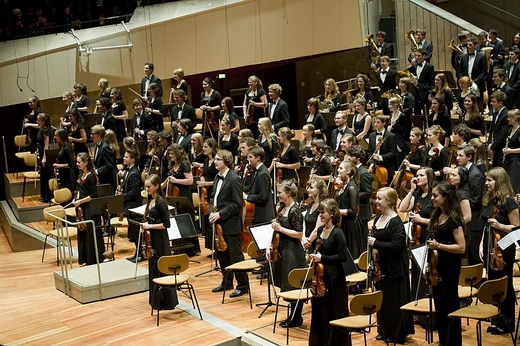
Symphony No. 9 (Beethoven)

The Symphony No. 9 in D minor, Op. 125, is a choral symphony and the last complete symphony Ludwig van Beethoven wrote. He worked on it between 1822 and 1824. Its first performance took place in Vienna on 7 May 1824. Many critics and musicologists consider it a masterpiece of Western classical music and one of the highest achievements in music history. It is among the best-known works of the common practice period and is one of the most frequently performed symphonies globally.
This symphony was the first major example of a composer including vocal parts in a symphony. Its fourth and final movement, often called the Ode to Joy, uses four vocal soloists and a chorus in the parallel key of D major. The text comes from Friedrich Schiller’s poem "An die Freude (Ode to Joy)," written in 1785 and revised in 1803, with additional words by Beethoven. In the 20th century, an instrumental version of the chorus was adopted by the Council of Europe and later the European Union as the Anthem of Europe. In 2001, UNESCO added Beethoven’s original handwritten manuscript, held by the Berlin State Library, to its Memory of the World International Register, making it the first musical score to receive that designation.
**History**
**Composition** The Philharmonic Society of London commissioned the symphony in 1817. Beethoven made early sketches later that year, setting the key as D minor and already planning vocal participation. He did most of the composition work between autumn 1822 and the completion of the autograph in February 1824. The symphony grew out of earlier Beethoven pieces that, though complete works, are forerunners to it. The Choral Fantasy, Op. 80, from 1808, is essentially an extended piano concerto movement that brings in a choir and vocal soloists for its climax. The vocal forces sing a theme first played by instruments, and this theme resembles the corresponding theme in the Ninth Symphony. An even earlier version of the Choral Fantasy theme appears in the song "Gegenliebe" for piano and high voice, dating from before 1795. According to Robert W. Gutman, Mozart’s Offertory in D minor, "Misericordias Domini," K. 222, written in 1775, contains a melody that foreshadows the "Ode to Joy."
**Premiere** Although most of Beethoven’s major works had premiered in Vienna, he planned to have his latest compositions performed in Berlin as soon as possible. He believed he had lost favor with the Viennese, whose musical taste was now dominated by Italian opera composers like Rossini. When his friends and financiers learned of this, they pleaded with him to hold the concert in Vienna, sending a petition signed by many prominent Viennese music patrons and performers. Flattered by this adoration, Beethoven premiered the Ninth Symphony on 7 May 1824 at the Theater am Kärntnertor in Vienna, alongside the overture *The Consecration of the House* and three parts of the *Missa solemnis* (Kyrie, Credo, and Agnus Dei). This was Beethoven’s first onstage appearance since 1814. The hall was packed with an eager, curious audience, including noted musicians and figures such as Franz Schubert, Carl Czerny, and Austrian chancellor Klemens von Metternich.
The premiere used an orchestra nearly twice the usual size, requiring the combined forces of the Kärntnertor house orchestra, the Vienna Music Society, and a select group of capable amateurs. No complete list of performers exists, but many of Vienna’s most elite musicians are known to have participated. The soprano and alto parts were sung by two famous young singers personally recruited by Beethoven: Henriette Sontag and Caroline Unger. German soprano Sontag was 18 when Beethoven asked her to perform. Twenty-year-old contralto Unger, a Viennese native, had gained critical praise in 1821 for appearing in Rossini’s *Tancredi*. After the 1824 premiere, Unger found fame in Italy and Paris, with Italian opera composers Bellini and Donizetti writing roles specifically for her voice. Anton Haizinger and Joseph Seipelt sang the tenor and bass/baritone parts, respectively.
Though the performance was officially conducted by Michael Umlauf, the theatre’s Kapellmeister, Beethoven shared the stage with him. Two years earlier, Umlauf had watched Beethoven’s attempt to conduct a dress rehearsal for a revision of his opera *Fidelio* end in disaster. For the Ninth’s premiere, Umlauf instructed the singers and musicians to ignore the almost completely deaf Beethoven. At the start of each part, Beethoven, who sat by the stage, gave the tempos. He turned the pages of his score and beat time for an orchestra he could not hear.
Several anecdotes surround the premiere. Based on participant testimony, the symphony was under-rehearsed (only two complete rehearsals) and somewhat uneven in execution. Nevertheless, the premiere was a great success. Beethoven was not to blame, as violinist Joseph Böhm recalled: Beethoven himself conducted, standing in front of a conductor’s stand and throwing himself back and forth like a madman. At one moment he stretched to his full height, at the next he crouched to the floor, flailing with his hands and feet as though he wanted to play all the instruments and sing all the chorus parts. The actual direction was in Louis Duport’s hands; the musicians followed his baton only. Reportedly, the scherzo was completely interrupted at one point.
- Composer
- Ludwig van Beethoven
- Key
- D minor
- Movements
- 4
- Notable feature
- First major symphony with vocal parts
Quick Facts
- Composer
- Ludwig van Beethoven
- Other Name
- The Ninth
- Key
- D minor
- Opus
- 125
- Period
- Classical-Romantic (transitional)
- Text
- Friedrich Schiller's "Ode to Joy"
- Language
- German
- Composed
- 1822–1824
- Dedication
- King Frederick William III of Prussia
- Duration
- 65 to 70 minutes
- Movements
- Four
- Scoring
- Orchestra with SATB chorus and soloists
Facts from the source article.
Lore & Background
Beethoven made preliminary sketches later that year, with the key set as D minor and vocal participation forecast. The symphony emerged from other pieces by Beethoven, such as the Choral Fantasy, Op. 80, which brings in a choir and vocal soloists for the climax. Mozart's Offertory in D minor, 'Misericordias Domini', K.
Reader's Guide
The Ninth Symphony is significant as the first example of a major composer scoring vocal parts in a symphony. Its final movement, commonly known as the Ode to Joy, features four vocal soloists and a chorus in D major, with text adapted from Friedrich Schiller's poem 'An die Freude' and additional text by Beethoven. In the 20th century, an instrumental arrangement of the chorus was adopted by the Council of Europe and later the European Union as the Anthem of Europe. In 2001, Beethoven's original manuscript was added by UNESCO to its Memory of the World International Register, becoming the first musical score so designated. The premiere involved an orchestra nearly twice as large as usual and was a great success, though there are suggestions it was under-rehearsed and somewhat uneven in execution.
Did You Know?
- The premiere featured an orchestra nearly twice as large as usual, combining the Kärntnertor house orchestra, the Vienna Music Society, and capable amateurs.
- At the premiere, Beethoven shared the stage with conductor Michael Umlauf but was almost completely deaf; the musicians were instructed to ignore him.
- The contralto Caroline Unger turned Beethoven around to accept the audience's cheers after the symphony ended, as he was still conducting several bars off.
A Revolutionary Leap in Symphonic Writing
The Ninth Symphony marked a watershed moment in orchestral composition. No major composer before him had scored sustained vocal parts within a symphonic framework. The final movement, set in the parallel key of D major, calls for four solo voices and a full chorus, a dramatic expansion that redefined what a symphony could encompass.
A Deaf Composer Takes the Stage
The concert also featured the overture Die Weihe des Hauses and three movements of the Missa solemnis. The Ninth demanded an orchestra nearly twice the usual size, drawing musicians from the Kärntnertor house orchestra, the Vienna Music Society, and a group of skilled amateurs. Officially, the theatre's Kapellmeister Michael Umlauf conducted, but Beethoven stood at the podium as well. Two years earlier, Umlauf had witnessed Beethoven's disastrous rehearsal of a Fidelio revision, so for this performance he quietly instructed the players and singers to follow his own baton and disregard the almost completely deaf composer. Beethoven, seated by the stage, set tempos at the start of each section, then turned pages and beat time for an orchestra he could no longer hear. Violinist Joseph Böhm later described the scene: Beethoven "threw himself back and forth like a madman," stretching to full height, then crouching to the floor, flailing hands and feet as though trying to play every instrument and sing every chorus part. The actual direction, Böhm noted, was in Louis Duport's hands.
Voices of the Premiere
The soprano part went to Henriette Sontag, who was just eighteen when the composer asked her to sing. The contralto was Caroline Unger, a Viennese native who had earned critical praise two years earlier in a Rossini role in Tancredi; after the Ninth, she went on to fame in Italy and Paris, with Bellini and Donizetti reportedly writing parts tailored to her voice. The tenor was Anton Haizinger and the bass/baritone was Joseph Seipelt. The performance itself, though a triumph, was not without rough edges—only two complete rehearsals had taken place, and witnesses suggested the execution was somewhat uneven. One of the most enduring anecdotes from the evening involves the applause. Testimonies differ on whether it occurred at the close of the scherzo or at the very end of the symphony, but the story is consistent: Beethoven, several bars behind the music, was still beating time when the audience erupted. Unger, the young contralto, walked over and gently turned the deaf composer around so he could face the cheering crowd. The critic for the Theater-Zeitung wrote that the public received "the musical hero with the utmost respect and sympathy."
From Vienna to the World Stage
The Ninth Symphony has secured a place among the most performed and most revered works in the Western classical canon. Critics and musicologists widely regard it as a masterpiece and one of the supreme achievements in musical history. Its influence extends far beyond the concert hall. In the twentieth century, an instrumental arrangement of the choral finale was adopted by the Council of Europe and subsequently by the European Union as the Anthem of Europe, giving the "Ode to Joy" melody a political and civic dimension that Beethoven could scarcely have imagined. The work's manuscript also carries extraordinary historical weight. Beethoven's original hand-written score, preserved in the Berlin State Library, was inscribed in 2001 on UNESCO's Memory of the World International Register, making it the first musical score ever to receive that distinction.
Frequently Asked Questions
What makes Symphony No. 9 (Beethoven) unique among symphonies?
It is widely recognized as the first major symphony to incorporate vocal and choral singing into its structure. That final movement, which sets Schiller's 'Ode to Joy' to music, was a radical break from the purely instrumental tradition that had defined the form up to that point.
Why is Symphony No. 9 (Beethoven) so important to music history?
Critics and musicologists broadly regard it as a pinnacle of Western classical composition and one of the supreme achievements ever written. It also remains one of the most frequently performed symphonies in the world today.
How does Symphony No. 9 (Beethoven) end?
The symphony closes with its fourth movement, a large-scale choral setting of Friedrich Schiller's 'Ode to Joy.' The music builds from quiet, almost meditative passages into a thunderous celebration of human unity and brotherhood.
More in Classical Music 1-16
Spotted an error? Know more?
This is a living reference — every entry is fact-audited, and reader corrections feed straight into our audit queue. Suggest an edit · See this site's audit record