
Gottfried von Strassburg
Author of the Middle High German romance *Tristan*.

CEphoto, Uwe Aranas · CC BY-SA 3.0
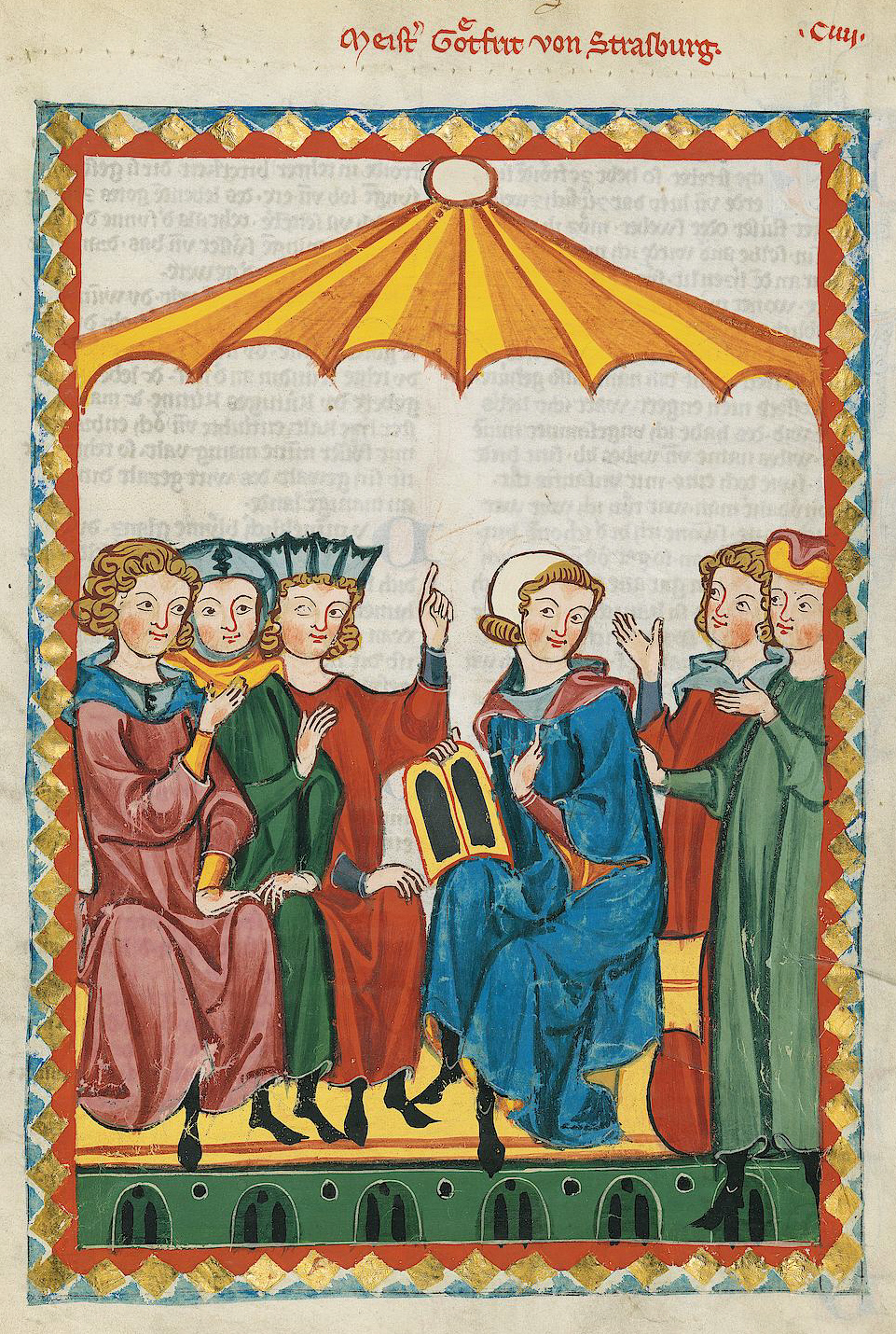
Gottfried von Strassburg, who died around 1210, wrote the Middle High German courtly romance *Tristan*, an adaptation of the 12th-century Tristan and Iseult legend. Alongside the *Nibelungenlied* and Wolfram von Eschenbach’s *Parzival*, his work is considered one of the great narrative masterpieces of the German Middle Ages. He may also have composed a few surviving lyrics. Richard Wagner’s opera *Tristan und Isolde* (1865) drew inspiration from Gottfried’s poem. Nothing is known of Gottfried’s life except that he came from or was closely associated with Strasbourg. He appears to have been a man of good birth and position who held an important municipal office there. Since he is always called *Meister* (master) rather than *Herr* (sir), he was likely not a knight—a conclusion supported by the dismissive attitude toward knightly exploits in *Tristan*. The poem ends abruptly, and two later writers, Ulrich von Türheim and Heinrich von Freiberg, who supplied endings, stated that Gottfried died before finishing it. References in the work place its composition in the first decade of the 13th century, and 1210 is conventionally accepted as the year of his death. His deep knowledge of Latin literature and rhetorical theory suggests a high-level monastic education. He also displays detailed technical understanding of music and hunting, far beyond that of his contemporaries. Gottfried draws more on the learned tradition of medieval humanism than on the chivalric ethos shared by other major writers of his time. He appears to have been influenced by contemporary Christian mystics, especially Bernard of Clairvaux. The earliest *Tristan* manuscripts, from the first half of the 13th century, show features of Alemannic and specifically Alsatian dialect, supporting his Strasbourg origin. Gottfried’s rhetorical style is very distinct. It is highly complex, marked by extensive symmetrical structure in both the overall organization of *Tristan* and individual passages. He also uses detailed word and sound patterns, playing with rhyme, alliteration, and assonance. A hallmark of his style is his skillful use of irony, for both humorous and tragic effects; he may have relied on irony to disguise criticisms of contemporary society and avoid censure. Gottfried states that his source was the *Tristan* of Thomas of Britain, an Anglo-French work from around 1160. He bases himself on Thomas because he “told the tale correctly,” distancing himself from less courtly versions by Béroul (Old French) and Eilhart von Oberge (Middle High German). Thomas’s work is also fragmentary, with little overlap with Gottfried’s poem, making direct evaluation of Gottfried’s originality difficult. However, Thomas’s version was the source for other adaptations, giving some idea of its style and content. It is clear that while Gottfried’s claim of reliance on Thomas is correct, he expanded on his source and refined the story psychologically. The 1995 discovery of the Carlisle Fragment of Thomas’s *Tristan*, which includes material from the Love Grotto episode, promises a better understanding of Gottfried’s use of his source. Thomas’s source, in turn, is a lost Old French *Tristan* story, reconstructed by Joseph Bédier, ultimately derived from Celtic legend. The text of *Tristan* is 19,548 lines long, written in rhyming couplets like all courtly romances. The first section of the prologue (lines 1–44) is written in quatrains and called the “strophic prologue”; pairs of sententious quatrains mark the main divisions of the story. The initial letters of these quatrains, indicated by large initials in some manuscripts, form an acrostic with the names Gotefrid-Tristan-Isolde that runs throughout the poem. The initial letters of the prologue’s quatrains give the name Dieterich, assumed to be Gottfried’s patron. If completed, *Tristan* would likely have been around 24,000 lines long. The story begins with the courtship of Tristan’s parents. Riwalin, King of Parmenie, travels to the court of King Marke in Cornwall, where he and Marke’s sister, Blanschefleur, fall in love. Blanschefleur becomes pregnant, and the couple steal back to Parmenie, but Riwalin is killed in battle. When she hears the news, Blanschefleur dies, but the baby is delivered and survives. He is named Tristan because of the sorrowful circumstances of his birth. Tristan grows up in Parmenie, passed off as the son of Riwalin’s marshal Rual li Fointeant, becoming the perfect courtier. While on board a merchant ship docked in Parmenie, Tristan is abducted by the Norwegian crew. At sea, a tempest strikes; the crew conclude they are being punished by God for abducting Tristan, so they set him ashore in a country that turns out to be Cornwall. Tristan encounters a hunting party, whom he astonishes with his skill, and he accompanies them to Marke’s court, where his many accomplishments make him popular, especially with Marke. Eventually, after years of searching, Rual comes to Cornwall and finds Tristan, who is now revealed as Marke’s nephew. Tristan is knighted. Cornwall is being forced to pay tribute to the King of Ireland, Gurmun, collected by his brother, the monstrous Morold.
- field
- Poetry, courtly romance
- nationality
- German (Strasbourg)
- known_for
- Author of the Middle High German romance *Tristan*
Lore & Background
Other than an origin in or close association with Strasbourg, nothing is known of his life. It would seem, however, that he was a man of good birth and position, who filled an important municipal office in his native city of Strasbourg, but since he is always referred to in German as *Meister* (master) and not *Herr* (sir), it seems safe to assume he was not a knight. *Tristan* ends abruptly, and according to the testimony of Ulrich von Türheim and Heinrich von Freiberg, two people who provided endings for *Tristan*, Gottfried died before finishing the work. His thorough familiarity with Latin literature and rhetorical theory suggest someone who had enjoyed a high level of monastic education. He also shows detailed technical knowledge of music and hunting, far beyond anything found in the works of his contemporaries. Gottfried draws more on the learned tradition of medieval humanism than on the chivalric ethos shared by his major literary contemporaries. He also appears to have been influenced by the writings of contemporary Christian mystics, in particular Bernard of Clairvaux. That his home was in Strasbourg is supported by the fact that the earliest manuscripts of *Tristan*, dating from the first half of the 13th century, show features of Alemannic and specifically Alsatian dialect.
Reader's Guide
Gottfried von Strassburg’s unfinished romance *Tristan* is considered one of the great narrative masterpieces of the German Middle Ages, alongside the *Nibelungenlied* and Wolfram von Eschenbach’s *Parzival*. The work adapts the 12th-century Tristan and Iseult legend, drawing specifically on the Anglo-French version by Thomas of Britain, whom Gottfried praised for telling the tale correctly. Although Gottfried relied on Thomas, he expanded and psychologically refined the story. The poem runs to 19,548 lines of rhyming couplets, with a prologue written in quatrains whose initial letters form an acrostic spelling the names Gotefrid, Tristan, and Isolde, as well as the name Dieterich, likely Gottfried’s patron. Gottfried’s rhetorical style is highly distinct, featuring complex symmetrical structure, intricate word and sound patterns, and irony used to both humorous and tragic effect. His work later inspired Richard Wagner’s opera *Tristan und Isolde*. Beyond *Tristan*, Gottfried likely composed a small number of surviving lyrics. His thorough knowledge of Latin literature, rhetoric, music, and hunting suggests a high level of monastic education, and he was influenced by contemporary Christian mystics such as Bernard of Clairvaux. His attitude toward knightly exploits in *Tristan* is dismissive, and he is referred to as *Meister* rather than *Herr*, indicating he was not a knight. The earliest manuscripts of *Tristan*, dating from the first half of the 13th century, show Alemannic and Alsatian dialect features, supporting his origin in Strasbourg.
Did You Know?
- Gottfried is referred to as *Meister* (master) and not *Herr* (sir), suggesting he was not a knight.
- The initial letters of quatrains in the poem form an acrostic with the names Gotefrid-Tristan-Isolde.
- The prologue's quatrains give the name Dieterich, assumed to be the name of Gottfried's patron.
- Gottfried shows detailed technical knowledge of music and hunting, far beyond his contemporaries.
Gallery

Frequently Asked Questions
What is Gottfried von Strassburg's most famous work?
His surviving masterpiece is a verse retelling of the Tristan and Iseult legend composed in Middle High German. It is traditionally placed alongside the Nibelungenlied and Wolfram von Eschenbach's Parzival as one of the three great narrative poems of that era.
Why is Gottfried von Strassburg's Tristan considered important?
It is widely regarded as a pinnacle of medieval German narrative poetry, prized for its emotional depth and formal craftsmanship. Scholars and readers alike hold it up as a defining work of the courtly-romance genre in the German-speaking world.
Did Gottfried von Strassburg write anything besides the Tristan romance?
A handful of short lyric poems are attributed to him, though their authorship is not always certain. These minor verses are the only other pieces of writing generally linked to his name in the surviving manuscript tradition.
More in Classical & Medieval Poets 1-24
Spotted an error? Know more?
This is a living reference — every entry is fact-audited, and reader corrections feed straight into our audit queue. Suggest an edit · See this site's audit record