
Fujiwara no Shunzei
Heian poet who compiled the seventh imperial waka anthology.

Daderot · CC0
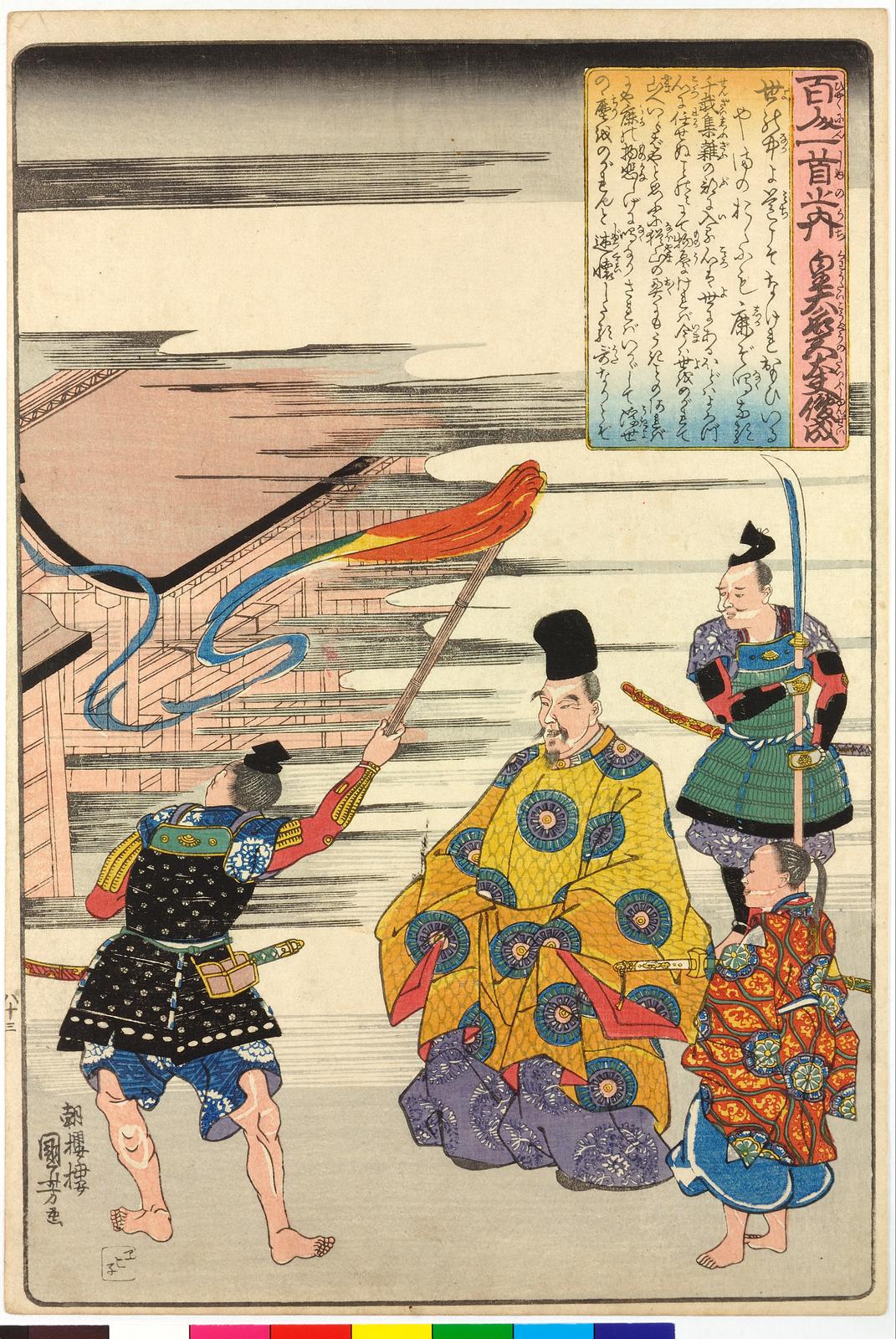
Fujiwara no Shunzei was a Japanese poet, courtier, and Buddhist monk active during the late Heian period. Born in 1114, he was a descendant of the statesman Fujiwara no Michinaga and belonged to the influential Fujiwara clan. Orphaned at age ten, he was adopted and initially took the name Akihiro, later changing it to Toshinari at age 53. He served at the imperial court, reaching the post of Kōtai Gōgū-daibu and the Senior Third Rank. Despite his relatively low court rank, the Retired Emperor Go-Shirakawa admired him and commissioned him in 1183 to compile the *Senzai Wakashū*, the seventh imperial waka anthology, a task of immense significance in court poetic circles. During the Genpei War, the warrior Taira no Tadanori risked crossing enemy lines to ask Shunzei to include his poem; Shunzei eventually did so, tactfully attributing it to "Anonymous." As a poet, Shunzei began composing young, influenced by older styles like the *Man’yōshū* and Tang Chinese poetry. He was an early supporter of *The Tale of Genji* and became known for his critical judgments at poetry contests, favoring the style of *yūgen*, which conveyed romantic emotion with nostalgia and regret. His approach was summarized as "old diction, new treatment," aiming for poems that produced an effect of charm, mystery, and depth beyond their words. He took Buddhist vows in 1176, adopting the dharma name Shakua, and wrote his major critical work, *Fūteishō*, a decade after the anthology commission. He died on December 22, 1204, at age ninety. His son, Fujiwara no Teika, succeeded him as a prominent poet, and his granddaughter, whom he raised, also became a successful poet.
- died
- 22 December 1204
- field
- Poetry, court service, Buddhist monasticism
- nationality
- Japanese
- known_for
- Compiling the Senzai Wakashū; innovations in waka; poetic style of yugen
Lore & Background
Fujiwara no Shunzei was a Japanese poet, courtier, and Buddhist monk of the late Heian period, noted for his innovations in the waka poetic form and for compiling the seventh imperial anthology, the *Senzai Wakashū*. He was born in 1114, a descendant of the statesman Fujiwara no Michinaga. His father died when he was ten, and he was adopted by Hamuro Akiyori, taking the name Akihiro; in 1167, at age 53, he returned to his birth house and took the name Toshinari (Shunzei being the Sino-Japanese reading of the same characters). He held the post of Kōtai Gōgū-daibu and the Senior Third Rank, though his court rank was considered pitiably low. In 1183, Retired Emperor Go-Shirakawa commissioned him to compile the *Senzai Wakashū*, a landmark event in court poetic circles. During the Genpei War, the *Tale of the Heike* recounts that Taira no Tadanori, from the opposing side, risked entering enemy territory to ask Shunzei to include his poem; Shunzei eventually did so, but tactfully attributed it to "Anonymous." Shunzei began composing poetry young, hewing to older styles like the *Man'yōshū* while also drawing on Tang Chinese poetry. He favored the poetic style of *yūgen*, which conveyed romantic emotion with undertones of nostalgia and regret, and his approach was summarized as "old diction, new treatment." He wrote that a good poem should produce an effect of charm, mystery, and depth, possessing an atmosphere distinct from its words. His discipline was intense: the poet Shinkei described him reciting verse late into the night, weeping softly. He took Buddhist vows in 1176 at age 62, adopting the dharma name Shakuagaku or Shakua. His major critical work, *Fūteishō*, was written a decade after the anthology commission. He died on December 22, 1204, at age 90. His son, Fujiwara no Teika, and his granddaughter, Fujiwara Toshinari no Musume, both became prominent poets.
Reader's Guide
Shunzei's significance lies in his role as compiler of the Senzai Wakashū, a landmark imperial anthology, and his innovations in waka poetry. He favored the yugen style, emphasizing romantic emotion with undertones of nostalgia and regret, and advocated 'old diction, new treatment'. His critical philosophy is preserved in Fūteishō, written a decade after the anthology commission. He was an early supporter of the Tale of Genji and influenced later poets, including his son Fujiwara no Teika and his granddaughter, Shunzei's Daughter. His disciplined, emotional approach to composition, described by poet Shinkei, underscores his legacy as a key figure in Japanese poetic tradition.
Did You Know?
- He wrote the Man'yōshū Jidaikō, a chronological study and poetic commentary of the Man'yōshū.
- His son Fujiwara no Teika is considered one of the four best poets in Japanese history.
- The Tale of the Heike recounts that Taira no Tadanori risked capture to ask Shunzei to include his poem in the Senzai Wakashū.
The Poet of a Poetic Clan
A member of a minor and distant branch of the great Fujiwara aristocratic clan, he belonged to a family that, unable to compete directly in the political arena with the senior branches, had instead carved out prestige through artistic specialization—above all, the composition and criticism of waka poetry. Within this tradition, Shunzei achieved a standing that transcended mere family obligation: he was widely regarded as one of the most respected poets of his generation and served as a judge in formal poetry competitions, a role that placed him at the center of the courtly aesthetic establishment. His reputation was not simply inherited but earned through sustained excellence in the ancient five-line, thirty-one-syllable form, and it was this hard-won standing that would later provide the foundation upon which his son Teika built an even more towering literary career.
Compiler of the Senzai Wakashū
Among Shunzei's most concrete and enduring achievements was his role as the compiler of the Senzai Wakashū, the seventh in the sequence of Imperial anthologies of waka poetry. This commission placed him among the select circle of court poets entrusted with shaping the official record of the nation's poetic tradition. The waka form he helped curate was an ancient structure—five lines totaling thirty-one syllables—whose conventions had been refined over centuries of courtly practice. By selecting and arranging poems for this imperial collection, Shunzei exercised a form of critical authority that extended well beyond his own compositions. His work as a judge in poetry competitions further reinforced this curatorial role, giving him a voice in determining which poets and which aesthetic sensibilities would be elevated within the establishment. The Senzai Wakashū thus stands as a testament to his dual identity: not merely a creator of individual verses, but an architect of the broader poetic canon that would guide Japanese literary taste for generations to come.
The Poetic Dynasty
Shunzei's family was, in many ways, a dynasty of letters. Shunzei's niece, known in literary circles as Kengozen or simply "Shunzei's Daughter," also achieved considerable respect as a composer of waka and renga, and Teika was known to consult her for poetic counsel. The family's poetic circle extended further still: the priest Jakuren, also called Sadanaga, was adopted by Shunzei around the time that Shunzei's younger brother retired from worldly pursuits, and Jakuren went on to be recognized as a successful poet before his career was cut tragically short. This web of talent—father, son, niece, and adopted son—illustrates how poetry functioned as both a family vocation and a mechanism for a junior clan branch to secure cultural prestige in the court.
A Long Life and a Lasting Shadow
Shunzei lived to the remarkable age of ninety, dying in 1204, a span that carried him through the late Heian period and into the early Kamakura era. His longevity meant that his influence in court affairs and literary circles persisted for decades, providing a stabilizing presence for his son Teika, whose own career was marked by repeated illness and sharply fluctuating fortunes. Even after Shunzei's death, the prestige he had accumulated as a poet, anthology compiler, and competition judge continued to cast a long shadow over the family's standing. The poetic ideas and traditions he helped shape, transmitted through Teika and then through Teika's own descendants, would go on to dominate classical Japanese poetry for centuries. In this sense, Shunzei's legacy was not confined to his own compositions or his single imperial anthology; it was a generational inheritance, a standard of excellence that his line carried forward well into the medieval and even the modern literary consciousness of Japan.
Gallery
Frequently Asked Questions
What is Fujiwara no Shunzei most famous for?
He is best known for compiling the Senzai Wakashū, the seventh imperial anthology of waka poetry in Japanese literary history. His editorial choices in that collection helped steer the direction of the waka tradition for the generations that followed.
What poetic style is associated with Fujiwara no Shunzei?
Shunzei is closely linked to the aesthetic of yūgen, an emphasis on profound depth, mystery, and evocative suggestion rather than plain statement. His verses tend to hint at emotion and imagery, leaving much to the reader's imagination.
Did Fujiwara no Shunzei take monastic vows?
Yes, he eventually entered Buddhist monastic life, adding a spiritual dimension to a career that already included court service and literary achievement. His path thus spanned secular duty, poetic innovation, and religious practice.
More in Classical & Medieval Poets 1-24
Spotted an error? Know more?
This is a living reference — every entry is fact-audited, and reader corrections feed straight into our audit queue. Suggest an edit · See this site's audit record