Hipponax
Ancient Greek iambic poet known for vulgar wit and choliambic meter.
Last updated

Frederic Moore · Public domain
Hipponax was an Ancient Greek iambic poet active in the second half of the sixth century BCE, originally from Ephesus and later based in Clazomenae. According to ancient sources, he was expelled from Ephesus by the tyrants Athenagoras and Comas before settling in Clazomenae. He was known for his malicious wit and for composing verses that depicted the vulgar, unheroic side of Ionian life. His poetry frequently attacked contemporary sculptors, particularly Bupalus and Athenis.
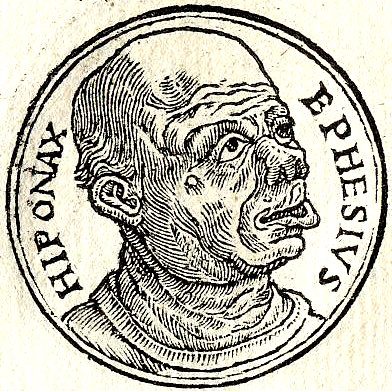
One account claims that Hipponax sought to marry Bupalus’s daughter but was rejected due to his physical ugliness, and that Bupalus then made insulting likenesses of him. In retaliation, Hipponax wrote such savage verses that Bupalus hanged himself—a story that closely parallels the legend of the earlier iambic poet Archilochus, raising doubts about its accuracy. Another version of the dispute involves a woman named Arete, who appears in fragments as both the mother of Bupalus and a sexual partner of Hipponax. The poet was reputed to be small, thin, and surprisingly strong, though his physical deformity may have been a literary invention inspired by the nature of his work.
He composed in the iambic tradition, but is credited with inventing the choliambic meter, or “halting iambic,” which substitutes a spondee or trochee for the final iambus, suiting his burlesque themes. His surviving fragments also include trochaic tetrameter and dactylic hexameter, the latter used for mock-heroic parody of Homer. He frequently employed Lydian loanwords, as in an address to Zeus using the Lydian word for “king.” His poetry dwells on eating, defecating, and fornicating, often combined in graphic scenes, such as a fragment describing a sexual encounter in a malodorous privy involving a Lydian-speaking woman and obscene rites. Despite the interest of Alexandrian scholars, who collected his work in two or three books, only fragments remain.
Quick Facts
- Floruit
- late 6th century BCE
- Field
- Poetry
- Nationality
- Ancient Greek (Ionian)
- Known for
- Iambic poetry
- invention of the choliambic meter
- attacks on Bupalus and Athenis
Facts from the source article.
Background
Ancient authorities record only the barest details about his life, sometimes contradicting each other, and his extant poetry is too fragmentary to support autobiographical interpretation. According to the Suda, he was expelled from Ephesus by the tyrants Athenagoras and Comas, then settled in Clazomenae, and wrote verses satirizing Bupalus and Athenis because they made insulting likenesses of him. A scholiast on Horace records two differing accounts of the dispute: one that Hipponax sought to marry Bupalus's daughter but was rejected due to his ugliness, and another that Bupalus portrayed him as ugly; in both, Hipponax retaliated so savagely that Bupalus hanged himself—a story closely resembling that of Archilochus, inviting scepticism.
Did You Know?
- According to a scholiast, Hipponax's verse attacks drove the sculptor Bupalus to hang himself, a story similar to that of Archilochus.
- A fragment describes a sexual encounter in a malodorous privy, possibly inspiring an episode in Petronius's Satyricon.
More in Classical & Medieval Poets
Sources
Compiled from Wikipedia and the sources listed below. Text from Wikipedia is available under CC BY-SA 4.0; this entry is adapted from it.
- Wikipedia: Hipponax (CC BY-SA 4.0).
Spotted an error? Know more?
Reader corrections go straight into our review queue. Suggest an edit · How this site is sourced