Rajaraja I
Chola emperor who expanded the empire and built the Thanjavur temple.

via Wikipedia: Rajaraja I · see source
Rājarāja I (3 November 947 – January/February 1014), also known as Rajaraja the Great, was a Chola emperor who reigned from 985 to 1014. He was known for his conquests of southern India and the Anuradhapura kingdom of Sri Lanka, as well as increasing Chola influence across the Indian Ocean. His birth name is Arulmozhi Varman. Rajaraja commissioned the construction of the Rajarajeshwaram Temple in the Chola capital of Thanjavur, revered as one of the most prominent examples of medieval South Indian architectural style. During his reign, important Tamil literary works by poets such as Appar, Sambandar, and Sundarar were gathered and compiled into a single collection known as the Thirumurai, earning him the title 'Thirumurai Kanda Cholar'. He initiated a project of land survey and assessment in 1000 which led to the reorganisation of Tamil country into individual units known as valanadus.
Quick Facts
- Regnal name
- Rāja Rāja Cola (or) Rāja Rāja I
- Predecessor
- Uttama
- Successor
- Rajendra I
- Birth name
- Arul Mozhi Varman
- Born
- 3 November 947
- Birthplace
- Thanjavur, Chola Empire (modern-day Tamil Nadu, India)
- Died
- 1014, 1, 3 November 947
- Place of death
- Thanjavur, Chola Empire
Facts from the source article.
Did You Know?
- Rajaraja's birth name was Arun Mozhi Varman, meaning 'The Word of Sun Clan', as recorded in the Thiruvalangadu copper-plate inscription.
- Rajaraja assumed the title Pandya Kulashani, meaning 'Thunderbolt to the Race of the Pandyas', after his victory over the Pandyas.
- He took the title Mummudi Chola, meaning 'Three Crowned', symbolising his power over the Cholas, Pandyas, and Cheras.
- In 993, Rajaraja conquered Anuradhapura in Sri Lanka, designating it as Ila-mandalam in Chola records.
Early life
Rajaraja I was born Arun Mozhi Varman around 947, under the Sadhayam star, to the Chola king Parantaka II and his wife Vanavan. The Tamil Nadu government marks his birth as 3 November 947. He had an older brother, Aditha II, and an older sister, Kundavai. His rise to power ended a messy period of succession after his great-grandfather Parantaka I. That king’s elder son Gandaraditya took the throne, but when he died his son Madhurantakan was too young, so the crown went to Gandaraditya’s younger brother Arinjaya.
Arinjaya soon died, and his son Parantaka II followed. It was arranged that Madhurantakan would eventually rule, a plan possibly made by Rajaraja himself. Aditha II died suspiciously, likely assassinated. After Sundara Chola’s death, Madhurantakan became king as Uttama Chola. When he died, Arul Moli Varman took the throne in mid-985, adopting the title Rajaraja, meaning “King among Kings.”
Military conquests
Rajaraja I began his rule over a modest territory near Thanjavur and Tiruchirappalli, which he built into a structured empire with a strong military and fleet. Around 988, his early inscriptions celebrate a victory at Kandalur Salai in Kerala, where he is called the destroyer of that place. The Thiruvalangadu inscription notes his general captured Vizhinjam, likely with naval support. By the 990s, his inscriptions appear in Kanyakumari, and by the early 1000s in Thiruvananthapuram. A 1005 Senur inscription records the fall of Madurai and the conquest of Kollam, Kolla-desham, and Kodungallur. He fought the Western Gangas and Western Chalukyas, pushing Chola power to the Tungabhadra River. In the east, he struggled with the Telugu Chola king Jata Choda Bhima for control of Vengi. Eventually, Vengi became a close Chola ally, and Chola influence spread along the eastern coast up to Kalinga.
Arts and architecture
Rajaraja first heard parts of the Tevaram at his court and set out to recover the lost hymns, enlisting Nambiyandar Nambi. With what was seen as divine help, Nambi discovered the texts—cadijam leaves half-eaten by white ants—in a chamber inside the second precinct of the Thillai Nataraja Temple in Chidambaram. The temple's brahmanas, the Dikshitars, opposed the effort, but Rajaraja overruled them by consecrating images of the saint-poets through Chidambaram's streets.
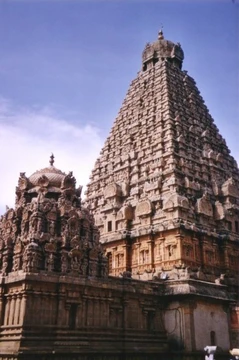
This earned him the title 'Tirumurai Kanda Cholan', meaning 'One who saved the Tirumurai'. Nambi arranged the hymns of Sambandar, Appar, and Sundarar into the first seven books, later called the Tevaram, and added other works to form the full Saiva canon. In 1010, Rajaraja built the Peruvudaiyar Temple in Thanjavur, also known as Periya Kovil, RajaRajeswara Temple, or Rajarajeswaram, dedicated to Shiva. This temple, one of India's largest and a prime example of Chola Dravidian architecture, is part of the UNESCO World Heritage Site 'Great Living Chola Temples' along with Gangaikonda Cholapuram and Airavatesvara. No contemporary portraits or statues of Rajaraja survive; a bronze figure at the Thanjavur temple is a modern fake.
In popular culture
The 2022 film Ponniyin Selvan: I, based on Kalki Krishnamurthy's 1955 novel, portrays the succession troubles during Sundara Chola's reign, with Ravi Mohan playing the younger prince Arulmozhi Varman (future Rajaraja I). Its sequel Ponniyin Selvan: II was released in 2023. The 1973 Tamil film Rajaraja Cholan starred Sivaji Ganesan. Kalki's novel Ponniyin Selvan revolves around Rajaraja's early life and the mysteries surrounding Aditha Karikalan's death. Other works include Nandipurathu Nayagi by Vembu Vikiraman, Rajaraja Cholan by Kathal Ramanathan, Kandalur Vasantha Kumaran Kathai by Sujatha, Rajakesari and Cherar Kottai by Gokul Seshadri, and Udayaar by Balakumaran. The 1988 historical drama Bharat Ek Khoj depicted Rajaraja in episodes 22 and 23.
More in Chola Dynasty
Spotted an error? Know more?
Reader corrections go straight into our review queue. Suggest an edit · How this site is sourced