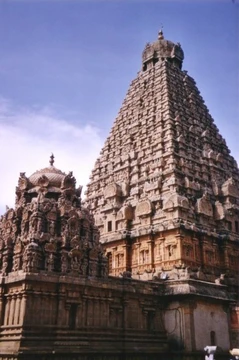
Early Cholas
Early Cholas: a Tamil kingdom of the pre- and post-Sangam period.
The Early Cholas were a Tamil kingdom of the Chola dynasty, active before and after the Sangam period (600 BCE–300 CE). They were one of the three main kingdoms of Tamilakam, with early capitals at Urayur or Tiruchirapalli and Kaveripattinam. Alongside the Pandyas and Cheras, their history extends into a period with scarce written records. The names of the three dynasties appear in the Pillars of Ashoka (inscribed 273–232 BCE) as kingdoms on friendly terms with Ashoka. The Hathigumpha inscription of Kalinga king Kharavela (c. 150 BCE) mentions a confederacy of Tamil kingdoms that had existed for over 100 years.
Quick Facts
- Period
- 600 BCE–300 CE
- Early capitals
- Urayur or Tiruchirapalli and Kaveripattinam
- Kingdom type
- One of three main kingdoms of Tamilakam
- Dynasty
- Chola dynasty
Facts from the source article.
Did You Know?
- Karikala Chola (c. 90 BCE) broke a confederacy of the other two Tamil kings after the Chera king was wounded on the back and committed suicide.
- The Srirangam Ranganathaswamy temple was first built by Chola ruler Dharmavarma, destroyed by Kaveri flood, and rebuilt by King Killivalavan after seeing a Golden Vimana directed by a parrot.
- Kocengannan, a Chola king mentioned in Sangam literature, is one of the 63 nayanars in Tamil Shaiva tradition.
Early Cholas
Medieval Chola inscriptions contain much history about the Early Chola kings, who were regarded as descendants of the sun. Stories tell of King Kantaman, a contemporary of the sage Agastya, whose devotion brought the Kaveri river into existence, and of King Manu, who sentenced his own son to death for accidentally killing a calf. King Sibi, who gave his own flesh to a hawk to rescue a dove, is also part of early Chola lore. These incidents were heavily emphasized in later Chola mythical genealogies in copper-plate charters of the 10th and 11th centuries.
The earliest such list, the Anbil Plates, gives fifteen names before Vijayalaya Cholan, including Karikala, Perunarkilli, and Kocengannan. The Thiruvalangadu Plate expands this to forty-four names, and the Kanyakumari Plate to fifty-two, with no two lists fully agreeing. Chola kings Dharmavarcholan and Killivalavan developed the Srirangam shrine into the large temple seen today, with ancestors such as Killi, Thiru Mangai, Kulasekaran, Rajamahendra, and Thiru Vikrama named in the Sri Ranganathar temple in Tiruchchirappalli.
The temple was first built by Chola ruler Dharmavarma, destroyed by Kaveri flood, and rebuilt by King Killivalavan after seeing the Golden Vimana directed by a parrot. Stone inscriptions from late 100 BCE to 100 CE refer to this temple, making it one of the oldest surviving active temple complexes in South India. Mandapas built near the main Sanctum Sanctorum date from 100 CE to 300 CE, built by Uraiyur Cholas.
Cholas in Sangam literature
The earliest Chola kings with tangible evidence appear in Sangam literature, written between 600 BCE and 300 CE, though an internal chronology of these works has not been established. Karikala Chola, from around 90 BCE, is pre-eminent among those mentioned in Pattinappaalai. His father was Ilamcetcenni, a brave king. The name Karikala, meaning elephant feller or charred leg, likely refers to a fire accident in his youth.
Pattinappaalai describes this accident and his rise to the throne, along with battles against the other two Tamil kings, in one of which the Chera king was wounded on the back and committed suicide, breaking a confederacy against Karikala. Later legends, absent in Sangam works, attribute to him the conquest of India up to the Himalayas and construction of the Grand Anicut. The poet Kovur Kilar mentions a civil war between Chola chieftains Nalankilli and Nedunkilli, with Nedunkilli besieged in Avur.
Another poem begs both princes to end the war, as the loser would still be a Chola. Kalavali by Poygayar describes the Chola King Kocengannan battling the Chera king Kanaikkal Irumporai; the Chera was captured, but Poygayar's poem praising Kocengannan led to the Chera's release. Kocengannan is one of the 63 nayanars. The Periplus of the Erythraean Sea, written in the time of Domitian (81–96 CE), provides information on the Chola country, its towns, ports, and commerce.
Ptolemy, writing half a century later, also describes the Chola country, its port, and inland cities. The Mahavamsa recounts conflicts between Ceylon inhabitants and Tamil immigrants from Chola Country.
Social conditions
Sangam literature provides a complete picture of social and economic conditions in the early Chola period. The land was fertile, with ample food; poems state that in the Chola country watered by the Kaveri, a space the size of a lying elephant could produce enough grain to feed seven. Hereditary monarchy was the prevailing government, though disputed succession and civil war occurred. The sphere of state activity was limited, and respect for custom constrained even perverse dictators. Chola monarchs were approachable by subjects, who often received justice directly from the king. The Tamil area had an independent existence outside the control of northern empires. Tamil kings and chiefs were always in conflict with each other mostly over property. Royal courts were mostly places of social gathering rather than dispensation of authority; they were centres for distribution of resources.
More in Chola Dynasty
Spotted an error? Know more?
Reader corrections go straight into our review queue. Suggest an edit · How this site is sourced