
Duke Wen of Jin
Exiled prince who became hegemon of the Chinese states.

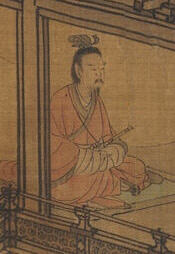
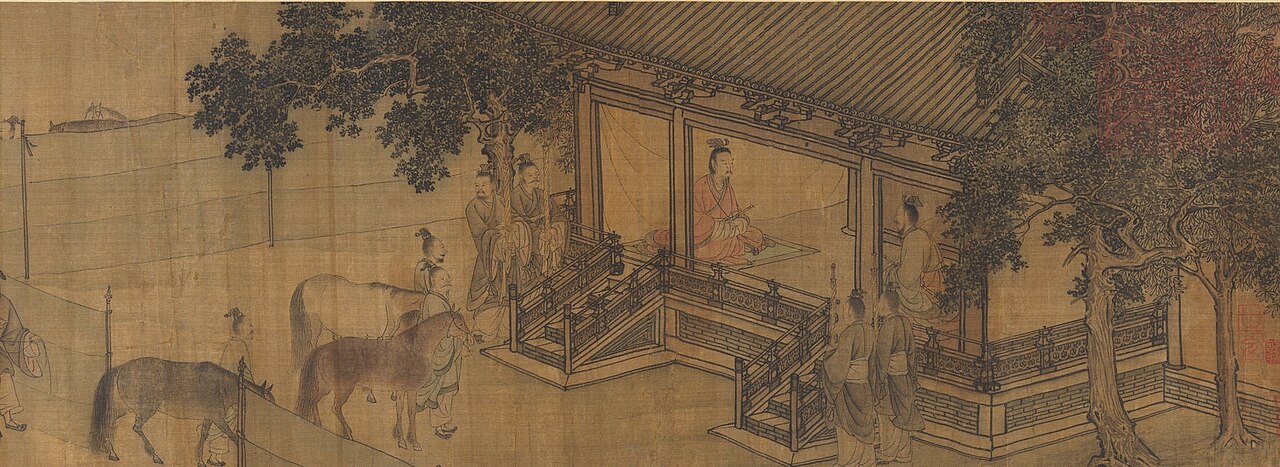
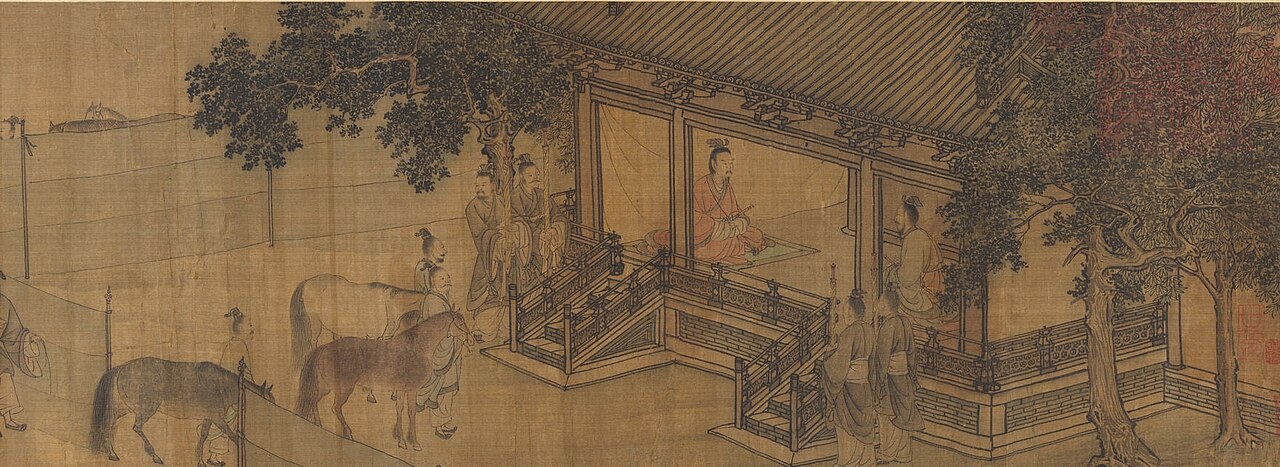
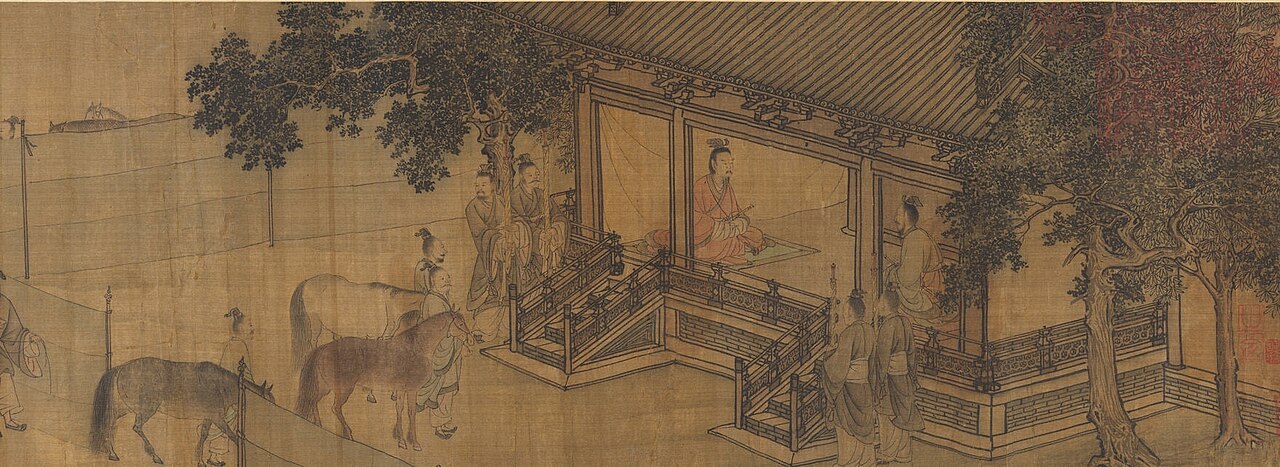
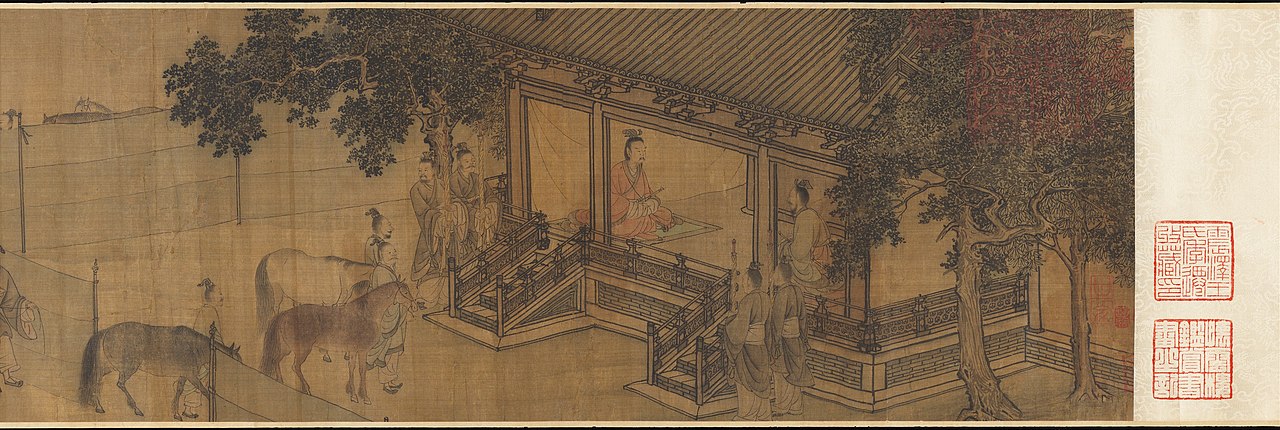
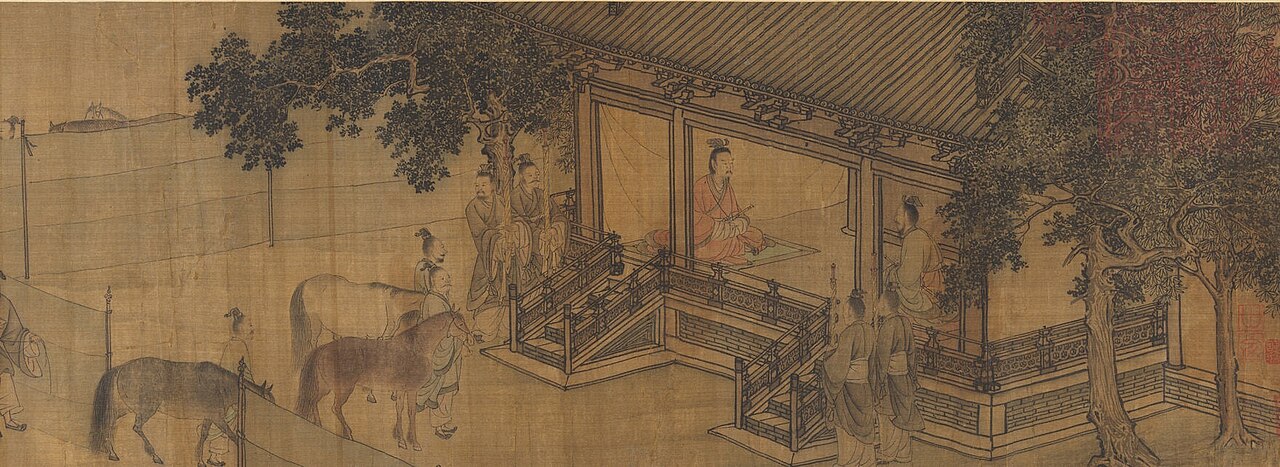
Li Tang · Public domain
Duke Wen of Jin (697–628 BC), born Ji Chong'er, ruled the state of Jin from 636 BC until his death. After roughly two decades in exile, he took the throne and quickly made Jin the dominant power among the Chinese states of his era. He appears in many Chinese legends, especially those involving his loyal follower Jie Zhitui, whose death is said to have given rise to the Cold Food Festival and the Qingming Festival.
His posthumous title, "Duke Wen of Jin," means "Cultured Duke of Jin." His given name was Chong'er, and his clan name was Ji.
Chong'er was born in 697 BC to Duke Xian of Jin. According to the *Zuo Zhuan*, his ribs were fused together, a mark of strength and leadership. His half-brothers included Shensheng and Xiqi. Shensheng was the original heir, but in his later years Duke Xian favored the concubine Li Ji, who wanted her son Xiqi to succeed. She plotted against Shensheng, leading to his suicide in 656 BC.
This sparked the Li Ji Unrest, a civil war in which Duke Xian attacked his own sons, forcing them to flee Jin. Chong'er escaped north with a group of capable men, including Zhao Cui, Hu Yan, Wei Chou, Jia Tuo, Xian Zhen, and Jie Zhitui. In 651 BC, after Duke Xian died and a succession crisis erupted, Chong'er was asked to return and take the throne, but he declined. Instead, his half-brother Yiwu became Duke Hui of Jin. In 644 BC, after Duke Hui tried to have him assassinated, Chong'er moved to the State of Qi. He stayed there until another succession crisis in Qi in 639 BC, then fled through the states of Cao, Song, Zheng, Chu, and finally Qin. Over these 19 years of wandering, Chong'er gained prestige and loyal followers; a noblewoman from a foreign court once remarked that every one of his companions was fit to be a state's prime minister. In 636 BC, after Duke Hui died, Duke Mu of Qin escorted Chong'er back to Jin with an army, and he was installed as duke.
As duke, Chong'er—now Duke Wen—reformed Jin's military and civil institutions to repair the damage from the earlier slaughter of the ducal family. He created a three-army system with an upper, middle, and lower army, each led by a General and a Lieutenant-General. The talented men he had gathered during his exile were given senior military and government posts. With this army and his prestige, he absorbed many neighboring states and made others vassals, including Cao, which he attacked for mistreating him during his exile. He also supported the Eastern Zhou court and King Xiang of Zhou. When King Xiang was deposed by his brother in 635 BC, Duke Wen led a coalition that restored him. He also resisted the northward expansion of Chu. In 633 BC, Chu invaded Jin's ally Song, and Duke Wen led a coalition of Jin, Qin, Qi, and Song to a decisive victory at the Battle of Chengpu in 632 BC. This checked Chu's expansion for decades and cemented Duke Wen's position. The next year, he convened a large coalition of rulers at Jiantu and was confirmed as hegemon, becoming one of the Five Hegemons. He died in 628 BC, and his son Duke Xiang succeeded him, inheriting the hegemony that Jin would hold for nearly a century.
One legend tells that while Chong'er was a guest in Chu, its king asked how he would repay the hospitality. Chong'er replied that if Jin and Chu ever met in battle, he would order his troops to retreat three *she* (about 30 km). After becoming duke, he faced Chu at Chengpu and kept his promise, ordering a retreat. He used this maneuver to lure the Chu commander Ziyu into an ambush and won the battle.
Another legend involves Jie Zhitui. Accounts from at least the 4th century BC say Jie followed Chong'er through all his years of exile but, believing Heaven was responsible for Qin's help in installing Chong'er, refused to seek reward and insulted those who did. He and his mother became hermits in the forests of Mount Mian and were never seen again. Distracted by riots from Duke Yu's partisans, Chong'er forgot about Jie until a poem about a dragon and snakes appeared on his palace gate. Unable to find Jie, he set aside the fields of Mianshang for sacrifices in his honor. This later became a temple, and by the early Han, Jie was regarded as a Taoist immortal with power over the weather. Later versions of the story added further embellishments.
Quick Facts
- Succession
- Duke of Jin
- Reign
- 636–628 BC
- Predecessor
- Duke Huai
- Successor
- Duke Xiang
- Full Name
- Ancestral name: Jī (姬) / Given name: Chóng'ěr (重耳)
- Birth Date
- 697 BC
- Death Date
- 628 BC (aged 68–69)
- Father
- Duke Xian
- Mother
- Hu Ji Ji (胡季姬)
- Spouse
- Ji Kui (季隗) / Qi Jiang (齊姜) / Huai Ying
- Issue
- Ji Botiao (姬伯鯈) / Ji Shuliu (姬叔劉) / Duke Xiang / Ji Yong (姬雍) / Ji Le (姬樂) / Duke Cheng
- Posthumous Name
- Duke Wen (文公)
Facts from the source article.
Lore & Background
The Zuo Zhuan notes that 'his ribs were all grown together,' a sign of strength and leadership. After a succession crisis involving his half-brothers, Chong'er fled Jin with a retinue of capable men, including Zhao Cui, Hu Yan, and Jie Zhitui. He wandered for 19 years through states such as Qi, Cao, Song, Zheng, Chu, and Qin, gaining prestige and followers. As duke, Duke Wen reformed Jin's military and civil institutions, forming a three-army system. He absorbed many surrounding states and made others vassals, including Cao, which he attacked and temporarily subjugated for rude treatment during his exile. The next year, he convened a coalition of rulers at Jiantu and was confirmed as hegemon, becoming one of the Five Hegemons. Legends about Duke Wen include his promise to the king of Chu to retreat three she (about 30 km) if they met in battle, which he fulfilled at Chengpu, using the retreat to lure the Chu commander into an ambush. Another legend involves his retainer Jie Zhitui, who supposedly cut flesh from his own thigh to feed the starving Chong'er during exile. After Chong'er became duke, Jie was overlooked for reward and retired to the forest; a forest fire set to drive him out led to his death, inspiring the Cold Food Festival.
Reader's Guide
Duke Wen of Jin is significant as a ruler who transformed Jin from a state torn by civil war into the dominant power of the Spring and Autumn period. His 19-year exile allowed him to gather talented followers and build alliances, which he used to implement military reforms and expand Jin's territory. Duke Wen's support of the Eastern Zhou court enhanced his legitimacy and influence. His legacy also includes cultural traditions: the legend of Jie Zhitui gave rise to the Cold Food Festival, which later evolved into the Qingming Festival (Tomb-Sweeping Day), still observed in China. The story of his retreat three she exemplifies the value placed on keeping promises in Chinese culture. Duke Wen is remembered as one of the Five Hegemons, a group of rulers who dominated the Chinese states during the Spring and Autumn period.
Did You Know?
- Duke Wen's personal name was Ji Chong'er, and his posthumous name 'Wen' means 'Cultured'.
- The Zuo Zhuan records that his ribs were all grown together, considered a sign of strength and leadership.
- He ordered his troops to retreat three she (about 30 km) to fulfill a promise made to the king of Chu, then used the retreat to win the Battle of Chengpu.
- The legend of his retainer Jie Zhitui's death in a forest fire inspired the Cold Food Festival, which later developed into the Qingming Festival.
Aristocratic Roots and a Temple-Born Heir
Yang Jian entered the world on 21 July 541, born to Lady Lü inside a Buddhist temple in Pingyi, a settlement in what is now Weinan, Shaanxi. His childhood name was Naluoyan, and his Xianbei-style name was Puliuru Jian, a surname his father Yang Zhong had received as part of Yuwen Tai's broader Xianbeification policies. The family belonged to the Yang clan of Hongnong, a line of Han origin that had intermarried with Xianbei nobility across several generations and traced its ancestry back to the Han-dynasty general Yang Zhen. A nun named Zhixian, struck by the infant's appearance, took him in during those earliest years. Yang Jian later attended the imperial college reserved for the sons of aristocrats and senior officials. By the age of fourteen he was already serving in the military under Yuwen Tai, and in 555 his father's achievements earned him the title Duke of Chengji County. Two years later, at sixteen, he married the thirteen-year-old Dugu Qieluo, daughter of the powerful Dugu Xin, and was appointed vice minister of internal affairs before receiving the greater title of Duke of Daxing Commandery.
Surviving the Suspicious Throne
Yang Jian's service under the Northern Zhou was shadowed by a constant threat of execution. Both Yuwen Xian, Emperor Wu's brother, and the general Wang Gui argued that Yang's unusual appearance betrayed treasonous intent and urged his death; Emperor Wu declined, but the episode pushed Yang into deliberately masking his talents. He nonetheless threw himself into the campaigns of 575 and 576–577 that shattered Northern Qi. After Emperor Wu died in 578, his successor Emperor Xuan appointed Yang minister of defense while suspecting him so intensely that he once declared, "I will surely slaughter your clan!" On another occasion he summoned Yang to the palace with orders to kill him if any trace of fear showed on his face; Yang arrived composed and lived. In summer 581, as Emperor Xuan prepared a campaign against Chen and then fell gravely ill, two associates, Liu Fang and Zheng Yi, both friends of Yang's, rushed him to the palace. They overrode the rival candidate Yuwen Zhao and issued an edict naming Yang regent. He at once abolished the wasteful and cruel policies of his predecessor, and his frugality and diligence quickly won the people's trust.
Reunification and the Grand Canal
Yang Jian is credited with reunifying China proper in 589, an act that ended nearly three centuries of political fragmentation. That long period of division had begun in 304, when the Cheng-Han and Han-Zhao regimes broke away from the Western Jin. By defeating the general Yuchi Jiong, who had resisted his authority, Yang seized the throne and established the Sui dynasty, becoming the first ethnic Han ruler to command the entirety of North China since the Xianbei had conquered the region from the Liu Song dynasty, not counting the brief reconquest by Emperor Wu of Liang. His reign also saw the initiation of the Grand Canal, a vast infrastructure project designed to facilitate the integration of northern and southern China and to move goods, troops, and administrative control across the newly unified territory. The canal would go on to shape Chinese geography and commerce for centuries, but its conception under Yang Jian marked a decisive step toward knitting the two halves of the empire back into a single political and economic whole after the long era of divided rule.
Prosperity, Military Security, and Cultural Identity
Historians generally regard Emperor Wen's reign as a golden age of prosperity not matched since the Han dynasty. Economically, the state flourished to the point that contemporaries reported grain stores sufficient for fifty years. Militarily, the Sui faced formidable threats at the outset: the Göktürks pressed from the north, Tibetan tribes bordered the west, Goguryeo loomed in the northeast, and Champa (Linyi) threatened from the south. By the end of his reign, however, the Göktürks had fractured into an eastern and a western khaganate, the eastern one being nominally submissive to Sui, as was Goguryeo. Champa was defeated and, though not conquered, ceased to be a serious threat. Beyond governance, Yang Jian was a committed Buddhist who actively encouraged the state to patronize and spread the faith. He also consistently emphasized Han Chinese cultural identity throughout his rule, a deliberate stance given that his own family had intermarried with the Xianbei for generations and that the preceding dynasties had been Xianbei-led. This cultural assertion helped define the Sui as a Han-restored dynasty rather than a continuation of the steppe-ruled regimes that had preceded it.
Gallery
More in Chinese Emperors And Leaders 1-22
Spotted an error? Know more?
This is a living reference — every entry is fact-audited, and reader corrections feed straight into our audit queue. Suggest an edit · See this site's audit record