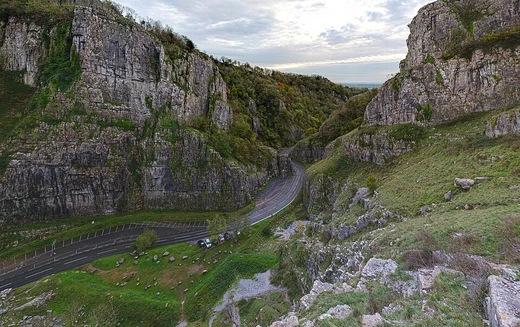
Frasassi Caves
Italian karst cave system with notable chambers and scientific experiments.

The Frasassi Caves, known in Italian as Grotte di Frasassi, are a karst cave system located in the municipality of Genga, within the province of Ancona in the Marche region of Italy. They rank among the country's most renowned show caves.
A farmer first uncovered an entrance to one of the caves on June 28, 1948. During the 1950s and 1960s, members of the Italian Mountaineering Club from the towns of Jesi and Fabriano found additional entrances. In the 1970s, a team of speleologists from Ancona, led by Giancarlo Cappanera, discovered more caves on September 25, 1971. This site lies about 7 kilometers (4 miles) south of Genga, near the hamlet of San Vittore and the Genga-San Vittore railway station on the Rome–Ancona line. The system is rich in water and notably abundant in stalactites and stalagmites.
Near the cave entrance stand two sanctuary chapels: the Santuario di Santa Maria infra Saxa (Sanctuary of Holy Mary under the Rock), built in 1029, and the Tempietto del Valadier, a Neoclassical temple constructed in 1828.
The cave system contains several named chambers. The Grotta delle Nottole, or "Cave of the Bats," is named for its large bat colony. The Grotta Grande del Vento, or "Great Cave of the Wind," discovered in 1971, features roughly 13 kilometers (8.1 miles) of passageways. The Abisso Ancona, or "Ancona Abyss," is a vast space measuring about 180 by 120 meters wide and nearly 200 meters tall. The Sala delle Candeline, or "Room of the Candles," gets its name from its many candle-like stalagmites. The Sala dell'Infinito, or "Room of the Infinite," is a tall chamber with massive speleothem columns supporting its roof.
The caves have been used for chronobiology experiments. Among those who spent long periods inside was Italian sociologist Maurizio Montalbini. In 1986, he entered the Grotte di Frasassi beneath Italy's Apennine Mountains. He survived on pills, powders, and astronaut-like food while researchers monitored his health. His few comforts were chocolate, honey, and plenty of tobacco—he smoked nearly two packs of cigarettes daily. During his time underground, away from sunlight, Montalbini lost almost 30 pounds. He would stay awake for fifty hours at a stretch, then sleep for five. He spent his time reading and writing a novel titled *Where the Sun Sleeps*. He reported enjoying his underground experience, aside from occasional earthquakes. "One cannot fight solitude, one must make a friend of it," he remarked after emerging 210 days later, though he believed only 79 days had passed. He died in 2009.
Penn State researchers, led by microbiologist Professor Jennifer Macalady, studied microbial biofilms in some of the planet's most hostile environments to understand the limits of life and how life began on Earth. Macalady, along with doctoral student Dani Buchheister, explored the Frasassi cave system, sampling biofilms from underground lakes, including Lago Verde. These biofilms, described as "alien cave goo" due to their stringy dark nature, were studied to uncover how microbes survive in extreme conditions without sunlight or oxygen, similar to early Earth. Key findings included that microbes can survive with minimal resources like rocks and water, and that these biofilms may reflect the first metabolic processes on Earth. Their research was featured in the December 2023 issue of *National Geographic*.
The Frasassi caves are partnered with several sister caves worldwide: Grand Roc in Les Eyzies, Aquitaine, France; the Wieliczka Salt Mine in Wieliczka, Lesser Poland, Poland; and Kartchner Caverns State Park in Benson, Arizona, United States.
- discovery_date
- June 28, 1948 (first entrance, discovered by members of the Gruppo Speleologico Marchigiano)
Lore & Background
The Frasassi Caves are a karst cave system located in the municipality of Genga, in the province of Ancona, Marche, Italy. They are considered among the most famous show caves in the country. The system is rich in water and particularly well endowed with stalactites and stalagmites. The first entrance was discovered by a farmer in 1948, with further entrances found in the following decades by members of the Italian Mountaineering Club and a group of speleologists led by Giancarlo Cappanera. The caves contain several named chambers, including the Grotta delle Nottole, or "Cave of the Bats," named for its large bat colony; the Grotta Grande del Vento, or "Great Cave of the Wind," discovered in 1971; the Abisso Ancona, or "Ancona Abyss," a vast space roughly 180 by 120 meters wide and nearly 200 meters tall; the Sala delle Candeline, or "Room of the Candles," named for its candle-like stalagmites; and the Sala dell'Infinito, or "Room of the Infinite," a tall chamber with massive speleothem columns. Near the entrance are two sanctuary chapels: the Santuario di Santa Maria infra Saxa, dating from 1029, and the Tempietto del Valadier, a Neoclassical temple built in 1828. The cave system has also been used for scientific experiments in chronobiology and for studying microbial biofilms in extreme, sunless environments.
Reader's Guide
The Frasassi Caves are a karst cave system located in the municipality of Genga, Italy, in the province of Ancona, Marche. They are among the most famous show caves in Italy. The system is rich in water and particularly well endowed with stalactites and stalagmites. An entrance was first discovered by a farmer in 1948, with further entrances found in the following decades by members of the Italian Mountaineering Club and a group of speleologists led by Giancarlo Cappanera in 1971. The caves contain several named chambers, including the Grotta delle Nottole, named for a large bat colony; the Grotta Grande del Vento, discovered in 1971 with extensive passageways; the vast Abisso Ancona, roughly 180 by 120 meters wide and nearly 200 meters tall; the Sala delle Candeline, noted for its candle-like stalagmites; and the Sala dell'Infinito, a tall chamber with massive speleothem columns. Near the entrance stand two sanctuary chapels: the 1029 Santuario di Santa Maria infra Saxa and an 1828 Neoclassical temple known as the Tempietto del Valadier. The caves have been used for chronobiology experiments. In 1986, sociologist Maurizio Montalbini spent 210 days underground, surviving on pills and powders, losing nearly 30 pounds, and experiencing a distorted perception of time, believing only 79 days had passed. Penn State researchers, led by microbiologist Jennifer Macalady, studied microbial biofilms from underground lakes, including Lago Verde, to understand how microbes survive without sunlight or oxygen, findings that may reflect early Earth metabolic processes. The caves are partnered with sister caves in France, Poland, and the United States.
Did You Know?
- Researchers led by Professor Jennifer Macalady studied microbial biofilms in the caves, sampling 'alien cave goo' from underground lakes including Lago Verde.
More in Caves & Gorges 1-23
Spotted an error? Know more?
This is a living reference — every entry is fact-audited, and reader corrections feed straight into our audit queue. Suggest an edit · See this site's audit record