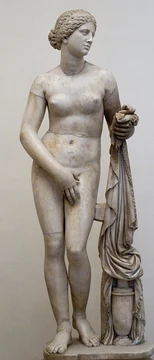
Venus (mythology)
Roman goddess of love, beauty, desire, and ancestral mother of Rome.
Venus oversaw love, beauty, desire, sex, fertility, prosperity, and victory. Romans considered her their ancestor through her son Aeneas, and Julius Caesar traced his lineage to her. She later became the most iconic Greco-Roman deity of love and sexuality in Western tradition.
Quick Facts
- Member of
- Dii Consentes
- Deity of
- Goddess of love
- beauty
- desire
- sex
- fertility
- prosperity
- prostitution
- and victory
- Consort
- Mars and Vulcan
- Parents
- Caelus
- Day
- Friday (dies Veneris)
- Planet
- Venus
- Children
- Cupid (in later tradition); Aeneas (fathered by Anchises in Virgil's Aeneid)
- Greek equivalent
- Aphrodite
Facts from the source article.
Did You Know?
- The Latin theonym Venus and the common noun venus stem from a Proto-Italic form reconstructed as wenos- ('desire'), itself from Proto-Indo-European wénh₁-os ('desire').
- In the sanctuary of Mefitis at Rossano di Vaglio, the name Venus is mentioned with an accompanying epithet referring to the deity Mefitis.
Epithets
Like many major Roman gods, Venus collected a variety of epithets that highlighted different aspects of her worship, roles, or similarities to other deities. The Romans were fond of folk-etymology and believed in the idea of nomen-omen, where a name could reveal a god's true nature, which helped expand her original powers. Venus Acidalia appears in Virgil's Aeneid as mater acidalia. The commentator Servius called this a rare and strangely obscure epithet. He guessed it might refer to a supposed Fountain of Acidalia where the Graces, Venus's daughters, bathed. He also linked it to the Greek word for dart, needle, or arrow, suggesting love's arrows and bitter cares. Ovid used acidalia only in that latter sense. This epithet was likely a literary invention by Virgil, built from earlier uses where acidalia had no clear connection to Venus, and it almost certainly never had a real cult following. Venus Anadyomene, meaning "rising from the sea," comes from a once-famous painting by the Greek artist Apelles. It showed Aphrodite's birth from sea-foam as a full-grown adult, supported by an oversized scallop shell. The Renaissance painter Sandro Botticelli used this image in his work The Birth of Venus. Other versions of her birth show her standing on land or a shoreline, wringing seawater from her hair. Venus Barbata, or Bearded Venus, is mentioned in Servius's commentary on the Aeneid. Macrobius's Saturnalia describes a statue of Venus in Cyprus that had a beard and male genitals but wore female clothes and had a female figure. Her worshippers cross-dressed, with men in women's clothes and women in men's. Macrobius noted that Aristophanes called this figure Aphroditos. The Latin poet Laevius wrote about worshipping a nurturing Venus whether female or male. Several Greek and Roman sculptures show her in the anasyrmene pose, from the Greek verb anasyromai meaning to pull up one's clothes to reveal male genitals, a gesture traditionally thought to hold apotropaic or magical power.
Cult history and temples
The first temple built for Venus was promised to Venus Obsequens by Q. Fabius Gurges while he was fighting the Samnites. It opened in 295 BC near the Aventine Hill, and the money to build it supposedly came from fines paid by Roman women for sexual offenses. The temple’s rituals and nature were likely shaped by the cults of Greek Aphrodite, which had already spread across southern Italy. The dedication date tied Venus Obsequens to the Vinalia rustica festival. In 217 BC, early in the Second Punic War, Rome lost badly at Lake Trasimene. The Sibylline oracle said Carthage could be beaten if the Venus of Eryx, the goddess of Carthage’s Sicilian allies, switched sides. Rome besieged Eryx, promised the goddess a grand temple for her loyalty, seized her statue, and brought it to Rome. They placed it on the Capitoline Hill among the twelve dii consentes. Stripped of her obvious Carthaginian traits, this foreign Venus became Venus Genetrix. Roman myth already held that Venus was the mother and protector of Aeneas, the Trojan prince who founded the Roman people, so the Romans saw this as a homecoming. Rome’s later victory over Carthage proved Venus’s favor. The Capitoline cult was mostly for high-ranking Romans. In 181 BC, a separate cult to Venus Erycina as a fertility goddess was set up in a plebeian area just outside Rome’s sacred boundary, near the Colline Gate. This temple likely kept much of the original goddess’s character and rites. Similarly, a shrine to Venus Verticordia, founded in 114 BC but linked to an older Venus-Fortuna cult, was located in the Aventine and Circus Maximus district, a strongly plebeian setting for Venus worship, in contrast to her aristocratic role as a Stoic and Epicurean all-goddess.
The Cupids
Cupid and Amor are taken to be different names for the same Roman love-god, the son of Venus, fathered by Mercury, Vulcan or Mars. Childlike or boyish winged figures who accompany Venus, whether singly, in pairs or more, have been variously identified as Amores, Cupids, Erotes or forms of Greek Eros. The most ancient of these is Eros, whom Hesiod categorises as a primordial deity emerging from Chaos as a generative power with neither mother nor father. Eros was the patron deity of Thespiae, where he was embodied as an aniconic stone as late as the 2nd century AD. From at least the 5th century BC he also had the form of an adolescent or pre-adolescent male at Elis and elsewhere in Greece, acquiring wings, bow and arrows, and divine parents in the love-goddess Aphrodite and the war-god Ares. At Elis and in Athens, Eros shared cult with a twin named Anteros. Xenophon's Socratic Symposion features a dinner-guest with eros for his wife; in return, she has anteros for him. Some sources suggest Anteros as avenger of slighted love. In Servius's 4th century commentary on Virgil's Aeneas, Cupid is a deceptive agent of Venus, impersonating Aeneas's son and making Dido forget her husband. When Aeneas rejects her love and covertly leaves Carthage, Dido is said to invoke Anteros as contrary to Cupid. Ovid's Fasti, Book 4, invokes Venus as Mother of the Twin Loves, the gemini amores. Amor is the Latin name preferred by Roman poets and literati for the personification of kindly love. Where Cupid can be imperious, cruel, prone to mischief or even war-like, Amor softly persuades. Cato the Elder, having a Stoic's outlook, sees Cupid as a deity of greed and blind passion, morally inferior to Amor. The Roman playwright Plautus, however, has Venus, Cupid and Amor working together.
Iconography
Domestic murals, mosaics, and household shrines often featured images of Venus. In Petronius’s Satyricon, the freedman Trimalchio places a statue of Venus among the Lares in his lararium. Two Venus types are found almost exclusively in Pompeii: Venus Pompeiana and Venus Pescatrice. Venus Pompeiana appears mostly in formal reception rooms, shown in full regalia with a mantle, standing stiffly upright, her right arm crossed over her chest. Venus Pescatrice is more playful, found in less formal, non-public areas; she typically sits in a landscape holding a fishing rod, with at least one cupid nearby. Venus’s symbols largely match those of Aphrodite. Roses were offered during her rites at Porta Collina, but above all she was associated with myrtle, cultivated for its white, fragrant flowers, evergreen leaves, and medicinal-magical uses. Worshipers and statues of Venus wore myrtle crowns at her festivals. Before myrtle became part of Venus’s cults, it was used in purification rites for Cloacina, the Etruscan-Roman goddess of Rome’s main sewer. This link later made Cloacina into Venus Cloacina. Roman folk-etymology also turned the obscure goddess Murcia into “Venus of the Myrtles,” whom we now call Murcia.
More in Aphrodite
Spotted an error? Know more?
Reader corrections go straight into our review queue. Suggest an edit · How this site is sourced