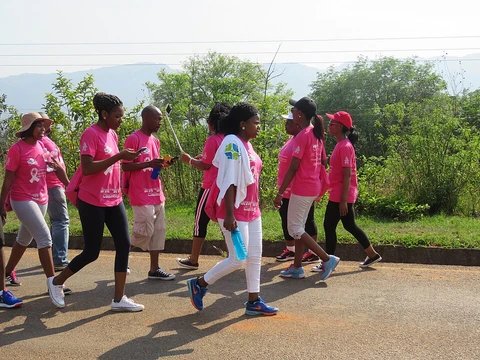
Feeling Nuts Movement
Social media campaign promoting regular testicular self-checks.

Ethel Snowden · Public domain
The Feeling Nuts campaign, run by the London-based organization Check One Two, urges young men to examine their testicles regularly for testicular cancer. It gained widespread attention after people and celebrities posted crotch-grabbing photos and videos with the hashtag #feelingnuts, and later became a televised event on Channel 4. The effort combines social media with television.
The movement was started by brothers Simon and Andrew Salter. They were moved by Wendy Gough, a mother whose son died from testicular cancer in 1998 because he was too embarrassed to talk about it. Since his death, Gough had given awareness talks in schools, which deeply affected the Salters. They concluded that raising money was unnecessary to prevent deaths from testicular cancer, so they created a form of currency based on social awareness instead. In an interview, the brothers explained that young men resist lectures from charities, so they took a different route. They founded Check One Two and launched its first campaign, Feeling Nuts. Andrew Salter stated that their goal is to empower people to spread awareness of this preventable cancer and change behavior so men check themselves regularly. He believes this social movement, built around the #feelingnuts campaign, will get the nation discussing a taboo subject and ultimately save lives.
The hashtag #FeelingNuts was first posted on April 10, 2014, to promote Testicular Cancer Awareness Month and encourage regular self-checks. On June 12, 2014, Check One Two’s YouTube channel uploaded a video challenging viewers to share crotch-grabbing pictures with the hashtag to raise awareness. The campaign reached a turning point when the brothers dropped their trousers in a public stunt and took a selfie grabbing their own crotches. That tweet went viral, amassing thousands of retweets and favorites. Using the hashtag, they began a monthly call for men to check themselves, then challenged boyband 5 Seconds of Summer and Richard Branson’s son Sam Branson, who accepted. Soon other celebrities joined in, including Hugh Jackman, William Shatner, Ricky Gervais, Jamie Oliver, and Cara Delevingne. By October 2014, the campaign had gone viral.
- Founders
- Simon and Andrew Salter
- Organization
- Check One Two
- Launch date
- 10 April 2014
- Field
- Testicular cancer awareness
- Known for
- Hashtag #FeelingNuts and viral crotch-grab selfies
- Global reach
- At least 750 million people within 3 months (Brandwatch estimate)
Lore & Background
The Feeling Nuts movement was created by brothers Simon and Andrew Salter after being inspired by Wendy Gough, a mother who lost her son to testicular cancer in 1998 because he was too embarrassed to discuss it. Gough had conducted awareness talks in schools, which left a lasting impression on the Salter brothers. They realized that raising money wasn't necessary to stop men dying of testicular cancer and therefore created a new currency through social awareness. In an interview with The Times, the brothers stated that 'young guys don’t want to listen to charities lecturing them so we took a different approach,' creating the social movement organization Check One Two and devising its first campaign 'Feeling Nuts'
Reader's Guide
The Feeling Nuts movement is significant as a pioneering example of using viral social media and entertainment to address a taboo health topic. By replacing traditional charity fundraising with social awareness as a 'new currency,' the campaign demonstrated that behavior change could be driven through humor, celebrity participation, and shareable content rather than lectures. Its reach—estimated at 750 million people within three months—shows the power of a well-timed hashtag and celebrity endorsement in public health messaging. The movement's legacy lies in its model: a low-cost, high-impact campaign that normalized a simple preventive action (testicular self-examination) by making it culturally acceptable to discuss and joke about. The subsequent Channel 4 comedy special further proved that television could amplify a social media movement, blending entertainment with a serious message. While the article does not provide long-term health outcome data, the campaign's immediate success in generating global conversation and media coverage established a template for future health awareness campaigns targeting young men.
Did You Know?
- The tipping point came in August 2014 when the brothers dropped their trousers in Oxford Street in London and took a selfie grabbing their crotches, receiving 4,864 retweets and 13,507 favorites on Twitter.
- The Feeling Nuts Comedy Night on Channel 4 reunited Martin Clunes and Neil Morrissey for a new Men Behaving Badly sketch for the first time in over 15 years.
- Social media monitoring company Brandwatch estimated that within 3 months, the campaign had reached at least 750 million people globally.
Origins & the Gough Inspiration
The Feeling Nuts campaign traces its roots to a deeply personal loss. In 1998, Wendy Gough lost her son to testicular cancer, a tragedy she attributed to his embarrassment about discussing the condition. In the years that followed, Gough travelled to schools delivering awareness talks, and her story left a lasting mark on Simon and Andrew Salter, the London-based brothers behind Salter Brothers Entertainment. The pair concluded that traditional fundraising was not what would actually prevent young men from dying of this cancer. Instead, they wanted to forge what they described as a new currency built on social awareness rather than donations. That philosophy led them to establish Check One Two, a social movement organisation, and to design a campaign that deliberately avoided the tone of a charity lecture. As Andrew later told The Huffington Post, the goal was to empower ordinary people to spread the word and shift everyday behaviour toward regular self-checks. The hashtag #FeelingNuts officially launched on 10 April 2014 to mark Testicular Cancer Awareness Month, and a follow-up YouTube video uploaded on 12 June that year challenged viewers to post crotch-grab photos under the tag.
The Oxford Street Moment & Celebrity Chain Reaction
The campaign's explosive growth can be pinned to a single afternoon in August 2014. Simon and Andrew Salter dropped their trousers on Oxford Street in central London and snapped a selfie of themselves grabbing their crotches. The image, posted with the #feelingnuts tag, racked up 4,864 retweets and 13,507 favourites on Twitter almost immediately. That stunt became the springboard for a structured monthly call to action urging men to perform regular self-examinations. The brothers then turned the concept into a celebrity challenge, directing it at boyband 5 Seconds of Summer and Sam Branson, the son of Richard Branson. Sam Branson accepted, and the dominoes began to fall. Within weeks, names like Hugh Jackman, William Shatner, Ricky Gervais, chef Jamie Oliver, and supermodel Cara Delevingne had all joined the chain, each tagging the next. By October 2014 the hashtag had fully broken out of its niche. Social media monitoring firm Brandwatch estimated that within just three months of launch the campaign had reached at least 750 million people worldwide, accompanied by thousands of separate media stories across print, broadcast, and digital outlets.
The Feeling Nuts Comedy Night on Channel 4
On 17 September 2014, the Salter brothers announced a partnership with Channel 4 to produce a 90-minute live comedy special titled The Feeling Nuts Comedy Night. The show premiered on 24 October 2014 and was hosted by comedian Jack Whitehall. Its lineup blended stand-up, sketch comedy, and music in service of the awareness message. Cara Delevingne, Jimmy Carr, and the pop group One Direction all appeared in comedy sketches, while James Corden and the duo Rizzle Kicks delivered musical performances. Perhaps the most talked-about moment came when Martin Clunes and Neil Morrissey reunited on stage for a brand-new Men Behaving Badly sketch, their first collaboration in that format in more than fifteen years. The event proved to be a ratings triumph for the broadcaster, comfortably beating and more than doubling the channel's average for that time slot. The Comedy Night demonstrated that the Feeling Nuts movement could translate seamlessly from a Twitter hashtag into a prime-time television event, reaching audiences who might never have encountered the campaign through social media alone.
A New Currency: Strategy & Lasting Impact
From the outset, the Salter brothers positioned Feeling Nuts as something fundamentally different from a conventional charity appeal. In a conversation with The Times, they explained that young men simply did not want to be lectured by established charities, so they chose an entertainment-first, peer-to-peer model instead. Andrew later articulated the broader mission in an interview with The Huffington Post: the aim was to empower everyday people to spread the word about a preventable cancer and to nudge behaviour toward regular self-checking. The brothers believed that wrapping the taboo subject in humour and celebrity spectacle would get the nation talking in a way that traditional health campaigns could not. The dual-platform strategy, combining a viral social media hashtag with a dedicated television broadcast, ensured the message reached both digital-native audiences and mainstream viewers. Check One Two was structured not as a one-off stunt but as an ongoing social movement organisation, with the monthly self-check reminder serving as a recurring behavioural anchor. The campaign's reach of an estimated 750 million people within three months underscored the power of that approach.
Gallery
More in Cancer awareness 1-24
Spotted an error? Know more?
Reader corrections go straight into our review queue. Suggest an edit · How this site is sourced