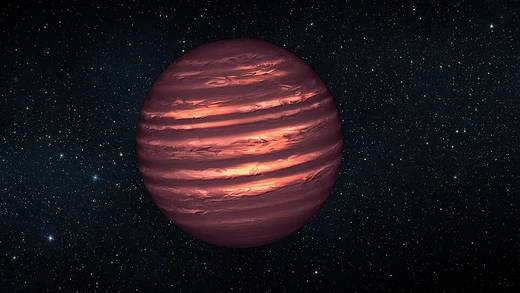
SDSS 1557
A white dwarf–brown dwarf binary with a circumbinary debris disk.
Last updated
SDSS 1557 (also cataloged as SDSS J155720.77+091624.6 and WD 1554+094) is a binary system made up of a white dwarf and a brown dwarf, with a circumbinary debris disk surrounding both objects. The disk formed when a minor planet was tidally torn apart by the white dwarf in the past.
The brown dwarf companion
The brown dwarf companion was first suspected in 2011 due to an excess of light in the Y and J bands. Follow-up observations using the Gemini Observatory and the Very Large Telescope confirmed the brown dwarf, designated SDSS 1557B, along with the circumbinary disk. By measuring radial velocity shifts in the magnesium absorption line at 4482 angstroms, researchers determined that a brown dwarf with a mass of 66 Jupiter masses orbits the white dwarf at a distance of about 0.7 solar radii, completing an orbit every 2.27 hours. The brown dwarf shows a hydrogen-alpha emission line, likely from irradiation.
Additional observations with the Hubble Space Telescope’s WFC3 instrument, using time-resolved spectrophotometry, revealed that SDSS 1557B resembles ultra-short period planets and is probably tidally locked. Because white dwarfs emit more ultraviolet radiation than main-sequence stars, the brown dwarf receives higher UV exposure than a typical hot Jupiter. Tidal locking creates extreme temperature differences between its dayside and nightside; the brown dwarf is inefficient at redistributing heat from the day side to the night side. The nightside is likely dominated by clouds, while the dayside is probably dominated by opaque H⁻ and may have a temperature inversion.
The circumbinary disk
The system was first flagged as a white dwarf with a circumstellar disk in 2011 due to an excess in the K band. High abundances of metals such as calcium, magnesium, and silicon in the white dwarf’s atmosphere indicate it has been polluted by planetary debris. The disk’s ring lies at about 3.3 solar radii, outside the white dwarf’s Roche lobe, and its dust grains have a temperature of 1,100 Kelvin. Material from the disk crosses the gap between the disk and the white dwarf in streams, a process seen in other binary systems like CoRoT 223992193.
Past evolution of the system
The system formed at least 1.5 billion years ago as a low-mass-ratio binary consisting of a star (with a mass between 1.06 and 1.85 solar masses) and a companion with a semi-major axis of less than one astronomical unit.
Quick Facts
- Binary components
- White dwarf and brown dwarf
- Orbital period
- 2.27 hours
- Disk dust temperature
- 1,100 K
- System age
- At least 1.5 Gyr
Facts from the source article.
Lore & Background
The system formed at least 1.5 billion years ago as a low-mass-ratio binary of a star (1.06–1.85 solar masses) and a companion with a semi-major axis of less than one astronomical unit. The brown dwarf was engulfed when the star became a giant, undergoing a common envelope phase. Around 33 million years ago the common envelope was ejected, forming a low-mass helium core white dwarf and the present binary. A minor planet, likely an asteroid larger than 4 km with a mass of at least 10^14 kg, survived the giant phase, was scattered toward the binary, and tidally disrupted by the white dwarf when it crossed the Roche radius, creating the debris disk.
The brown dwarf SDSS 1557B was discovered after Y- and J-band excess was noted in 2011. Follow-up observations with Gemini Observatory and the Very Large Telescope confirmed the companion and the circumbinary disk. Radial velocity measurements using the magnesium absorption line at 4482 Å revealed a 66-Jupiter-mass brown dwarf orbiting at about 0.7 solar radii with a period of 2.27 hours.
The brown dwarf shows hydrogen-alpha emission and is likely tidally locked. Hubble WFC3 time-resolved spectrophotometry showed that the brown dwarf is inefficient at redistributing heat from its dayside to its nightside, leading to vast temperature differences. The nightside is likely dominated by clouds, while the dayside is likely dominated by opaque H− and may have a temperature inversion.
The circumbinary disk was first suspected from K-band excess in 2011. High metal abundances (Ca, Mg, Si) indicate the white dwarf is polluted with planetary debris. The disk ring lies at about 3.3 solar radii, exterior to the Roche lobe, with dust grains at 1,100 K. Material from the disk crosses the gap in streams, a process seen in other binaries such as CoRoT 223992193.
Reader's Guide
SDSS 1557 is significant as a rare example of a white dwarf–brown dwarf binary with a circumbinary debris disk formed from a tidally disrupted minor planet. Its ultra-short orbital period of 2.27 hours places it among the closest known brown dwarf companions to a white dwarf, similar to ultra-short period planets. The system provides a laboratory for studying the aftermath of common envelope evolution, as the brown dwarf survived engulfment during the giant phase of the primary star. The irradiated brown dwarf, tidally locked and inefficient at heat redistribution, offers insights into atmospheric processes under extreme ultraviolet exposure from the white dwarf—conditions more intense than those around main-sequence stars.
The debris disk, sourced from a disrupted asteroid, demonstrates how planetary material can survive a star's giant phase and later be scattered and destroyed, polluting the white dwarf. This system helps constrain models of post-common-envelope binaries, tidal locking, and the fate of planetary systems around evolved stars. It also serves as a comparison to other white dwarf–brown dwarf binaries such as WD 0137−349.
More in Brown Dwarfs
Sources
Compiled from Wikipedia and the sources listed below. Text from Wikipedia is available under CC BY-SA 4.0; this entry is adapted from it.
- Wikipedia: SDSS 1557 (CC BY-SA 4.0).
Spotted an error? Know more?
Reader corrections go straight into our review queue. Suggest an edit · How this site is sourced