Rahbeks Allé Brewery
A Copenhagen brewery that merged into De Forenede Bryggerier.
Last updated
Where it is
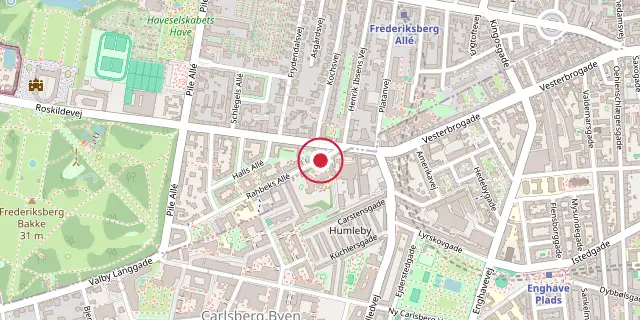
Coordinates: 55°40′12″N 12°32′13″E (55.6700, 12.5370) · Open in OpenStreetMap
Coordinates and connected clubs: the infobox of Wikipedia: Rahbeks Allé Brewery (CC BY-SA 4.0). Map: drawn by Codexery from OpenStreetMap tiles.
Rahbeks Allé Brewery (Danish: Bryggeriet i Rahbeks Allé) was a brewery in Copenhagen, Denmark, founded in 1860 by Peter August Vogelius. It operated independently until 1890, when it merged with several other breweries to form De Forenede Bryggerier, and from 1923 it was known as Kongens Bryghus. The site was decommissioned after De Forenede Bryggerier was acquired by Carlsberg Group in 1969, and its buildings were later converted into apartments.
Lore & Background
The brewery was established in 1860 by Peter August Vogelius with Jørgen Christian Hauberg as a silent partner, under the name A. Vogelius's Bryggeri. Vogelius, a relative of Carlsberg-founder J. C. Jacobsen's wife Laura, had worked at Carlsberg Brewery and previously leased Jacobsen's small beer brewery at Brolæggerstræde 5, but those buildings were too small and outdated to compete with newer breweries outside the city. Jacobsen assisted Vogelius in planning the new brewery on Rahbeks Allé, and the buildings were designed by Jens Eckersberg. The brewery began operating on 14 August 1861, bought a neighbouring piece of land in 1863, and was expanded in 1864.
The brewery was expanded and modernized in 1873-74, with Vogelius and Hauberg selling it to a consortium to raise capital. Vogelius remained an owner but day-to-day management was handled by a brewer from Svanholm Brewery; Vogelius returned as managing director from 1880 to 1887, succeeded by William Haurowitz, formerly managing director of the largest brewery in Trondheim, Norway. In 1888, the brewery was one of ten breweries included in Danmarks Industrielle Etablissementer I-III.
In 1890, the brewery merged with several others—including Kongens Bryghus, Marstrands Bryggerier, Tvedes Bryggeri, Alliance, Bryggeriet Kastrup, and three Frederiksberg breweries—under the name De Forenede Bryggerier. From 1902, the Rahbeks Allé site was used exclusively for brewing small beer and skibsøl, and was expanded in 1909 and again in 1913.
From 1923, Rahbeks Allé and Kroneølbryggeriet operated under the name Kongens Bryghus, still part of De Forenede Bryggerier. A tall round silo was constructed in 1957. The site was decommissioned when De Forenede Bryggerier merged into Carlsberg in 1969, after which Carlsberg used the buildings for stabling horses, storage, and an educational centre.
Reader's Guide
The significance of Rahbeks Allé Brewery lies in its role as one of several Copenhagen breweries that consolidated into De Forenede Bryggerier in 1890, a major merger that shaped the Danish brewing industry before being absorbed by Carlsberg in 1969. The brewery's founder, Peter August Vogelius, had direct ties to Carlsberg's founder J. C. Jacobsen, and Jacobsen's assistance in planning the brewery highlights the interconnected nature of Copenhagen's brewing families. The site's physical legacy is notable: the red brick buildings from 1860-61, designed by Jens Eckersberg, and the 1957 silo by Tyge Hvass were converted into apartments between 1994 and 1997, preserving the industrial architecture as residential space.
The 21-story silo now contains 38 apartments, while the older buildings house 85 apartments set in a small garden. This conversion represents a common pattern in Copenhagen's urban development, where former industrial sites are adapted for modern housing while retaining their historical character. The brewery's history also illustrates the shift from small, independent breweries to large consolidated operations that dominated the Danish beer market in the 20th century.
More in Breweries of Scandinavia and the Low Countries
Sources
Compiled from Wikipedia and the sources listed below. Text from Wikipedia is available under CC BY-SA 4.0; this entry is adapted from it.
- Wikipedia: Rahbeks Allé Brewery (CC BY-SA 4.0).
Spotted an error? Know more?
Reader corrections go straight into our review queue. Suggest an edit · How this site is sourced