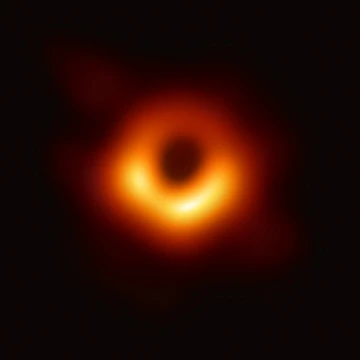
Rotating black hole
A black hole that spins about its axis.
Last updated
Astrophysical black holes are expected to have non-zero angular momentum due to their formation from collapsing rotating stars.[1] Angular momentum is a property of black holes that are rotating.[2] Every known celestial body, from planets to black holes, rotates around an axis.[2]
Quick Facts
- Type
- Black hole with angular momentum
- Relevant solutions
- Kerr and Kerr–Newman
- Key property
- Possesses angular momentum
Facts from the source article.
Key facts and history
The collapse of a massive, spinning star or the merger of objects with net angular momentum leads to the creation of rotating black holes.[3] Because stars rotate, astrophysicists anticipate that every black hole in the universe is a rotating one.[3] Spin rates for black holes were reported by astronomers in The Astrophysical Journal during the latter part of 2006.[4] GRS 1915+105, a black hole located in the Milky Way, spins at up to 1,150 times per second, which is near the maximum possible rate.[4]
Rotational energy from a spinning black hole can be harnessed to generate substantial power.[5] The Penrose process, which operates within the ergosphere, enables this extraction of energy.[5] A 2022 mathematical proof confirmed the stability of the equilibrium solution that Roy Kerr discovered in 1963.[6] Rotating black holes can exist in one of two thermal phases: a heating phase where they lose energy, and a cooling phase.[7]
What the cited sources add
The Walty article explains that a distant observer would see a spaceship going in circles around a spinning black hole because space-time is being dragged around.[8] That report also notes that when a black hole rotates fast, each extra image of a background galaxy appears only 50, 5, or even 2 times closer to the edge, rather than 500 times.[9] The Starr article describes that in 1969 Roger Penrose proposed exploiting the ergosphere to extract energy from a rotating black hole.[10] An experiment employing a rotating sound absorber, described in a 2020 article, confirmed the energy-extraction process.[10]
References
- Wikipedia, "Rotating black hole" (CC BY-SA 4.0), which cites: Capelo, "Formation of the First Black Holes", 2019, p. 1–22 (we also read that source) en.wikipedia.org
- Wikipedia, "Rotating black hole" (CC BY-SA 4.0), which cites: "Why and how do planets rotate?", Scientific American, April 14, 2003; Siegel, "This Is Why Black Holes Must Spin At Almost The Speed Of Light", Forbes, Aug 1, 2019; Walty, "It is said that most black holes likely have spin. What exactly is it that spins?", Astronomy.com, July 22, 2019 (we also read that source) en.wikipedia.org
- Wikipedia, "Rotating black hole" (CC BY-SA 4.0), which cites: "Why and how do planets rotate?", Scientific American, April 14, 2003; Siegel, "This Is Why Black Holes Must Spin At Almost The Speed Of Light", Forbes, Aug 1, 2019 (we also read that source) en.wikipedia.org
- Wikipedia, "Rotating black hole" (CC BY-SA 4.0), which cites: Hayes, "Black hole spins at the limit", Cosmos magazine, 2006-11-24 (original not read by us) en.wikipedia.org
- Wikipedia, "Rotating black hole" (CC BY-SA 4.0), which cites: Cromb, "Amplification of waves from a rotating body", Nature Physics, 2020, p. 1069–1073; Starr, "After 50 Years, Experiment Finally Shows Energy Could Be Extracted From a Black Hole", Science Alert, 25 June 2020; Williams, "Extracting X rays, Ύ rays, and relativistic e<sup>−</sup>e<sup>+</sup> pairs from supermassive Kerr black holes using the Penrose mechanism", Physical Review D, 1995, p. 5387–5427; Koide, "Energy Extraction from a Rotating Black Hole by Magnetic Reconnection in the Ergosphere", The Astrophysical Journal, August en.wikipedia.org
- Wikipedia, "Rotating black hole" (CC BY-SA 4.0), which cites: Giorgi, "A Researcher Shores Up Einstein's Theory With Math", Columbia University, October 19, 2022 (original not read by us) en.wikipedia.org
- Wikipedia, "Rotating black hole" (CC BY-SA 4.0), which cites: Davies, "Thermodynamic phase transitions of Kerr-Newman black holes in de Sitter space", Classical and Quantum Gravity, 1989, p. 1909–1914 (original not read by us) en.wikipedia.org
- Walty, "It is said that most black holes likely have spin. What exactly is it that spins?", Astronomy.com, July 22, 2019. facts only, no text reused. astronomy.com
- "Danish Student solves how the Universe is reflected near black holes", Niels Bohr Institute, 2021-08-09. facts only, no text reused. nbi.ku.dk
- Starr, "After 50 Years, Experiment Finally Shows Energy Could Be Extracted From a Black Hole", Science Alert, 25 June 2020. facts only, no text reused. sciencealert.com
Each numbered sentence above was checked against the source it cites before publication. Sentences citing Wikipedia adapt text from the English Wikipedia article Rotating black hole (contributors), used under CC BY-SA 4.0; this entry is available under the same licence. Other sources were used for facts only; no text or images are copied from them.
More in Black holes
Sources
Compiled from Wikipedia and the sources listed below. Text from Wikipedia is available under CC BY-SA 4.0; this entry is adapted from it.
- Wikipedia: Rotating black hole (CC BY-SA 4.0).
- Word definitions: the Codexery glossary, each quoted from its Wikipedia article.
Spotted an error? Know more?
Reader corrections go straight into our review queue. Suggest an edit · How this site is sourced