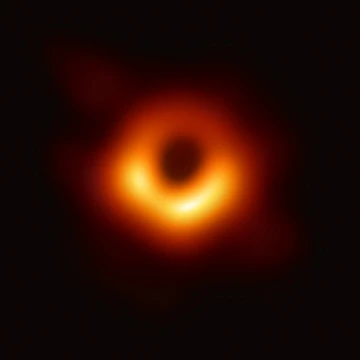
Ring singularity
The ring-shaped singularity of a rotating Kerr black hole.
Last updated
A ring singularity, or ringularity, is the gravitational singularity of a rotating black hole, specifically a Kerr black hole, that is shaped like a ring rather than a point. This shape arises because a point cannot support the rotation or angular momentum of a collapsing rotating body under classical general relativity. The ring singularity is a key feature distinguishing Kerr black holes from non-rotating ones.
Quick Facts
- Type
- Gravitational singularity
- Associated with
- Kerr black hole
- Shape
- Ring (2D, zero thickness, non-zero radius)
- Field
- General relativity
Facts from the source article.
Description
For a non-rotating spherical body collapsing under general relativity, theory predicts a 0-dimensional point singularity. In contrast, a rotating fluid body has an equatorial bulge and angular momentum, so its minimal singularity shape is a 2D ring with zero thickness but non-zero radius, called a ringularity or Kerr singularity. The Kerr metric describes how the rotating hole's frame-dragging curves spacetime near the ring, causing different observers to point to different apparent centers of gravity on the ring. Objects falling toward the ring acquire angular momentum before striking it, and a perpendicular light ray initially aimed at the ring's center curves in the direction of ring motion before intersecting the ring.
Traversability and nakedness
An observer crossing the event horizon of a non-rotating Schwarzschild black hole cannot avoid the central singularity. However, an observer falling into a Kerr black hole may avoid the central ring singularity by using the inner event horizon, making it theoretically possible for the Kerr black hole to act as a traversable wormhole, though not likely in practice.
As a toy wormhole
The Kerr singularity serves as a mathematical tool to study the wormhole field line problem. When a charged particle passes through a wormhole, continuity equations require electric field lines to remain unbroken; the entry mouth appears to emit the charge's field lines while the exit mouth gains a charge density deficit. For mass, the entry mouth gains mass density and the exit mouth loses it. The Kerr singularity exhibits the same feature, enabling study of this issue.
Existence
It is generally expected that quantum effects may prevent the formation of a singularity under collapse, producing quantum fuzz instead. Without quantum gravity, the interior geometry of a rotating black hole is likely not the Kerr geometry, as the inner Cauchy horizon is probably unstable due to infinite blue-shifting of infalling radiation. This instability was supported by studies of charged black holes, and realistic gravitational collapse into rotating black holes remains an active research topic.
More in Black holes
Sources
Compiled from Wikipedia and the sources listed below. Text from Wikipedia is available under CC BY-SA 4.0; this entry is adapted from it.
- Wikipedia: Ring singularity (CC BY-SA 4.0).
Spotted an error? Know more?
Reader corrections go straight into our review queue. Suggest an edit · How this site is sourced