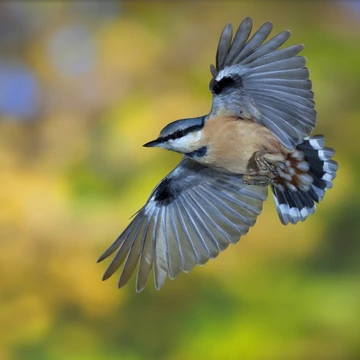
Common nightingale
Small passerine famed for its powerful, beautiful nocturnal song.

The common nightingale (Luscinia megarhynchos), also called the rufous nightingale, is a small passerine bird belonging to the Old World flycatcher group known as chats. These chats were once mistaken for thrushes, but genetic analysis revealed they are true flycatchers, with the resemblance to thrushes arising from convergent evolution. The name "nightingale" combines "night" with the Old English word *galan*, meaning "to sing." Its scientific genus name, *Luscinia*, is Latin for nightingale, while *megarhynchos* derives from Ancient Greek for "great bill." Three subspecies are recognized: the western nightingale, the Caucasian nightingale, and the eastern nightingale.
Slightly larger than a European robin, the bird measures 15–16.5 cm in length. It has plain brown upperparts except for a reddish tail, with buff to white underparts, and the sexes look alike. The eastern and Caucasian subspecies are paler above with a more distinct face pattern, including a pale stripe above the eye. The male’s song is celebrated as one of nature’s most beautiful sounds, inspiring poetry, opera, and fairy tales, though historically most people did not realize that only males sing.
This migratory insectivore breeds in forest and scrub across Europe and the Palearctic, wintering in Sub-Saharan Africa. It is absent from the Americas. Its distribution lies south of the closely related thrush nightingale, with which it sometimes hybridizes. In Germany, favored breeding habitat occurs below 400 meters elevation, with mean growing-season temperatures above 14°C, over 20 days per year exceeding 25°C, annual rainfall under 750 mm, a low aridity index, and no closed canopy. In the UK, the bird is at its northern range limit, where numbers fell by 53 percent between 1995 and 2008, placing it on the red list. A 2012–2013 survey found about 3,300 territories, mostly in southeast England and East Anglia. However, the European breeding population is estimated at 3.2 to 7 million pairs, giving it least concern status.
Nightingales are elusive, hiding in dense shrubs and undergrowth. They sing at night as well as by day; only unpaired males sing nocturnally, likely to attract a mate, while dawn song defends territory. Their song is loud, featuring whistles, trills, and gurgles, with a distinctive loud whistling crescendo absent in the thrush nightingale. Males can produce up to 250 differ
- Scientific name
- Luscinia megarhynchos
- Length
- 15–16.5 cm
- Breeding range
- Europe and the Palearctic
- Wintering range
- Sub-Saharan Africa
- Conservation status (Europe)
- Green (least concern)
- Known for
- Powerful, beautiful song; nocturnal singing
Lore & Background
The common nightingale is slightly larger than the European robin, plain brown above except for the reddish tail, and buff to white below. Three subspecies are recognized: the western nightingale (L. m. megarhynchos), the Caucasian nightingale (L. m. africana), and the eastern nightingale (L. m. golzii). The eastern and Caucasian subspecies have paler upper parts and a stronger face-pattern. The male's song is loud, with whistles, trills, and gurgles, and males can produce up to over 300 distinct song types, with a syllable repertoire of about 1,160 syllables. Only unpaired males sing regularly at night, and nocturnal song likely serves to attract a mate, while dawn song defends territory. Nightingales are elusive, hiding in dense vegetation, and sing even more loudly in urban environments to overcome background noise.
Reader's Guide
The common nightingale has been an enduring cultural symbol for poets across ages, appearing in works from Homer's Odyssey to T. S. Eliot's 'The Waste Land'. Its song has been interpreted as a lament due to the myth of Philomela and Procne, and later as a symbol of poetic creativity, especially during the Romantic era. In Ukrainian literature, it symbolizes romantic encounters and melancholy, and it is the official national bird of Iran. Despite its cultural prominence, historically most people were unaware that female nightingales do not sing. However, the European breeding population is estimated at 3.2 to 7 million pairs, giving it green conservation status.
Did You Know?
- The common nightingale's genus name Luscinia is Latin for 'nightingale', and megarhynchos is from Ancient Greek for 'great bill'.
- Only unpaired males sing regularly at night; nocturnal song probably serves to attract a mate.
- The bird is a host of the acanthocephalan intestinal parasite Apororhynchus silesiacus.
More in Birds 1-24
Spotted an error? Know more?
This is a living reference — every entry is fact-audited, and reader corrections feed straight into our audit queue. Suggest an edit · See this site's audit record