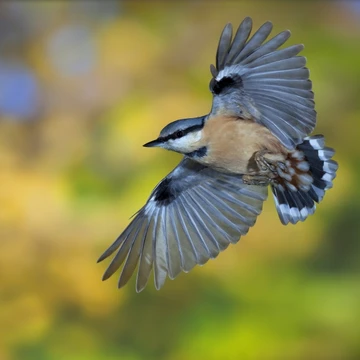
Bird
Warm-blooded, feathered vertebrates that are the only living dinosaurs.
Last updated
Birds are the only living dinosaurs, having evolved from earlier theropods.[1] Modern birds (Neornithes) likely originated in the Late Cretaceous and diversified greatly after the Cretaceous–Paleogene extinction event 66 million years ago.[1] Crocodilians are the closest living relatives of birds, and together they constitute the archosaur clade.[1][2]
Scientific classification
- KingdomAnimalia
- PhylumChordata
- ClassAves
Named by Linnaeus, 1758
Sources: Wikipedia taxobox: Bird (CC BY-SA 4.0)
Quick Facts
- Class
- Aves
- Number of species
- over 11,000 living species
- Orders
- 44
- Size range
- 5.5 cm (bee hummingbird) to 2.8 m (common ostrich)
- Key characteristics
- feathers
- toothless beaked jaws
- hard-shelled eggs
- four-chambered heart
- lightweight skeleton
- Study
- ornithology
Facts from the source article.
Biology and range
Birds live and breed on all seven continents, with the highest diversity in tropical regions.[3] Many species migrate annually over great distances, and some seabirds come ashore only to breed.[4] The skeleton consists of very lightweight bones with large air-filled cavities connected to the respiratory system.[5] As Julia Clarke explains, bird legs appear thin partly because the meatier thighs are tucked under feathers.[6]
Bird legs also have a fused metatarsal bone that is both light and strong.[6] A tendon system locks bird toes while perching, allowing them to sleep without falling.[6] Birds are primarily uricotelic, excreting nitrogenous waste as uric acid rather than urea or ammonia.[7] Most male birds lack an intromittent penis, though it is present in Palaeognathae and Anseriformes.[8]
Female birds typically have a single ovary and oviduct on the left side.[9]
What the specialist sources record
Elbein reports that bird ancestors' thigh bones shifted from vertical to horizontal orientation as flight evolved.[6] The same article states that powerful flapping chest muscles shifted birds' center of mass forward, causing torsos to shrink.[6] Jones reports that some adult birds eat fecal sacs because nestling poop contains nutrients.[10] The Audubon article also notes that transporting sacs outside the nest could attract predators.[10]
An article in Scientific American by Asher Elbein explains that the apparent thinness of bird legs is partly an illusion created by feathers, which make the body look much larger than it is.[6]
References
- Wikipedia, "Bird" (CC BY-SA 4.0), which cites: Claramunt, "A new time tree reveals Earth history's imprint on the evolution of modern birds", Sci Adv, 2015; Brocklehurst, "Tip dating and Bayes factors provide insight into the divergences of crown bird clades across the end-Cretaceous mass extinction", Proceedings. Biological Sciences, 2024 (original not read by us) en.wikipedia.org
- Wikipedia, "Bird" (CC BY-SA 4.0), which cites: Padian, "Encyclopedia of Dinosaurs", Academic Press, 1997, p. 41–96 (original not read by us) en.wikipedia.org
- Wikipedia, "Bird" (CC BY-SA 4.0), which cites: Brooke, "Albatrosses And Petrels Across The World", Oxford University Press, 2004 (original not read by us) en.wikipedia.org
- Wikipedia, "Bird" (CC BY-SA 4.0), which cites: Weir, "The Latitudinal Gradient in Recent Speciation and Extinction Rates of Birds and Mammals", Science, 2007, p. 1574–1576; Schreiber, "Biology of Marine Birds", CRC Press, 2001; Sato, "Buoyancy and maximal diving depth in penguins: do they control inhaling air volume?", Journal of Experimental Biology, 1 May 2002, p. 1189–1197 (original not read by us) en.wikipedia.org
- Wikipedia, "Bird" (CC BY-SA 4.0), which cites: Ehrlich, "Adaptations for Flight", Birds of Stanford, 1988; Gill, "Ornithology", WH Freeman and Co, 1995 (we also read that source) en.wikipedia.org
- Elbein, "Why Do Birds Have Such Skinny Legs?", Scientific American. facts only, no text reused. scientificamerican.com
- Wikipedia, "Bird" (CC BY-SA 4.0), which cites: Ehrlich, "Drinking", Birds of Stanford, 1988; Tsahar, "Can birds be ammonotelic? Nitrogen balance and excretion in two frugivores", Journal of Experimental Biology, 2005, p. 1025–1034; Skadhauge, "Does the ostrich (Struthio camelus) coprodeum have the electrophysiological properties and microstructure of other birds?", Comparative Biochemistry and Physiology A, 2003, p. 749–755; Preest, "Ammonia excretion by hummingbirds", Nature, April 1997, p. 561–562; Gill, "Ornithology", WH Freeman and Co, 1995; Mora, "The regulation of urea-biosynthesis enzym en.wikipedia.org
- Wikipedia, "Bird" (CC BY-SA 4.0), which cites: "Encyclopedia of Animal Behavior", Academic Press, 21 January 2019; Yong, "How Chickens Lost Their Penises (And Ducks Kept Theirs)", Phenomena: Not Exactly Rocket Science, 6 June 2013; "Ornithology, 3rd Edition – Waterfowl: Order Anseriformes"; McCracken, "The 20-cm Spiny Penis of the Argentine Lake Duck (Oxyura vittata)", The Auk, 2000, p. 820; Marcus, "Ostrich penis clears up evolutionary mystery", Nature, 2011 (original not read by us) en.wikipedia.org
- Wikipedia, "Bird" (CC BY-SA 4.0), which cites: Guioli, "Gonadal Asymmetry and Sex Determination in Birds", Sexual Development, 2014, p. 227–242 (original not read by us) en.wikipedia.org
- Jones, "What Are Fecal Sacs? Bird Diapers, Basically", Audubon, 7 August 2018. facts only, no text reused. audubon.org
Each numbered sentence above was checked against the source it cites before publication. Sentences citing Wikipedia adapt text from the English Wikipedia article Bird (contributors), used under CC BY-SA 4.0; this entry is available under the same licence. Other sources were used for facts only; no text or images are copied from them.
More in Birds
Sources
Compiled from Wikipedia and the sources listed below. Text from Wikipedia is available under CC BY-SA 4.0; this entry is adapted from it.
- Wikipedia: Bird (CC BY-SA 4.0).
- Word definitions: the , each quoted from its Wikipedia article.
Spotted an error? Know more?
Reader corrections go straight into our review queue. Suggest an edit · How this site is sourced