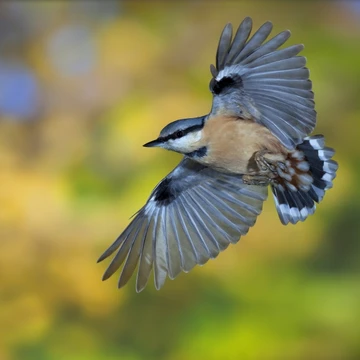
Falcon
Fast-flying raptors with exceptional vision and a global distribution.
Last updated
The genus Falco, comprising roughly 40 species, consists of birds that hunt other animals for food.[1] Lengths among falcon species vary dramatically, from the 20 cm pygmy falcon to the gyrfalcon which can reach 65 cm.[2] Female falcons are typically larger than their male counterparts, a pattern known as reversed sexual size dimorphism.[2][3]
Scientific classification
- KingdomAnimalia
- PhylumChordata
- ClassAves
- OrderFalconiformes
- FamilyFalconidae
- GenusFalco
Named by Linnaeus, 1758
Sources: Wikipedia taxobox: Falcon (CC BY-SA 4.0)
Quick Facts
- Type species
- Falco subbuteo
Facts from the source article.
Biology and range
The Animal Diversity Web notes that falconids are native to terrestrial ecosystems worldwide, except the high arctic and Antarctica.[3] Africa and South America host the highest diversity of falconids.[3] Falconids are found in nearly every terrestrial habitat, including deserts, tundra, forests, and cities.[3] Peregrine falcons and kestrels successfully breed in cities, nesting on tall buildings and hunting urban wildlife.[3]
Peregrine falcons have been recorded diving at speeds of 390 km/h, making them the fastest-moving creatures on Earth.[4][5] One falcon species possesses visual acuity measured at 2.6 times greater than that of humans.[4] Parrots and songbirds, rather than other raptors, are the closest living relatives of falcons.[6]
What the specialist sources record
The Animal Diversity Web states that Falconidae contains 11 genera and 64 species, divided into subfamilies Polyborinae and Falconinae.[3] Falconids are medium-sized to large birds of prey with wingspans from 55 to over 125 cm and weights from 28 to 2100 g.[3] The Animal Diversity Web reports that most falconids are solitary and territorial, though a few species are colonial.[3] Falcons frequently usurp nests built by other species, such as corvids and other raptors.[3]
Chicks fledge after 28 to 30 days in small falcons, up to 49 days in the largest falcons.[3] Falconids have a single annual breeding cycle and, in contrast to hawks, they do not construct nests but may modify the substrate at a chosen site.[3]
References
- Wikipedia, "Falcon" (CC BY-SA 4.0), which cites: Oberprieler, "The raptor guide of Southern Africa", Game Parks Publishing, 2009; Oberprieler, "The raptor guide of Southern Africa", Game Parks Publishing, 2009; Sale, "Falcons (Collins New Naturalist Library, Book 132)", HarperCollins UK, 28 July 2016; Cenizo, "A stem falconid bird from the Lower Eocene of Antarctica and the early southern radiation of the falcons", Journal of Ornithology, 2016, p. 885 (we also read that source) en.wikipedia.org
- Wikipedia, "Falcon" (CC BY-SA 4.0), which cites: Krüger, "The Evolution of Reversed Sexual Dimorphism in Hawks, Falcons and Owls: a comparative study", Evolutionary Ecology, 2005, p. 467–486 (original not read by us) en.wikipedia.org
- Kirschbaum, "Falconidae (falcons)", Animal Diversity Web. facts only, no text reused. animaldiversity.org
- Wikipedia, "Falcon" (CC BY-SA 4.0), which cites: Fox, "Falcon visual acuity", Science, 1976, p. 263–65; "The Speed of Animals" in The New Book of Knowledge. Grolier Academic Reference. 2003. p. 278. (original not read by us) en.wikipedia.org
- Wikipedia, "Falcon" (CC BY-SA 4.0), which cites: For example, tail colour in the common and lesser kestrels is absolutely identical, yet they do not seem closely related. (original not read by us) en.wikipedia.org
- Wikipedia, "Falcon" (CC BY-SA 4.0), which cites: "Mesozoic retroposons reveal parrots as the closest living relatives of passerine birds", Nature Communications, 2011, p. 443–8 (original not read by us) en.wikipedia.org
Each numbered sentence above was checked against the source it cites before publication. Sentences citing Wikipedia adapt text from the English Wikipedia article Falcon (contributors), used under CC BY-SA 4.0; this entry is available under the same licence. Other sources were used for facts only; no text or images are copied from them.
More in Birds
Sources
Compiled from Wikipedia and the sources listed below. Text from Wikipedia is available under CC BY-SA 4.0; this entry is adapted from it.
- Wikipedia: Falcon (CC BY-SA 4.0).
- Word definitions: the Codexery glossary, each quoted from its Wikipedia article.
Spotted an error? Know more?
Reader corrections go straight into our review queue. Suggest an edit · How this site is sourced