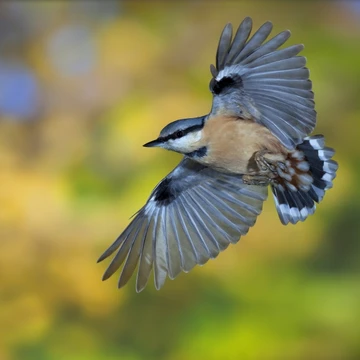
Columbidae
Bird family of doves and pigeons, worldwide and diverse.
Last updated
Columbidae is the family of pigeons and doves, comprising 52 genera and 353 species according to a 2025 checklist.[1] The smaller species are often called doves and the larger ones pigeons in colloquial English, but this distinction is not scientifically consistent.[2][3] The family occurs worldwide except for Antarctica, the high Arctic, and the driest parts of the Sahara.[4][3]
Scientific classification
- KingdomAnimalia
- PhylumChordata
- ClassAves
- OrderColumbiformes
- FamilyColumbidae
Named by Illiger, 1811
Sources: Wikipedia taxobox: Columbidae (CC BY-SA 4.0)
Quick Facts
- Type genus
- Columba
Facts from the source article.
Biology and range
The extinct dodo was the largest columbid ever, with a height of about 62.6–75 cm and a weight range of 10.2–27.8 kg.[5] They have no gall bladder, though they do secrete bile directly into the gut.[6] Their wings are large with eleven primary feathers, and wing muscles comprise 31–44% of body weight.[7] The family is distributed across all terrestrial habitats except the driest Sahara, Antarctica, and the high Arctic.[4][3]
Some species have enormous ranges: the rock dove (common pigeon) went feral in cities worldwide after domestication.[8] Other species have tiny, restricted distributions, such as the Grenada dove, found only on the island of Grenada.[9] Columbidae have stocky builds, with lengths spanning 15 to 75 cm and weights from 30 g to over 2000 g.[3] The crowned pigeons of New Guinea, the biggest living columbids, reach lengths of 66–79 cm and weights of 1.8–4 kg, comparable to a turkey's size.[5]
The Indomalayan and Australasian realms host the highest species diversity within the family.[1]
What the specialist sources record
The Animal Diversity Web account notes that incubation lasts 11 to 30 days and that hatching can be synchronous or asynchronous.[3] Chicks fledge in 10 to 36 days and may continue receiving food from parents for 30 to 40 days.[3] Crop milk, produced by both sexes, is 75–77% water, 11–13% protein, 5–7% fat, and 1.2–1.8% minerals and amino acids.[3] The GBIF Backbone Taxonomy lists Columbidae as an accepted family in the order Columbiformes, with 93,590,524 occurrence records as of October 2026.[10]
A 2008 article by McDonald, citing Sweet, states that both "dove" and "pigeon" refer to the 300-plus species in Columbidae.[11] The Handbook of the Birds of the World, volume 4, was published by Lynx Edicions in December 1997.[12] The book "Pigeons and Doves" was published by Bloomsbury Publishing Plc in 2010.[13]
References
- Wikipedia, "Columbidae" (CC BY-SA 4.0), which cites: AviList Core Team, "AviList: The Global Avian Checklist, v2025", 2025; Winkler, "Order Columbiformes Columbidae Pigeons and Doves", Birds of the World (original not read by us) en.wikipedia.org
- Wikipedia, "Columbidae" (CC BY-SA 4.0), which cites: McDonald, "What's the Difference Between Pigeons and Doves?", Big Questions, 17 August 2008; McDonald, "What's the Difference Between Pigeons and Doves?", Big Questions, 17 August 2008; Tom Hibbert, "Dove vs pigeon – what's the difference between these two cooing birds? – Discover Wildlife", Discover Wildlife, 17 October 2023 (we also read that source) en.wikipedia.org
- "Columbidae (doves and pigeons)", Animal Diversity Web. facts only, no text reused. animaldiversity.org
- Wikipedia, "Columbidae" (CC BY-SA 4.0), which cites: "Columbidae (doves and pigeons)", Animal Diversity Web (we also read that source) en.wikipedia.org
- Wikipedia, "Columbidae" (CC BY-SA 4.0), which cites: "Columbidae (doves and pigeons)", Animal Diversity Web; "Victoria crowned-pigeon videos, photos and facts – Goura victoria", Arkive; "Southern crowned-pigeon videos, photos and facts – Goura scheepmakeri", Arkive; Baptista, "Western Crowned-Pigeon Goura cristata", Birds of the World, 2020; Baptista, "Scheepmaker's Crowned-Pigeon Goura scheepmakeri", Birds of the World, 2020; "Thorsen, M., Blanvillain, C., & Sulpice, R. (2002). Reasons for decline, conservation needs, and a translocation of the critically endangered upe (Marquesas imperial pi en.wikipedia.org
- Wikipedia, "Columbidae" (CC BY-SA 4.0), which cites: Smith, "COLUMBIDAE Pigeons and Doves", Fauna Paraguay; Hagey, "Biliary bile acids of fruit pigeons and doves (Columbiformes)", Journal of Lipid Research, 1994, p. 2041–8; "Doves", The Medieval Bestiary; Browne, "Pseudodoxia Epidemica", University of Chicago, 1646 (original not read by us) en.wikipedia.org
- Wikipedia, "Columbidae" (CC BY-SA 4.0), which cites: "Columbiformes (Pigeons, Doves, and Dodos) – Dictionary definition of Columbiformes (Pigeons, Doves, and Dodos)", Encyclopedia.com; Clairmont, "Twirl: A Fresh Spin at Life", Harper Collins, 2014, p. 42; "Columbiformes (Pigeons, Doves, and Dodos) – Dictionary definition of Columbiformes (Pigeons, Doves, and Dodos)", Encyclopedia.com (original not read by us) en.wikipedia.org
- Wikipedia, "Columbidae" (CC BY-SA 4.0), which cites: "Rock Pigeons (Columba livia) aka Feral or Domestic Pigeons", Beauty of Birds, 16 September 2021; "Rock Pigeons (Columba livia) aka Feral or Domestic Pigeons", Beauty of Birds, 16 September 2021; "Rock Pigeons (Columba livia) aka Feral or Domestic Pigeons", Beauty of Birds, 16 September 2021; "Rock Pigeons (Columba livia) aka Feral or Domestic Pigeons", Beauty of Birds, 16 September 2021; Sokol, "New York and Boston Pigeons Don't Mix", The New York Times, 23 April 2020 (original not read by us) en.wikipedia.org
- Wikipedia, "Columbidae" (CC BY-SA 4.0), which cites: "Whistling Fruit Doves", Beauty of Birds, 16 September 2021; Gibbs, "Pigeons and Doves: A Guide to the Pigeons and Doves of the World", Bloomsbury Publishing, 2010, p. 406; "Grenada Dove (Leptotila wellsi) – BirdLife species factsheet", Datazone Birdlife (original not read by us) en.wikipedia.org
- GBIF Backbone Taxonomy and occurrence index, Columbidae (taxon key 5233). CC BY 4.0 (backbone); counts are facts. gbif.org
- McDonald, "What's the Difference Between Pigeons and Doves?", Big Questions, 17 August 2008. facts only, no text reused. mentalfloss.com
- Open Library record, ISBN 9788487334221 ("Handbook of the Birds of the World. Volume 4"). CC0 (metadata); book content not read. openlibrary.org
- Open Library record, ISBN 9781408135563 ("Pigeons and Doves"). CC0 (metadata); book content not read. openlibrary.org
Each numbered sentence above was checked against the source it cites before publication. Sentences citing Wikipedia adapt text from the English Wikipedia article Columbidae (contributors), used under CC BY-SA 4.0; this entry is available under the same licence. Other sources were used for facts only; no text or images are copied from them.
More in Birds
Sources
Compiled from Wikipedia and the sources listed below. Text from Wikipedia is available under CC BY-SA 4.0; this entry is adapted from it.
- Wikipedia: Columbidae (CC BY-SA 4.0).
- Word definitions: the , each quoted from its Wikipedia article.
Spotted an error? Know more?
Reader corrections go straight into our review queue. Suggest an edit · How this site is sourced