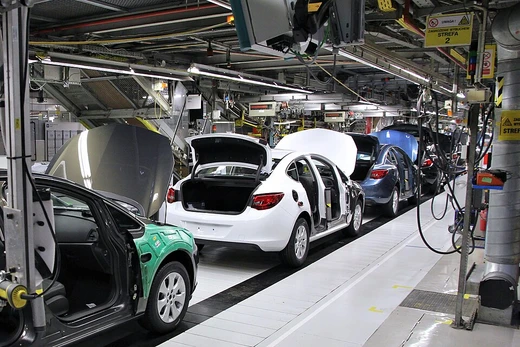
Fordism
System of standardized mass production and mass consumption.

Fordism is an industrial and manufacturing approach that underpins modern social and labor-economic systems built on standardized mass production and mass consumption. Named after Henry Ford, the term appears in social, economic, and management theories about production, working conditions, consumption, and related topics, particularly those of the 20th century. It represents an ideology of advanced capitalism tied to American socioeconomic structures during the post-war economic boom.
The system is defined as a method for producing standardized, low-cost goods while paying workers enough to buy them. It is also seen as a model of economic growth and technological progress based on mass production—making standardized products in huge quantities using special-purpose machinery and unskilled labor. Though first applied in the automotive industry, the principles work for any manufacturing process. Its success came from three main ideas: standardizing products so nothing is handmade but made by machines and molds; using assembly lines with special-purpose tools so common-skilled workers can contribute; and paying workers higher "living" wages so they can afford what they make.
These principles, combined with the technological changes of Ford’s era, made the system attractive. Ford’s assembly line was not entirely new—it had been used in slaughterhouses—but his key innovation was breaking complex tasks into simpler ones using specialized tools. This created interchangeable parts that worked the same way every time, allowing the assembly line to adjust its components for different products. Ford’s real achievement was recognizing the potential of breaking the process down and rebuilding it more effectively for real-world use. The main advantages were reduced manpower needs and deskilled labor, which lowered production costs.
Bob Jessop described four levels of Fordism. First, the capitalist labor process: using highly organized, Taylorist methods to boost output and fully use workers. Second, the accumulation regime: believing in a "virtuous circle of growth" where higher productivity raises wages, which in turn boosts productivity, demand, investment, and efficiency. Third, the social mode of economic regulation: analyzing capital flow at both micro levels (wages, internal movement) and macro levels (monetary policy, commerce, external relations). Fourth, the generic mode of "societalization": understanding the roles of the state and companies in workers’ daily economic lives, habits, and regional impacts.
The Ford Motor Company was one of many small auto makers between 1890 and 1910. After five years of production, Ford introduced the Model T—simple, light, and sturdy enough for rough roads. Mass production lowered its price, making it affordable for average consumers. Ford also raised wages to fight absenteeism and turnover, which reached nearly 400% annually, giving workers the means to become customers. This drove massive consumption: the Model T eventually accounted for 60% of all U.S. automobile output. The system relied on synchronization, precision, and specialization within the company. Ford and his managers never used the word "Fordism" themselves, but many contemporaries applied the label.
The term gained prominence when Antonio Gramsci used it in his 1934 essay "Americanism and Fordism" in his *Prison Notebooks*. Since then, it has been used by many writers on economics and society, mostly in the Marxist tradition. Historian Charles S. Maier noted that Fordism in Europe was preceded by Taylorism, a technique of labor discipline and workplace organization based on scientific studies of efficiency and incentives. Taylorism attracted European intellectuals, especially in Germany and Italy, from the late 19th century to World War I. After 1918, the focus shifted to Fordism—reorganizing the entire production process through assembly lines, standardization, and the mass market. In Europe, Fordism promised to sweep away pre-capitalist remnants by subordinating the economy, society, and even personality to technical rationality. The Great Depression dimmed this utopian vision, but World War II and its aftermath revived it. Later, inspired by Gramsci, Marxists took up Fordism in the 1930s and developed Post-Fordism in the 1970s.
- field
- Industrial engineering, manufacturing, socioeconomic theory
- known_for
- Standardized mass production, assembly line, high wages for workers
- originator
- Henry Ford
- key_principles
- Product standardization, assembly lines, living wages
Lore & Background
Fordism is a manufacturing system designed to produce standardized, low-cost goods and afford its workers decent enough wages to buy them. It has also been described as a model of economic expansion and technological progress based on mass production: the manufacture of standardized products in huge volumes using special purpose machinery and unskilled labor. Although Fordism was a method used to improve productivity in the automotive industry, the principle could be applied to any kind of manufacturing process. Major success stemmed from three major principles: the standardization of the product, the employment of assembly lines, and workers being paid higher living wages so they could afford to purchase the products they make. After five years of producing automobiles, Ford introduced the Model T, which was simple and light but sturdy enough to drive on the country's primitive roads. The mass production of this automobile lowered its unit price, making it affordable for the average consumer. Ford substantially increased his workers' wages to combat rampant absenteeism and employee turnover, which approached 400% annually, with the byproduct of giving them the means to become customers. The Model T attained a peak of 60% of the automobile output within the United States. Since then, it has been used by a number of writers on economics and society, mainly but not exclusively in the Marxist tradition. According to historian Charles S. Maier, Fordism proper was preceded in Europe by Taylorism.
Reader's Guide
Fordism's significance lies in its transformation of manufacturing and labor relations, creating a system that linked mass production with mass consumption. By standardizing products and using assembly lines with unskilled labor, Fordism dramatically cut production costs and manpower needs. The decision to pay workers higher wages not only reduced turnover but also turned them into consumers, fueling a virtuous circle of growth. This model became dominant in the post-war economic boom and influenced socioeconomic theory, particularly through Antonio Gramsci's analysis. Fordism also impacted global industrial development; the Soviet Union in the 1920s and 1930s enthusiastically embraced Fordism and Taylorism, importing American experts and engineering firms. The concepts of the Five-Year Plan and centrally-planned economy can be traced to Taylorism's influence on Soviet thinking. Later, the period after Fordism has been termed Post-Fordist and Neo-Fordist, with the Regulation School preferring the term After-Fordism to denote uncertainty about what comes next. Fordism's legacy includes both its productive efficiencies and its negative elements, such as economic inequality, which persisted into later phases of globalization.
Did You Know?
- Henry Ford and his senior managers did not use the word 'Fordism' themselves to describe their motivations or worldview.
- The assembly line had existed before Ford, although not with the same effectiveness; his real accomplishment was recognizing the potential by breaking tasks down into components.
- Fordism was preceded in Europe by Taylorism, a technique of labor discipline and workplace organization based on supposedly scientific studies of human efficiency.
- The Soviet Union in the 1920s and 1930s enthusiastically embraced Fordism and Taylorism, importing American experts and engineering firms.
Frequently Asked Questions
What is Fordism in the context of the automotive industry?
Fordism is a manufacturing and economic framework built on standardized mass production paired with mass consumption, essentially the operating logic of 20th-century industrial capitalism. It takes its name from Henry Ford and shaped how goods are built, how labor is compensated, and how consumers purchase products.
What are Fordism's core principles?
The system rests on three interlocking ideas: product standardization, the moving assembly line, and paying workers living wages so they could buy the very goods they made. Together these elements created a self-reinforcing cycle of production and demand.
Who is credited with originating Fordism?
Henry Ford is the originator, having rolled out the moving assembly line at his Detroit plants in the early 1910s. His Model T operation became the global template for high-volume industrial manufacturing.
Why is Fordism considered a turning point in automotive and labor history?
It converted car-making from a skilled craft into a repeatable industrial process, putting an automobile within reach of ordinary workers rather than just the wealthy. Ford's $5-a-day wage policy also set a lasting precedent linking worker compensation to consumer demand, a dynamic that powered the post-war economic boom.
What happened to Fordism after the mid-20th century?
The rigid, one-size-fits-all model gradually yielded to more flexible production systems as consumer tastes diversified and markets globalized. Nevertheless, its underlying assumptions about standardization, efficiency, and the wage-to-consumption link remain woven into modern industrial and economic thinking.
More in Automotive Industry 1-22
Spotted an error? Know more?
This is a living reference — every entry is fact-audited, and reader corrections feed straight into our audit queue. Suggest an edit · See this site's audit record