Ford Motor Company
American automaker that pioneered mass production via assembly lines.

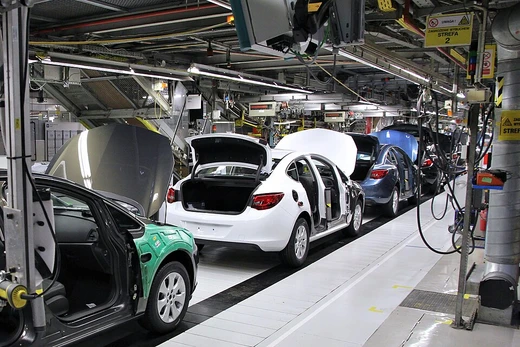
via Wikipedia: Automotive industry in Canada · see source
Ford Motor Company, often shortened to Ford or FoMoCo, is an American automaker based in Dearborn, Michigan. It sells cars and commercial vehicles under the Ford name and luxury vehicles under its Lincoln brand. The company was founded by Henry Ford and incorporated on June 16, 1903. It is listed on the New York Stock Exchange with the ticker symbol F. Though the Ford family holds only a minority ownership stake, they control a plurality of the voting power through special Class B shares, which give them 40 percent of the vote. The company went public in 1956.
Ford pioneered large-scale car manufacturing and industrial workforce management using moving assembly lines and carefully engineered production sequences. By 1914, these methods were globally known as Fordism. The company is the second-largest American automaker after General Motors and the sixth-largest worldwide, based on 2022 vehicle production. In 2023, Ford built 4.4 million vehicles and employed about 177,000 people. It was the eleventh-ranked American company on the 2018 Fortune 500 list, with global revenues of $156.7 billion in 2017.
Ford has owned and later sold several international brands. Its former British subsidiaries Jaguar and Land Rover, bought in 1989 and 2000, were sold to India’s Tata Motors in March 2008. The Swedish automaker Volvo was owned from 1999 to 2010. In the third quarter of 2010, Ford discontinued the Mercury brand, which had sold mid-priced cars in the U.S., Canada, Mexico, and the Middle East since 1938. The company operates joint ventures in China (Changan Ford and Jiangling Ford), Taiwan (Ford Lio Ho), Thailand (AutoAlliance Thailand), and Turkey (Ford Otosan). Ford also holds a 32 percent stake in China’s Jiangling Motors.
During the 2008–2010 automotive industry crisis, Ford struggled financially but did not require a federal government bailout, unlike the other two major U.S. automakers. It has since returned to profitability.
**History**
**20th century**
Henry Ford’s first car company, the Henry Ford Company, was founded on November 3, 1901. After Ford left with the rights to his name, it became the Cadillac Motor Company on August 22, 1902. The Ford Motor Company was launched in 1903 in a converted factory, with $28,000 (about $1,003,000 in 2025) from twelve investors, including John and Horace Dodge, who later founded Dodge Brothers. The first president was local banker John S. Gray, chosen to reassure investors that Ford would not leave as he had before.
Early on, the company produced only a few cars per day at its Mack Avenue and later Piquette Avenue factories in Detroit. Small teams of two or three men assembled each car from parts made mostly by outside suppliers. Within a decade, Ford led the world in refining the assembly line and brought much of the parts production in-house through vertical integration. Henry Ford was 39 when he founded the company, which became one of the world’s largest and most profitable. It has remained under continuous family control for over a century.
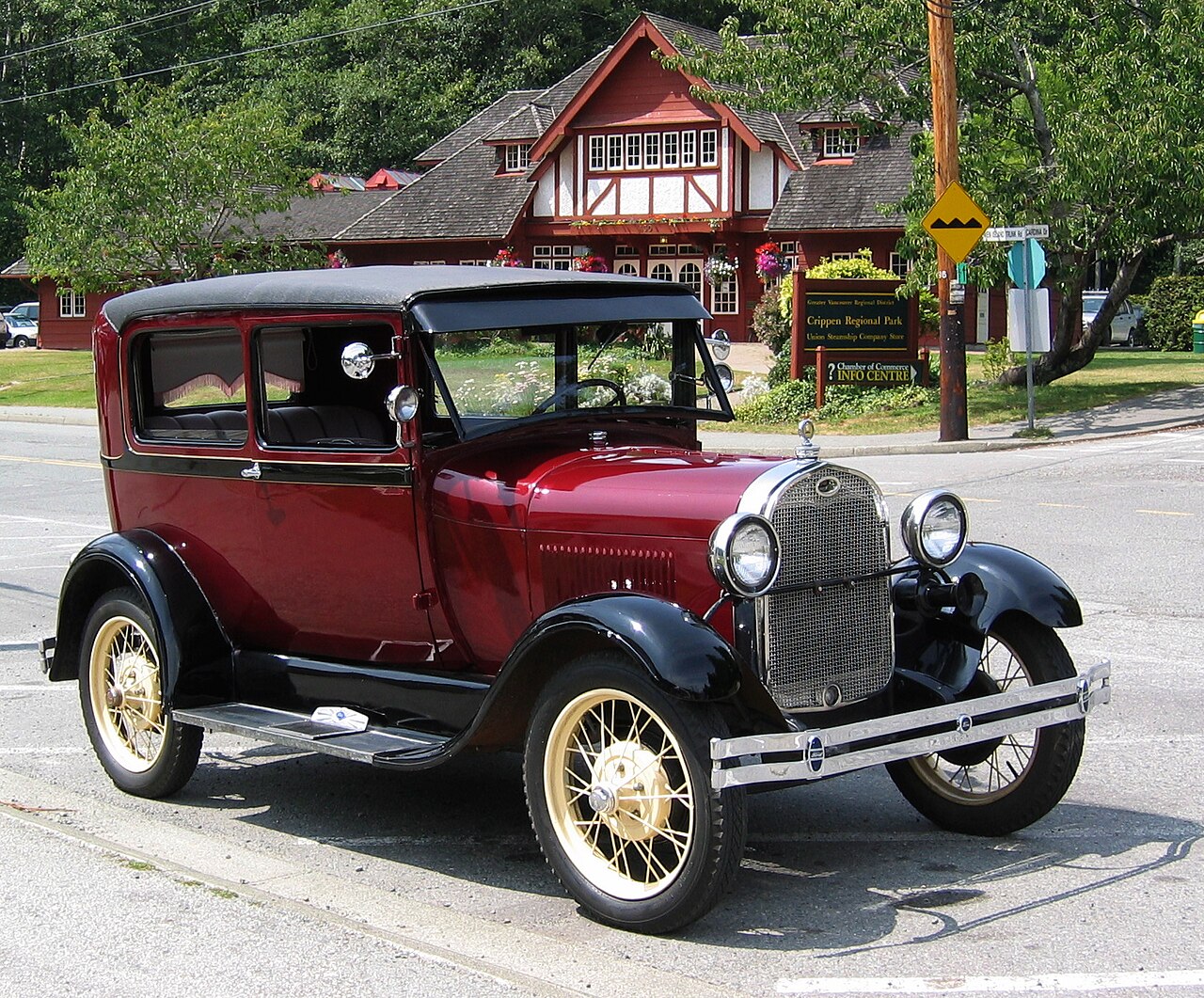
The first gasoline-powered car was built in 1885 by German inventor Karl Benz. To make cars affordable for the middle class, Ford introduced the first moving assembly line in 1913 at his Highland Park factory. Between 1903 and 1908, Ford produced Models A, B, C, F, K, N, R, and S, selling hundreds or a few thousand of each per year. In 1908, the mass-produced Model T was introduced, selling millions over nearly 20 years. It was replaced in 1927 by the Model A, the first production car with laminated safety glass in the windshield. In 1932, Ford launched the first low-priced V8 engine car.
To compete with General Motors’ mid-priced Pontiac, Oldsmobile, and Buick, Ford created the Mercury brand in 1939 as a higher-priced companion. Henry Ford bought the Lincoln Motor Company in 1922 to compete with luxury brands like Cadillac and Packard.
In 1929, the Soviet government contracted Ford to set up the Gorky Automobile Plant in Russia, initially producing the Model A and AA. This helped industrialize the country and supported the Soviet war effort in World War II. In 1944, Stalin wrote to the U.S. Chamber of Commerce calling Henry Ford “one of the world’s greatest industrialists.”
During World War II, the U.S. Department of War chose Ford to mass-produce the Consolidated B-24 Liberator bomber at its Willow Run plant. Meanwhile, Ford’s German and French subsidiaries, Ford Werke and Ford SAF, produced military vehicles and equipment for Nazi Germany, with some German operations using forced labor.
In 1951, Ford created a scientific laboratory in Dearborn, Michigan, for unfettered basic research. This led to involvement in superconductivity research, and in 1964, Ford Research Labs invented the superconducting quantum interference device, or SQUID.
- Founder
- Henry Ford
- Headquarters
- Dearborn, Michigan, United States
- Industry
- Automobile manufacturing
- Known for
- Pioneering moving assembly line and Fordism
- Stock ticker
- F (New York Stock Exchange)
- 2022 global rank
- Sixth-largest automaker worldwide
Verified Timeline
Lore & Background
Ford Motor Company, an American multinational automaker headquartered in Dearborn, Michigan, was founded by Henry Ford and incorporated on June 16, 1903. Its first president was local banker John S. Gray, chosen to reassure investors after Henry Ford had left a previous venture. Early production was small, with groups of two or three men assembling cars from parts made by supplier companies. Within a decade, Ford led the world in refining the assembly line concept and brought much part production in-house through vertical integration. The company introduced methods for large-scale manufacturing and industrial workforce management, typified by moving assembly lines; by 1914, these methods were globally known as Fordism. Ford sells automobiles and commercial vehicles under the Ford brand and luxury cars under Lincoln. It is listed on the New York Stock Exchange under the ticker symbol F and is controlled by the Ford family, who hold minority ownership but a plurality of voting power through special Class B shares. The company went public in 1956. Ford is the second-largest American-based automaker and the sixth-largest worldwide based on 2022 vehicle production. During the 2008–2010 automotive industry crisis, Ford struggled financially but did not require federal rescue. It has since returned to profitability and was ranked eleventh overall among American-based companies on the 2018 Fortune 500 list. In 2023, Ford produced 4.4 million automobiles and employed about 177,000 people worldwide. The company operates joint ventures in China, Taiwan, Thailand, and Turkey, and owns a 32% stake in China’s Jiangling Motors.
Reader's Guide
Ford Motor Company's significance lies in its transformation of automobile manufacturing through the moving assembly line, which made cars affordable for the middle class and established Fordism as a global industrial model. The company has been under continuous family control for over 100 years, making it one of the largest family-controlled companies in the world. Ford is the second-largest American-based automaker behind General Motors and the sixth-largest globally based on 2022 vehicle production. During the 2008–2010 automotive industry crisis, Ford struggled financially but did not require a federal government rescue, unlike the other two major U.S. automakers. It has since returned to profitability and was the eleventh-ranked overall American-based company in the 2018 Fortune 500 list, with 2017 global revenues of $156.7 billion. Ford's legacy includes innovations such as the first moving assembly line, the Model T, and safety features like child-proof door locks and the first retractable hardtop on a mass-produced six-seater car.
Did You Know?
- Ford owned the Swedish automaker Volvo from 1999 to 2010.
Early Canadian Roots: The Walkerville Years
In 1904, the first large-scale automobile production on Canadian soil took place in Walkerville, Ontario, a community situated near the border city of Windsor. At the Wagon Works factory, Gordon McGregor and Wallace Campbell, working alongside a small crew of laborers, rolled out 117 Ford Model C vehicles during the plant's inaugural year of operations. This modest output marked the beginning of Ford's manufacturing footprint in Canada, a country that would go on to rank as the world's second-largest auto producer between 1918 and 1923. The Walkerville operation represented a pivotal moment, as it demonstrated that the young American marque could establish a meaningful production presence beyond its home market. For a nation whose automotive sector would eventually account for ten percent of its manufacturing GDP and twenty-three percent of its manufacturing trade, those 117 Model Cs produced at the Wagon Works factory stood as a foundational chapter in the long partnership between Ford and Canadian industry.
The Auto Pact: Reshaping Ford's Canadian Role
The 1965 Automotive Products Trade Agreement, commonly known as the Auto Pact, stands as the single most transformative force in shaping the Canadian automotive landscape where Ford operates. Before this bilateral accord, the Canadian auto sector was characterized by relatively inefficient plants churning out numerous models behind a high tariff wall, which drove consumer prices upward and kept production costs elevated. The Auto Pact introduced two critical structural requirements: a one-to-one production-to-sales ratio and mandated Canadian Value Added thresholds. These provisions fundamentally reorganized how Ford and its competitors—General Motors, Fiat-Chrysler, Honda, and Toyota—structured their Canadian plants. The agreement effectively created a borderless North American manufacturing framework, tying the volume of vehicles a company could sell in Canada directly to the number it produced there. For Ford, this meant its Canadian operations became inextricably linked to a rules-based system that balanced domestic output with cross-border commerce, a framework that continued to define the industry's architecture decades after its signing.
Canadian Content and the Detroit Three Distinction
A 2016 DesRosiers study examining the 17 vehicle models assembled in Canada found that the average vehicle contained $4,105 in Canadian-sourced parts, representing 17.2 percent of total parts content. This figure has fluctuated over the years, ranging from a high of 25.6 percent down to as low as 13 percent, while a separate estimate placed overall Canadian content between 20 and 24 percent. A notable distinction emerges when comparing the Detroit Three—Ford, General Motors, and Fiat-Chrysler—against their Japanese counterparts. Honda and Toyota plants in Canada tend to incorporate higher levels of domestic content because they manufacture more components in-house, such as plastic-injection-molded parts, rather than sourcing them from external suppliers. This structural difference means Ford's Canadian facilities, while integral to the national supply chain, rely more heavily on imported components than their Japanese rivals. The broader industry context is significant: the automotive sector accounts for ten percent of Canada's manufacturing GDP and a quarter of its manufacturing trade, directly employing over 125,000 workers in assembly and parts production, with another 380,000 sustained through distribution and aftermarket channels.
Scale, Export Power, and Global Standing
Canada's position in global automotive production has shifted dramatically over the century. Between 1918 and 1923, the nation held the distinction of being the world's second-largest auto producer, and it ranked third after World War II. By 2020, however, Canada had settled into the thirteenth-largest producing nation globally while still claiming the seventh-largest auto exporter ranking by value, shipping out $32 billion worth of vehicles that year and producing 1.4 million units domestically. The sector's breadth extends well beyond passenger cars, encompassing trucks, buses, auto parts and systems, truck bodies and trailers, tires, and the broader category of machine, tools, dies, and molds. Ford's Canadian operations sit within this extensive ecosystem, which directly employs more than 125,000 people in vehicle assembly and parts manufacturing, while an additional 380,000 workers find employment in distribution networks and aftermarket sales and service. The industry's assembly plants are predominantly operated by foreign automakers headquartered in the United States or Japan, with hundreds of parts and systems manufacturers forming the supporting network. This layered structure makes Ford's role in Canada both a contributor to and a beneficiary of one of the nation's most consequential industrial sectors.
Gallery
Frequently Asked Questions
What manufacturing innovation is Ford most famous for?
Ford is credited with perfecting the moving assembly line for automobile production, a system that dramatically cut build times and made cars affordable for ordinary workers. This approach to industrial labor management became known as Fordism and reshaped factory work worldwide.
What brands does Ford sell vehicles under?
The company markets standard automobiles and commercial trucks under the Ford name, while its luxury division operates under the Lincoln brand. Both brands are produced and sold by the same parent corporation headquartered in Dearborn, Michigan.
Why is Ford considered a turning point in industrial history?
By engineering sequential, moving-assembly production and paying workers wages high enough to purchase the cars they built, Ford transformed the automobile from a luxury into a mass-market product. These practices set the template for modern factory management that industries far beyond cars still follow today.
More in Automotive Industry 1-22
Spotted an error? Know more?
This is a living reference — every entry is fact-audited, and reader corrections feed straight into our audit queue. Suggest an edit · See this site's audit record