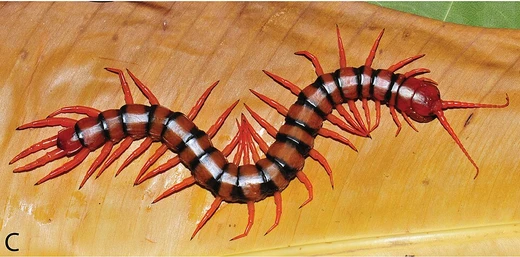
Scolopendra gigantea
World's largest centipede species, found in South America.
Last updated
With a body length that can surpass 30 cm, Scolopendra gigantea holds the record as the biggest centipede species globally.[1] Common names for this centipede include the Peruvian giant yellow-leg centipede and the Amazonian giant centipede.[1] The number of body segments on a specimen is either 21 or 23.[1]
Scientific classification
- KingdomAnimalia
- PhylumArthropoda
- SubphylumMyriapoda
- ClassChilopoda
- OrderScolopendromorpha
- FamilyScolopendridae
- GenusScolopendra
- SpeciesScolopendra gigantea
Named by Linnaeus, 1758
Sources: Wikipedia taxobox: Scolopendra gigantea (CC BY-SA 4.0)
How big is it?
Largest length in the source, 0.3 m, next to a 1.8 m person.
Diagram: drawn by Codexery, schematic shapes to scale (not a likeness). Length: Wikipedia: Scolopendra gigantea
Where the scolopendra gigantea has been recorded
Each dot is a place where the species has been observed and reported (138 records, half-degree grid) — not a modelled range. 29 inland records left out (institution coordinates).
Map: drawn by Codexery. Data: GBIF occurrence search (records CC0 / CC BY) · Natural Earth basemap (public domain)
Quick Facts
- Known for
- Largest centipede species in the world
- Maximum length
- Over 30 cm (12 in)
- Native region
- Northern South America and extreme south Caribbean
Facts from the source article.
Biology and range
The Animal Diversity Web states that Scolopendra gigantea inhabits tropical and subtropical forests in northern South America.[2] The Animal Diversity Web notes that it must live in humid environments due to its mode of breathing.[2] It has spiracles located at segments 4, 6, 8, 11, 13, 15, 17, 19, and 21.[2] The Animal Diversity Web reports a normal lifespan of about ten years and a length of 12 inches.[2]
It can overpower invertebrates like tarantulas and vertebrates such as lizards, frogs, snakes, birds, mice, and bats.[3] Aruba, Brazil, Curaçao, Colombia, Venezuela, and Trinidad are locations where museum-confirmed specimens have been gathered.[4] Sightings from Mexico, Puerto Rico, and Honduras are thought to represent either accidental transport or mistakes in labeling.[4] This centipede occupies dark, damp spots such as beneath rocks or within leaf litter, found in tropical or subtropical rainforests and tropical dry forests.[5]
Scolopendra gigantea is a good climber and seeks shelter beneath tree bark.[5]
What the specialist sources record
The Animal Diversity Web describes giant centipedes as voracious carnivores that eat crickets, worms, snails, roaches, lizards, toads, and mice.[2] It adds that Scolopendra gigantea is valuable to gardeners and farmers for controlling pest populations.[2] The same article mentions a 1950s account of a giant Scolopendra being fed small mice at London Zoo, likely this species.[6] The Animal Diversity Web states the venom can seriously wound a human.[2]
A Newsweek article quotes paleontologist Edgecombe describing a 2005 record of Scolopendra gigantea catching bats in a cave in Venezuela.[6]
References
- Wikipedia, "Scolopendra gigantea" (CC BY-SA 4.0), which cites: Shelley, "Neotype designation and a diagnostic account for the centipede, Scolopendra gigantea L. 1758, with an account of S. galapagoensis Bollman 1889 (Chilopoda Scolopendromorpha Scolopendridae)", Tropical Zoology, 20; Stewert, "Wicked Bugs", Algonquin Books of Chapel Hill, 2011, p. 145; Arends, "Predation by giant centipedes, Scolopendra gigantea, on three species of bats in a Venezuelan cave", Caribbean Journal of Science, 2005, p. 340–346 (we also read that source) en.wikipedia.org
- Meshew, "Scolopendra gigantea", Animal Diversity Web. facts only, no text reused. animaldiversity.org
- Wikipedia, "Scolopendra gigantea" (CC BY-SA 4.0), which cites: Arends, "Predation by giant centipedes, Scolopendra gigantea, on three species of bats in a Venezuelan cave", Caribbean Journal of Science, 2005, p. 340–346; Meshew, "Scolopendra gigantea", Animal Diversity Web (we also read that source) en.wikipedia.org
- Wikipedia, "Scolopendra gigantea" (CC BY-SA 4.0), which cites: Shelley, "Neotype designation and a diagnostic account for the centipede, Scolopendra gigantea L. 1758, with an account of S. galapagoensis Bollman 1889 (Chilopoda Scolopendromorpha Scolopendridae)", Tropical Zoology, 20; Shelley, "Neotype designation and a diagnostic account for the centipede, Scolopendra gigantea L. 1758, with an account of S. galapagoensis Bollman 1889 (Chilopoda Scolopendromorpha Scolopendridae)", Tropical Zoology, 20 (original not read by us) en.wikipedia.org
- Wikipedia, "Scolopendra gigantea" (CC BY-SA 4.0), which cites: Stewert, "Wicked Bugs", Algonquin Books of Chapel Hill, 2011, p. 145 (we also read that source) en.wikipedia.org
- White, "Scolopendra gigantea: The Giant Centipede With a Painful, Venomous bite", Newsweek. facts only, no text reused. newsweek.com
Each numbered sentence above was checked against the source it cites before publication. Sentences citing Wikipedia adapt text from the English Wikipedia article Scolopendra gigantea (contributors), used under CC BY-SA 4.0; this entry is available under the same licence. Other sources were used for facts only; no text or images are copied from them.
More in Arachnids & Myriapods
Sources
Compiled from Wikipedia and the sources listed below. Text from Wikipedia is available under CC BY-SA 4.0; this entry is adapted from it.
- Wikipedia: Scolopendra gigantea (CC BY-SA 4.0).
- Occurrence records: GBIF (CC0 / CC BY). Basemap: Natural Earth (public domain).
- Word definitions: the , each quoted from its Wikipedia article.
Spotted an error? Know more?
Reader corrections go straight into our review queue. Suggest an edit · How this site is sourced